The LinkedIn Visibility System for Senior-Level Professionals
TL;DR
- A strong LinkedIn profile helps you get found, but visibility helps you get remembered, trusted, and contacted.
- Senior-level professionals do not need to become influencers; they need to become visible to the right recruiters, hiring managers, peers, and leaders.
- LinkedIn visibility starts with targeting: know your audience, the roles you want, the companies you care about, and the problems you want to be known for solving.
- Use LinkedIn search, thoughtful comments, strategic connection requests, and consistent follow-up to turn visibility into real conversations.
- Thought leadership works best when it comes from real experience, including leadership lessons, personal stories, industry observations, and business problem breakdowns.
- The win is not more posts, more profile views, or more random activity. The win is building trust, creating conversations, and tracking the actions that move your job search forward.
Introduction
A polished LinkedIn profile helps you get found.
A LinkedIn visibility system helps you get remembered, trusted, and contacted.
That distinction matters for senior-level professionals because LinkedIn today is more than a digital resume. Recruiters use it. Hiring managers check it. Former colleagues engage with it. Your professional network is sitting there, one search or message away.
But many senior-level professionals still treat LinkedIn like a static profile. They update the job title, add a better profile picture, refresh a few skills, and wait for something to happen.
That is not a strategy.
That is a setup.
The real advantage comes after the profile is built. The goal is not to become a LinkedIn influencer. The goal is to become visible to the right people, known for the right problems, and consistent enough to turn LinkedIn activity into real conversations.
That is what I call the LinkedIn visibility system for senior-level professionals.
Quick System Overview: The LinkedIn Visibility System for Senior-Level Professionals
LinkedIn visibility is not random posting, chasing the LinkedIn algorithm, or trying to sound like every other person sharing leadership lessons online.
A strong visibility system does three things:
- Defines your target audience
- Shows that audience what problems you solve
- Turns engagement into conversations
Simple, but not easy.
Most people struggle with visibility because they skip the targeting. They post to everyone, connect with everyone, and measure everything except the actions that create real job search momentum.
For senior-level professionals, your audience is usually smaller and more specific. It may include recruiters in your target industry, hiring managers at 5-7 target companies, former colleagues, old managers, executives in your function, peers who can refer you, and partners who know where opportunities are forming.
Visibility is not popularity.
Visibility is being known by the right people for the right problems.
If that part feels unclear, this is where a strong senior-level networking system becomes important.
LinkedIn Profile Audit: Start With the Foundation
A strong LinkedIn profile still matters.
Your headline, About section, job title, Featured section, profile picture, skills, and experience all help a recruiter or hiring manager understand who you are. They also help LinkedIn understand where to place you in search.
Before building a visibility strategy, audit the basics:
- Does your About section tell a concise value story?
- Does your profile picture look clear and professional?
- Do your skills match the roles and companies you want next?
- Does your experience show outcomes, not just responsibilities?
- Does your headline include target keywords and a clear value statement?
- Does your Featured section show proof of work, credibility, or thought leadership?
This work helps you become searchable.
But searchability is only one piece.
A profile alone will not build trust, create relationships, or make someone say, “I should introduce this person to my VP.”
Most senior-level professionals do not have a talent problem. They have a visibility problem.

Optimize Your LinkedIn Profile Without Stopping There
Yes, optimize your LinkedIn profile.
Make the headline clear. Use relevant keywords. Lead with impact. Show measurable outcomes. Update your About section so it reads like a business case, not a biography.
But do not confuse profile changes with a full job search strategy.
A polished profile helps people understand your background. A visibility system helps them understand your relevance.
That means your profile should answer three questions quickly:
- What level of work do you do?
- What problems do you solve?
- What value do you create?
Once that foundation is clear, the next step is building visibility around the same themes.
LinkedIn Visibility Starts With the Right Audience
Before you create a content strategy, define the audience.
This is where many senior-level professionals get stuck. They ask, “What should I post?”
A better question is:
“Who needs to see how I think?”
If your audience is executive recruiters, your content should make your leadership scope, business impact, and decision-making style obvious. If your audience is hiring managers, your content should help them understand how you solve problems. If your audience is former colleagues, your content should remind them what you are good at and where you are headed.
For job search, start here:
- Pick 5-7 target companies
- Pick 2-3 target roles
- Identify 10-15 people, creators, or leaders active in those spaces
- Choose 3-5 business problems you want to be known for solving
Then build your LinkedIn activity around those people and conversations.
Not the entire platform.
The right people.
LinkedIn Visibility Playbook: Search, Engage, Connect
Recruiters use LinkedIn to find candidates. Senior-level candidates should use LinkedIn to find hiring signals.
Most job seekers only use LinkedIn search to look for job postings. That leaves opportunity on the table.
LinkedIn search can help you find:
- People talking about hiring
- Leaders growing teams
- Recruiters posting open roles
- Employees sharing company momentum
- Hiring managers describing team priorities
- Peers who recently moved into similar roles
Try simple Boolean searches like:
- “Product” AND “hiring”
- “Director of Operations” AND “we’re hiring”
- “VP Product” AND “team growth”
- “Program Manager” NOT “entry level”
- “Product Operations” NOT “internship” NOT “junior”
Then filter by posts.
That helps you find the original post where someone is actually talking about a job, team, company, or problem. Once you find those conversations, do not just like the post.
Comment. Connect. Follow up.
That is how visibility starts to become a relationship.
For a deeper breakdown, read my guide on how to network as a senior-level job seeker.

Define the Posting Mix
More posts are not always better.
Especially for senior-level professionals.
You do not need to post daily, turn every meeting into content, or chase whatever the LinkedIn algorithm appears to be rewarding this week. You need a repeatable way to show your audience what you know, what you value, and how you solve problems.
A simple posting mix could look like this:
- One thoughtful post per week
- Two short updates or reposts with perspective
- Three to five meaningful comments per day
- A few targeted connection requests per week
- One or two follow-up messages from engagement
The point is not volume.
The point is relevance.
Your content should help the right person think, “This person understands the problem.”
Commenting for LinkedIn Visibility
Before you worry about writing viral posts, start by writing useful comments where your target audience already spends time.
This is one of the easiest ways to build visibility on LinkedIn without creating a full content calendar.
A good comment can:
- Add credibility
- Spark engagement
- Show your expertise
- Put your name in front of the right audience
- Create a reason to connect
But the comment has to add something.
Not “Great post.”
Add a practical example, a leadership lesson, a useful question, a short story from experience, or a business impact connection.
Example:
“Strong point. I’ve seen this in senior-level interviews too. The candidates who stand out usually connect the activity to business impact. They do not just explain what they managed. They explain what changed because they were there.”
That comment shows how you think.
Do that consistently with the same 10-15 target authors, leaders, recruiters, and peers. Over time, people start recognizing your name, your perspective, and your value.
That is visibility.
Thought Leadership Framework for Senior Leaders
Thought leadership does not need to sound academic.
It does not need to sound like a company page.
And it definitely should not sound like generic AI content.
For senior leaders, the best thought leadership usually comes from real experience, which is also the foundation of strong personal branding.
Start with five simple content themes:
- Personal stories
- Leadership lessons
- Industry observations
- Business problem breakdowns
- Behind the scenes decision-making
You do not need to overshare. You do not need to reveal confidential information. You simply need to show how you think.
That could mean writing about how you evaluate tradeoffs, build alignment, manage risk, recover from mistakes, or lead through uncertainty.
Your audience should feel like the post could only be written by someone who has actually done the work.
That is how thought leadership builds trust.
The Executive Visibility System
Executive visibility is not just marketing.
It is relationship-building at scale.
At the senior level, people are not only evaluating your resume. They are trying to understand your judgment, communication style, leadership approach, and ability to create value quickly.
A strong LinkedIn presence can help answer questions like:
- Can this person lead?
- Can this person reduce risk?
- Can this person influence others?
- Can this person solve hard problems?
- Can this person communicate clearly?
- Can this person make the team better?
A company page has its place, but people trust people.
That is why executive visibility matters for leaders, job seekers, consultants, operators, and executives who want more career optionality.
It is also one of the practical ways executives can scale their influence beyond their current role.
Opportunity often comes from familiarity. Someone sees your post, then your comment, then your name again. Eventually, your connection request feels warm instead of random.
That is how visibility turns into trust.
Executive Visibility: Intake and Workflow
Senior leaders are busy.
That is why the system has to be simple.
If you are building executive visibility for yourself, do a short monthly or quarterly intake. Ask:
- What industry shifts am I watching?
- What questions are my peers asking?
- What problems am I solving right now?
- What conversations do I want to be part of?
- What leadership lessons have I learned recently?
- What stories would help people understand how I think?
You can capture ideas in a short document, notes app, or voice memo. The format matters less than the habit.
The goal is to create a low-friction workflow that turns real leadership insight into usable LinkedIn content.
My Personal Experience
When I moved from Boeing to Amazon, LinkedIn became more than a profile for me.
It became a relationship engine.
I reached out to former colleagues, reconnected with old managers, and engaged with people who were active in the areas I wanted to move toward. I paid attention to who was posting, who was hiring, and who seemed connected to the types of opportunities I wanted.
The goal was not to become famous on LinkedIn. The goal was to become visible to the right people.
That is especially important when you need to tell your story when you’re changing careers.
That meant commenting on relevant posts, supporting other people’s content, starting small conversations, and building familiarity before I ever made a direct ask.
This is what I call soft engagement:
- Find people active on LinkedIn
- Invest in supporting them
- Create conversations
- Build relationships
I have used this method successfully for years, and it was part of how I landed my last job in Big Tech.
The lesson is simple: do not wait until you need a referral to start building relationships.
At the senior level, trust compounds. The people who know your work, understand your value, and remember your name are often the people who help create the next opportunity.
Visibility on LinkedIn: Metrics and Measurement
If LinkedIn visibility is a system, you need to measure it like one.
Not vanity metrics.
Useful metrics.
For a senior-level job search, track:
- Profile views
- Search appearances
- Warm introductions
- Replies to comments
- Target comments left
- Follow-up messages sent
- Connection requests sent
- New conversations started
- Inbound recruiter messages
- Connection requests accepted
- Interviews created from LinkedIn activity
This is where many job seekers lose momentum. They do the work for a few days, then stop. They comment for a week, then forget to follow up. They connect with someone useful, then never start a real conversation.
A LinkedIn view is not the win.
A conversation is the win.

Implementation Plan and Cadence
A visibility system does not need to take hours every day.
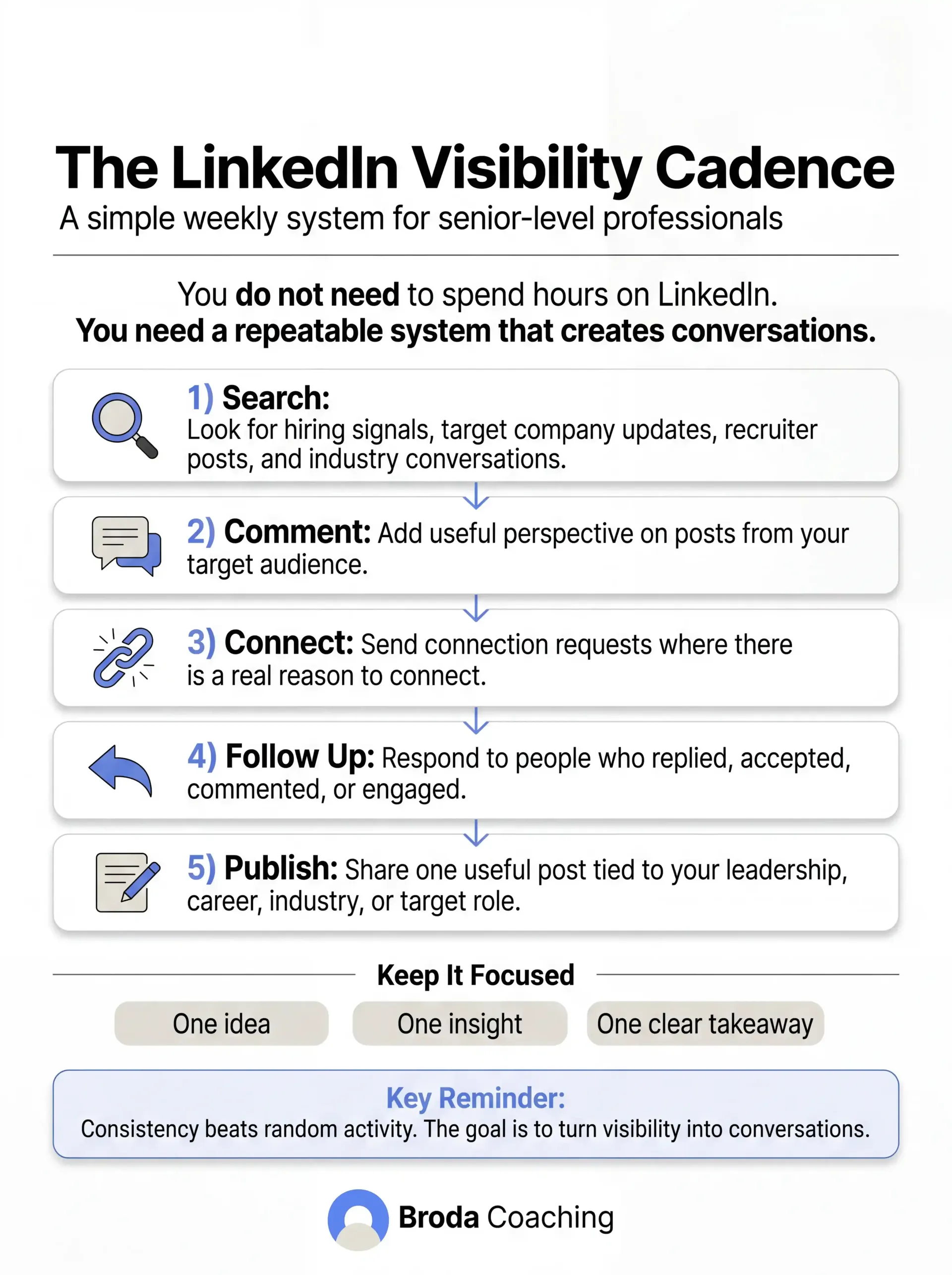
Start with a simple weekly cadence:
- Search for hiring signals, target company updates, recruiter posts, and industry conversations.
- Comment on posts from your target audience.
- Send connection requests where there is a real reason to connect.
- Follow up with people who replied, accepted, commented, or engaged.
- Publish one useful post tied to your leadership, career, industry, or target role.
Keep it focused.
One idea. One insight. One clear takeaway.
That is enough to start.
Resources and Templates
You can make this easier by creating a few simple templates.
Start with:
- A target people list
- A content idea bank
- A target company list
- A weekly engagement tracker
- A follow-up message template
- A connection request template
- A simple profile audit checklist
If you are adding visuals to your LinkedIn profile, Featured section, or website content, do not ignore accessibility. Use a clear alternative text description for images. Instead of leaving the description for this image blank, describe what the image shows and why it matters.
Clarity helps everyone.
The Missing Piece: Execution
Most senior-level professionals do not need another random job search spreadsheet.
They need a system.
Because LinkedIn visibility is not just about posting once, commenting twice, or updating your headline and hoping something happens. It is about consistently tracking the actions that create opportunity.
Who are you reaching out to? Who replied? Who needs a follow-up? Which companies are showing signals? Which roles are worth tracking? Which conversations are turning into interviews? Which posts, comments, and outreach efforts are creating inbound activity?
This is one of the reasons we built Better Work Co-Pilot.
Better Work Co-Pilot is our proprietary AI-powered job search tool built for Better Work clients. It is not Microsoft Co-Pilot.
It gives clients and coaches one centralized place to organize the moving parts of a senior-level job search, including networking activity (LinkedIn), target roles, applications, job opportunities, resume versions, interview tracking, reminders, notes, and weekly action items.
For LinkedIn visibility specifically, Better Work Co-Pilot helps clients track the execution work many job seekers forget to manage:
- Posts
- Comments
- Interviews
- Next steps
- Applications
- Inbound activity
- Outreach volume
- Networking contacts
- Follow-up messages
That matters because senior-level job searches are not won by random activity.
They are won by clear positioning, targeted visibility, consistent follow-up, and accountable execution.

Key Takeaway
A polished LinkedIn profile helps you get found.
A LinkedIn visibility system helps you get remembered, trusted, and contacted.
Senior-level professionals do not need to become influencers. They need to become visible to the right audience, known for the right problems, and consistent enough to turn LinkedIn activity into real conversations.
The professionals who win are not always the ones posting the most. They are the ones who know their target audience, show proof of value, build relationships, follow up consistently, and track the actions that move their search forward.
That is the system.
And when you apply it consistently, LinkedIn becomes much more than a profile.
It becomes a relationship engine.
Ready to Build a More Strategic Senior-Level Job Search?
If your LinkedIn profile is built but your job search still feels random, Better Work can help you turn scattered activity into a clearer system.
Through Better Work and Better Work Co-Pilot, our clients get support with positioning, networking activity, job opportunities, resume versions, interview tracking, outreach, follow-up, and the daily execution that creates momentum.
Because at the senior level, the goal is not just to apply more.
The goal is to become visible to the right people, for the right reasons, at the right time.
Learn more about the
Better Work program, or
apply now if you're ready for a strategic job search.

Sources
- Broda, Adam. First-hand professional experience as a former Amazon and Boeing hiring manager, Big Tech career transitioner, and senior-level career coach.
- Broda, Adam. First-hand LinkedIn soft engagement experience using outreach, professional network-building, and relationship-based visibility during his own career transition.
- LinkedIn, “The Future of Recruiting 2025.” LinkedIn reports that AI is accelerating recruiting by automating time-consuming tasks, giving recruiters more time for strategic activities like relationship-building, and that companies using the most skills-based searches are 12% more likely to make a quality hire.
- LinkedIn, “How to Navigate the LinkedIn Algorithm as a Content Creator.” LinkedIn describes the platform as prioritizing relevance, expertise, authentic engagement, meaningful conversations, and topic consistency over viral trends or sheer volume.
- LinkedIn, “LinkedIn Algorithm Best Practices.” LinkedIn notes that clear profile signals, consistent content themes, thoughtful replies, relevant ideas, and conversational engagement help content reach the right audience.
- LinkedIn, “6 B2B Marketing Insights for 2026: Creators Are Up Next in B2B.” LinkedIn highlights the growing importance of trusted human voices, noting that thought leadership is increasingly people-powered and that employee networks can be much larger than company page followings.
- Edelman and LinkedIn, “2025 B2B Thought Leadership Impact Report.” Edelman and LinkedIn report that thought leadership is a strategic tool for building trust, driving alignment, and opening doors with visible and hidden decision-makers.