The Best Career Change Strategy for Senior Level Professionals in 2026
TL;DR
- 2026 reality: Senior hiring is cautious, “spray-and-pray” breaks. You need a strategy + system, not more applications.
- 16-week execution plan:
- Weeks 1–2: Audit outcomes + transferable skills; pick a target career path
- Weeks 3–6: Lock positioning + Present→Past→Future narrative; update resume/LinkedIn to ROI-first
- Weeks 7–10: Build access before postings (network, outreach, visibility)
- Weeks 11–14: Apply selectively + run an interview system (stories, proof, role-fit)
- Weeks 15–16: Negotiate + choose with clear decision criteria
- Positioning wins: Stop leading with job titles. Lead with measurable impact: what you led, what changed, how you measured it, what it unlocked.
- Make the pivot feel inevitable: Clear narrative reduces risk for hiring managers—connect the dots from what you’ve done to the problems you’ll solve next.
- Build access + keep it warm: Informational conversations, consistent follow-up, and “keep recruiters warm” cadence. Soft skills (strategic communication, active listening, relationship building) are leverage.
- Upskill with intent (incl. AI literacy): Identify the smallest set of new skills that signals credibility and back it with proof-of-work.
Introduction
If you’re a senior-level professional thinking about a career change in 2026, you’re not imagining it:
- The job market is more cautious.
- Hiring managers can be pickier.
- And “spray-and-pray” applications break down fast at the senior level.
Indeed’s 2026 trends research points to a hiring environment that’s stabilizing, but not aggressively expanding. That’s a fancy way of saying: you need a plan.
This post is a practical playbook I use with clients who are making career pivots, changing careers, or trying to accelerate professional growth without taking a step backwards.
Executive Overview: The Best Career Change Strategy for Senior Level Professionals in 2026
The primary goal of a senior-level career transition isn’t “find a job.”
It’s this:
Land a new role where your experience maps cleanly to business outcomes, in a market shaped by technological disruption, digital transformation, and tighter talent management.
A clean high-level timeline I like:
- Weeks 1–2: Audit your current career + define your target career path.
- Weeks 3–4: Rebuild positioning + lock your pivot narrative (Present → Past → Future).
- Weeks 5–6: Update resume + LinkedIn to outcome-first (ROI-focused).
- Weeks 7–10: Build access before the req (network, outreach, visibility).
- Weeks 11–14: Selective applications + interview system (prep, stories, role-fit proof).
- Weeks 15–16: Close (negotiation, decision criteria, onboarding plan).
You’ll notice what’s missing.
“Apply to 200 jobs.”
That’s not a strategy. That’s coping.
Career Change Starts with Your Current Career, Not Your Next Job Title
Before you pick a new career path, you need to understand what you actually have to work with.
Here’s the quickest way to audit your current career and job market fit:
- List your top 10 outcomes from the last 3–5 years.
Think revenue, cost, cycle time, risk reduction, growth, retention, quality, customer impact. - Translate those wins into transferable skills.
Not “communication.” Not “leadership.”
Real skills employers pay for: systems thinking, critical thinking, problem solving, strategic communication, stakeholder management, data driven decision making. - Benchmark against job market demand.
Not by scrolling titles.
By looking at what problems companies are hiring to solve (and what skills companies keep repeating in postings).
For senior-level positions in 2026, demand is concentrated in sectors where strategic transformation and operational resilience are critical. Employers in 2026 increasingly prioritize demonstrable competencies over years of tenure.
Global employers are telling the same story: skill requirements are changing, and the pressure to reskill is rising.
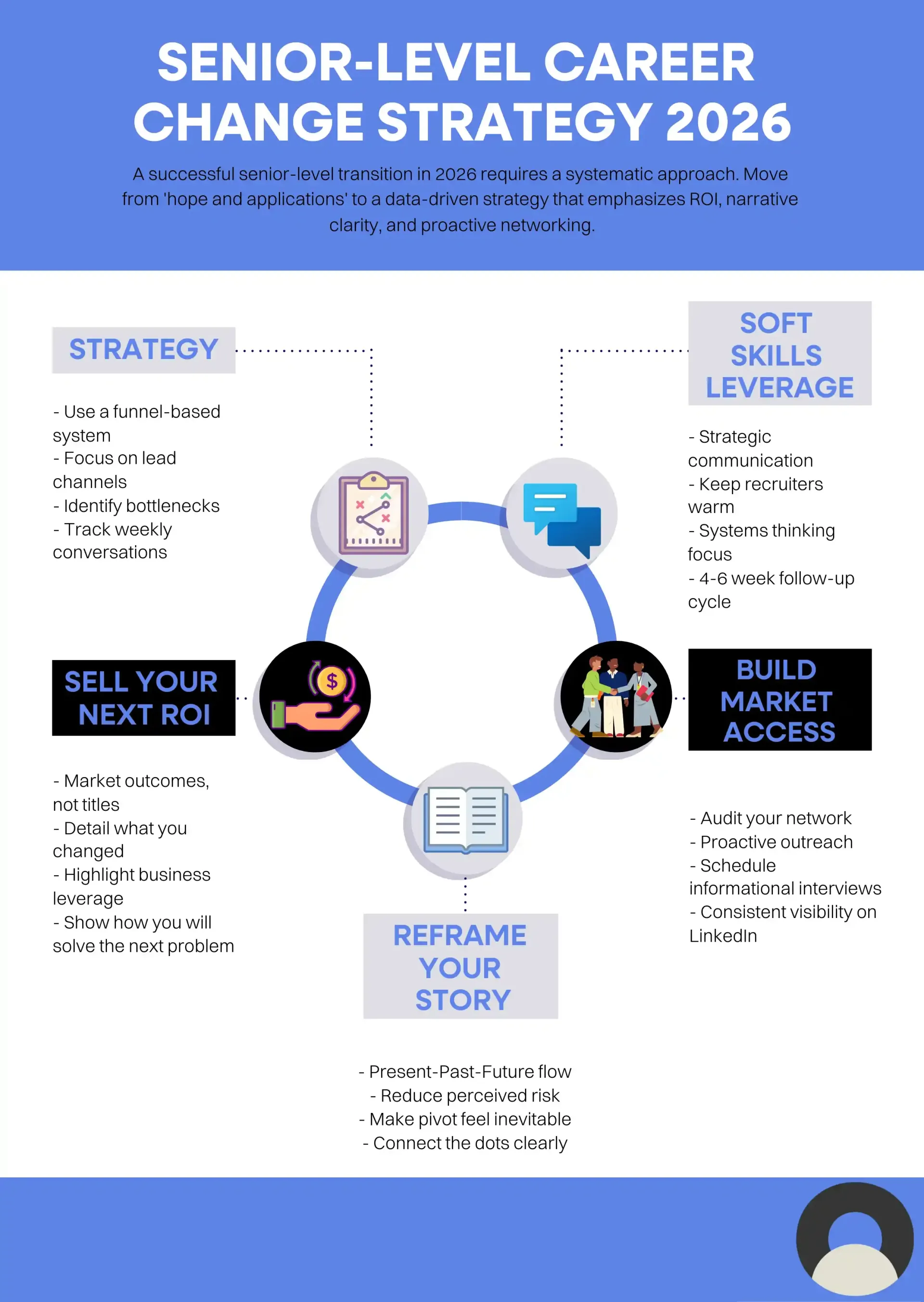
1) Treat the Career Change Like a Strategy, Not a Vibe
Senior-level transitions don’t reward “hope + applications.”
They reward:
- a target
- a plan
- repeatable actions
I teach job search like a funnel.
Because when you think in systems, you stop asking, “Why isn’t this working?” and start asking better questions:
- How many new conversations per week creates enough opportunities?
- What channel is producing the best leads (referrals, recruiter relationships, outbound networking)?
- Where is the bottleneck (visibility, positioning, interviews, closing)?
This is the difference between anxiety and control.
Career Pivot and Career Path: Define 2–3 Career Options (then pick one)
If you're not sure whether it's time for a career pivot or career change, consider this.
Signs that indicate a need for a career pivot can include feelings of burnout, a lack of growth, or a sense that your skills could be better utilized elsewhere.
Most senior-level professionals stay stuck because they won’t choose.
They keep five career options alive “just in case.”
That creates generic positioning. Generic messaging. Generic results.
Here’s the move:
- Shortlist 2–3 career options
- Map a career path for each (role progression + what success looks like)
- Prioritize one option based on:
- market demand
- cultural fit
- your self-awareness (what work you can sustain)
- how quickly you can gain experience and credibility
A trend I’m seeing across industries: employers increasingly expect candidates to arrive with proof of capability; skills, credibility signals, and a narrative that makes sense.
2) Win on Positioning: Stop Selling Your Past, Start Selling Your Next ROI
At the Senior, Principal, and Director levels, you’re not hired for effort.
You’re hired for:
- outcomes
- leverage
- the problems you can solve next
Most candidates market job titles.
Hiring managers hire business outcomes.
So if your resume reads like a list of responsibilities, your positioning is broken.
Your resume should read like a highlight reel:
- What you led.
- What changed.
- How you measured it.
- What it unlocked.
This matters even more in 2026 because skill requirements are shifting quickly; especially in roles exposed to AI and automated systems.
A Personal Experience: My Definition of a “Dream Job” Kept Changing
I stopped believing in dream jobs in 2021.
Now, I teach people to look for dream managers.
Because the reality is: your definition of success changes.
Mine did.
- In 2016, I wanted to be Chief Engineer at Boeing.
- In 2020, after my first child, I wanted flexibility in tech.
- In 2022, after my second child, I wanted to move closer to family.
- In 2023, I wanted to work for myself.
That’s not indecision.
That’s life.
Career growth isn’t about locking yourself into one identity. It’s about building a strategy that can evolve with you, so your work stays meaningful, your leadership stays sharp, and your career development doesn’t rely on luck.
3) Reframe Your Narrative to Make the Career Change Feel Inevitable
Senior-level hiring teams don’t want your life story.
They want:
- clarity
- confidence
- a clean “dot-connecting” narrative
When someone says, “I’m trying to pivot industries,” what the room hears is: risk.
Your job is to reduce that risk with a simple structure I use constantly:
Present → Past → Future
- Present: what you’re focused on now.
- Past: proof you’ve done the work.
- Future: why that maps to the new role / new field.
You’re not convincing people you want a career pivot.
You’re showing them why it’s the logical next step.
The Future of Jobs research is clear that skills will continue shifting; your narrative has to match the future, not just the past.
A Composite Story: Changing Careers by Fixing Positioning (Not Qualifications)
A Director I worked with wanted to pivot industries.
On paper, he was the candidate everyone claims they want: recognizable companies, real scope, legitimate leadership. His resume looked impressive. His background checked out.
And yet… zero momentum.
He was applying to roles that made sense. He was getting the occasional recruiter screen. But he wasn’t getting pulled into real interview loops. Nothing was building.
That’s the pattern I see over and over at the senior level: the market doesn’t reject your experience, it rejects your positioning.
His materials were basically saying, “Here’s what I’ve done.”
But the hiring manager was asking, “Why you, for this industry, solving this problem, right now?”
So we made two shifts while he was in our Better Work program.
First: we stopped leading with job titles and responsibilities and started leading with outcomes. We rebuilt his resume and LinkedIn around measurable impact; what changed because he was there. Revenue influenced, costs reduced, timelines accelerated, teams scaled, complexity navigated. We made the scope obvious without “strategic leader” fluff.
Because at Senior, Principal, and Director levels, you’re not hired for effort. You’re hired for results.
Second: we cleaned up the pivot narrative so it sounded inevitable. Not “I’m looking for something new,” but: here’s the problem I solve, here’s how I’ve solved it, and here’s why that maps directly to what your industry is dealing with right now.
Then we did the part most people avoid: we built a simple outreach system to create access before applying. Target list (tight). Role shortlist (specific). The right people (not just recruiters). Clear messages focused on relevance and impact. A follow-up cadence. Tracking. Weekly volume.
Within a few weeks, conversations started turning into interviews.
Not because he became qualified overnight; he was always qualified.
He just finally looked like the obvious hire for where he wanted to go next.
4) Don’t Rely on Posted Roles — Build Access in the Job Market
At the senior level, role scarcity is real.
Many high-quality roles get filled through relationships, referrals, and internal mobility before the public posting does anything meaningful. Networking with former colleagues in adjacent industries can help facilitate a career pivot.
Successful pivots often start with conducting informational interviews and auditing your network.
So your job is to build access before the req:
- warm networks
- proactive outreach
- consistent visibility
Business Insider framed career security as increasingly a “solo project” built through skills, credentials, and network strength. That’s not motivational fluff, it’s a description of how the current workforce is operating.
Practical ways to do this without making it awkward:
- Audit your network for target-industry contacts.
- Engage HR leaders and recruiters with curiosity and clarity.
- Show up publicly (LinkedIn) with useful perspective, not noise.
- Schedule informational interviews with insiders (short, specific asks).
5) Soft Skills, HR Leaders, and the “Keep Recruiters Warm” System
Soft skills aren’t “nice to have” in senior career transitions.
They’re leverage.
These are the ones that matter most in 2026:
- strategic communication
- relationship building
- active listening
- systems thinking across teams
- problem solving under uncertainty
Here’s a big one most people miss:
Don’t burn bridges after rejection.
Most candidates shut down after a “we went another direction” email.
Smart candidates build a living system:
- Send an appreciative thank-you.
- Save contact info.
- Follow up every 4–6 weeks with concise updates (new skills, new scope, new wins).
- Re-engage when a relevant role opens.
Recruiters move. HR leaders move. Hiring managers move.
Your network should outlive one opportunity.
Build Skills for Career Transitions (Including AI Literacy)
A senior-level career change in 2026 almost always includes building new skills.
Not necessarily a new degree. Not necessarily a full reinvention.
But yes: new skills.
Start with a skills gap inventory:
- What are the skills employers repeatedly request in your target industry?
- Which ones are table stakes vs differentiators?
- Which ones can you build quickly through targeted education, projects, or proof-of-work?
AI literacy is becoming a baseline expectation in more roles; not because everyone needs to be technical, but because automated systems are shaping how work gets done. PwC’s research highlights wage premiums and faster change in employer skill needs in AI-exposed roles.
Organizations need workers who can work alongside AI systems and interpret data for strategic decision-making.
Analytical thinking is the most important job skill for 2026, with 69% of employers adopting it. Going further, creative thinking complements analytical abilities and is essential for developing innovative solutions.
If you’re pivoting into spaces like renewable energy, operations, strategy, product, or transformation work, the winners are usually the people who can combine:
- Domain knowledge.
- Digital transformation and AI fluency.
- And clean business storytelling.
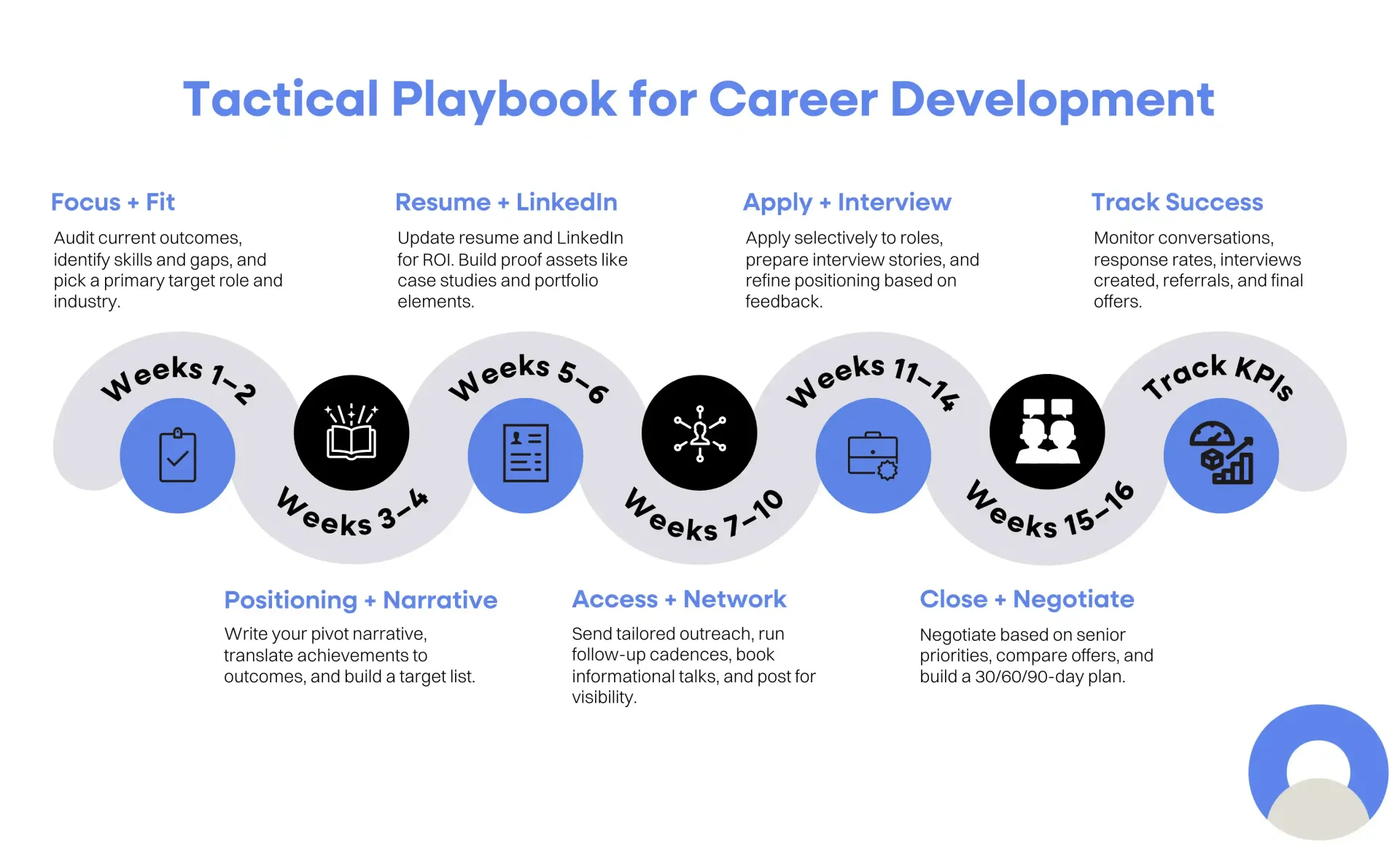
Tactical Playbook for Timebound Career Development (16 Weeks)
If you want a simple execution plan, here’s a 16-week structure:
Weeks 1–2 (Focus + Fit)
- Audit your current career outcomes (impact inventory).
- Identify transferable skills + gaps.
- Pick one primary target role + industry (with 1 backup option).
Weeks 3–4 (Positioning + Narrative)
- Write your Present → Past → Future pivot narrative.
- Translate achievements into business outcomes.
- Build a tight target-company list (25–40).
Weeks 5–6 (Resume + LinkedIn: Outcome-First)
- Update resume to ROI and measurable impact.
- Update LinkedIn headline/about/featured to match the pivot.
- Build “proof” assets (case study bullets, portfolio elements, talking points).
Weeks 7–10 (Access: Network + Outreach + Visibility)
- Send 3–5 tailored outreach messages per week.
- Run a follow-up cadence (tracking + reminders).
- Book informational conversations (aim for 10 over 8 weeks).
- Weekly visibility (comments + short posts that show domain credibility).
Weeks 11–14 (Apply + Interview + Iterate)
- Apply selectively to prioritized roles (quality > quantity).
- Interview prep as a system (research, stories, role-fit proof).
- Run mock sessions + refine positioning based on feedback.
Weeks 15–16 (Close: Offers + Negotiation)
- Negotiate based on senior-level priorities (scope, manager, team, growth).
- Compare offers using decision criteria (career growth + meaningful work + runway).
- Build a 30/60/90-day plan so you hit the ground running.
Track KPIs like you would in business:
- new conversations
- response rate
- interviews created
- referrals generated
- offers
Then iterate.
P.S. Check out my interview success guide to ensure you give great answers in your interview.
Main Takeaway
Career change at the senior level isn’t about starting over. It’s about repositioning what you already know, and building a system that creates access.
If you’re feeling stuck, it’s rarely because you lack ability.
It’s usually because your strategy is unclear, your positioning is generic, and your network isn’t being activated like a system.
Fix those three things, and career transitions get a lot simpler.
Sources
- Indeed Hiring Lab. Indeed’s 2026 U.S. Jobs & Hiring Trends Report (Nov 20, 2025).
- Spencer, K. In this job market, career security is often a solo project (Business Insider, Jan 2026).
- World Economic Forum. The Future of Jobs Report 2025 (Jan 2025).
- World Economic Forum. The jobs of the future – and the skills you need to get them (Jan 2025).
- PwC. The Fearless Future: 2025 Global AI Jobs Barometer (Jun 3, 2025).
- Deloitte. 2025 Global Human Capital Trends (Mar 2025).
- Gallup. State of the Global Workplace: 2024 Report (2024).
- U.S. Bureau of Labor Statistics. Employment Projections — 2024–2034 (Aug 28, 2025).