LinkedIn Profile Optimization for Senior-Level Professionals
TL;DR:
- Senior hiring is a search game—optimize Job Titles, Headline, and Skills first so you surface in the right queries.
- Write like a business case: concise About section with 3–4 strengths, quantified outcomes, clear leadership style, and a direct CTA.
- Show proof fast: pin a short intro video/value deck in Featured, secure 3–5 targeted Recommendations, and use a clean professional headshot.
- Maintain a light cadence: refresh keywords/sections every 1–2 weeks, toggle Open to Work discreetly, and post 1 high-signal update weekly.
- Key takeaway: clarity + relevance + proof → more recruiter views, more interviews.
Hiring at the senior-level is a search game. Hiring managers live inside databases and Boolean strings, scanning for leaders who solve expensive problems. This guide shows you how to optimize your LinkedIn profile so those searches point to you. The way you showcase your ability to solve complex problems in impactful ways converts views into interviews.
Introduction to LinkedIn Profile Optimization
A well-built LinkedIn profile is your always-on business case. For senior roles, it communicates personal brand, leadership style, and readiness for a wide scope of responsibilities. Recruiting firms and internal sourcers run targeted queries against hundreds of millions of profiles. The candidates whose job title, LinkedIn headline, and skills align with a clear problem set rise to the top. Your goal: make it effortless for recruiters to understand your value proposition in seconds and for potential employers to see a credible career trajectory.
My Personal Experience
As a hiring manager for 13+ years, I rarely search by company first. I search by problems and outcomes. In LinkedIn Recruiter my search strings look like: Director of Product AND (platform OR data) AND (reduce churn OR ARR growth OR time-to-market).
When results load, I scan three places in under 15 seconds: Headline, the first lines of About, and the most recent Experience bullets. The profiles that win translate scope into measurable change.
Example: two directors pop up. One says, ‘Responsible for platform strategy across multiple squads.’ The other says, ‘Owned platform roadmap for 8 squads; cut partner onboarding from 12→4 weeks, enabled $18M upsell ARR, and reduced incidents -32% by deprecating 5 legacy services.’ I don’t care that the first worked at a household-name logo, the second gets the interview.
Another tell: leaders who name the beneficiary of the impact. ‘Improved delivery’ is vague. ‘Reduced release lead time -38% for Payments, unblocking Sales to pursue $6.5M in Q3 pipeline’ is decision-grade.
If you want to rise in those searches, write like a business case: one-sentence scope, 3–5 quantified outcomes, pinned to revenue, cost, risk, quality, or time. That’s what moves you from ‘interesting company’ to ‘must-contact candidate.’
Implement these strategies using the LinkedIn optimization included in our coaching program to accelerate your job search.
Optimize the Sections LinkedIn Recruiter Weights Most (Job Title • Headline • Skills)
Treat Job Titles (current + past), Headline, and Skills as your SEO spine.
- Job title: Keep the current job title accurate; add clarifiers in parentheses to match your target role and industry (e.g., Director of Product (B2B SaaS, Data Platforms)). This improves search results without misrepresenting your current employer.
- Headline: Blend strategic keywords from your preferred companies and roles with outcomes (ARR, margin, cycle time).
- Skills list: Curate to match the roles you want now; prioritize scope-level capabilities (e.g., Strategic Planning, Portfolio Management, GTM, Data Platform Strategy). Ask leaders and peers for endorsements on the top items.
Adam's POV: When recruiters hunt, exact title/keyword matches in these three sections decide who shows up first. Nail these before you tweak anything else.
Write a Headline That Sells a Leadership Thesis—Not Just a Label
Two proven structures:
- [Target Role] + [Credibility] + [Key Outcome]
Example: VP Product | 2 exits | Scaled self-serve to $75M ARR - [Who you help] | [How] | [Proof/Differentiator]
Example: I help B2B fintechs reduce churn | Platform + Pricing | -420 bps in 12 months
Guidelines:
- Lead with relevant keywords in the first 80–100 characters.
- Make the sentence imply executive leadership and market impact (revenue, cost, risk, quality, time).
- Mirror language used by target companies and executive search firms.
Adam's POV: If I can’t tell how you make a business better in ~10 seconds, I move on. Your Headline is the fastest way to win that moment.

Turn the Skills Section Into a Relevance Engine
- Choose ~25–40 purposeful skills aligned to the language your preferred companies and target roles use.
- Pin three that reflect senior/principal/director scope (e.g., Product Strategy, Roadmapping, GTM Execution).
- Remove tactical/legacy items that dilute relevance; keep the skill set senior.
- Drive 5+ endorsements on your top 10. Endorsements are an authority signal to executive recruiters and search firms.
Adam's POV: Fewer, sharper skills beat a long grocery list. Relevance is what gets you discovered by the right people.
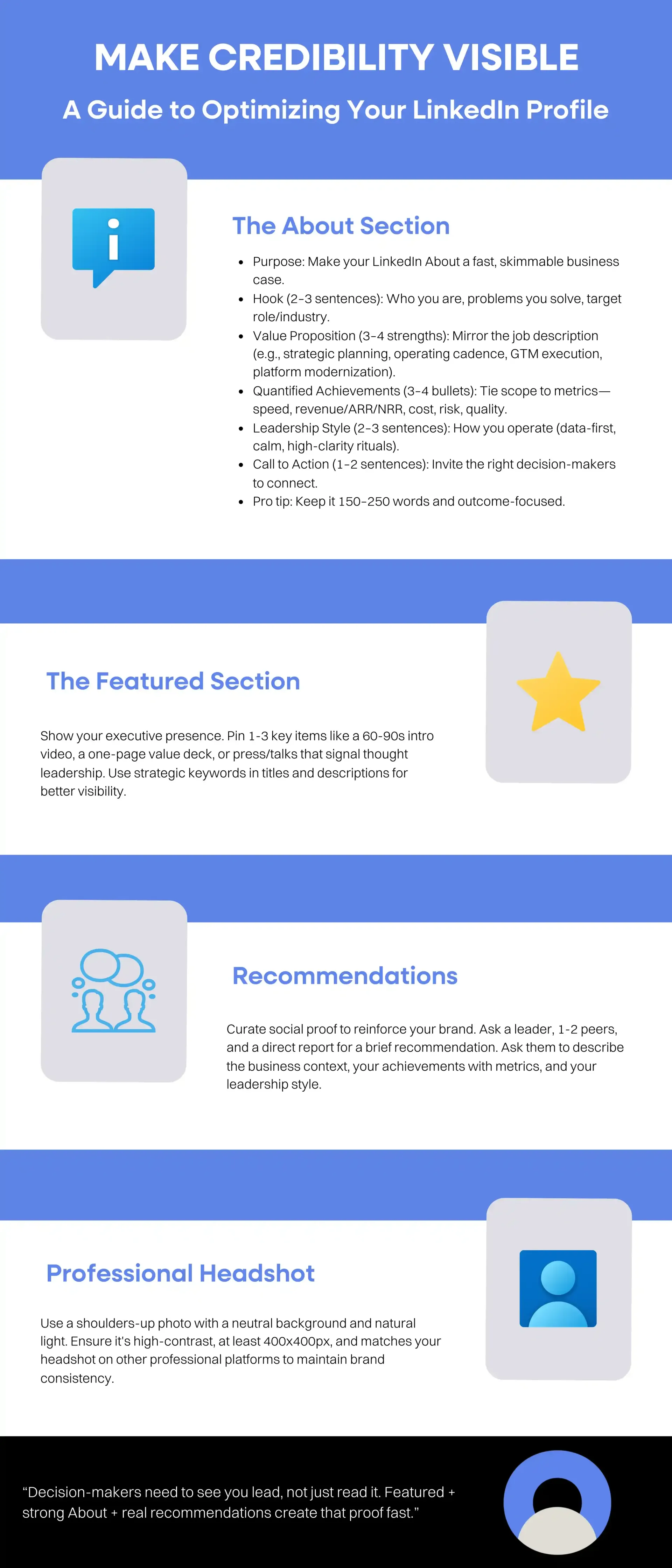
Make Credibility Visible: About Section, Featured Section, Recommendations, Professional Headshot
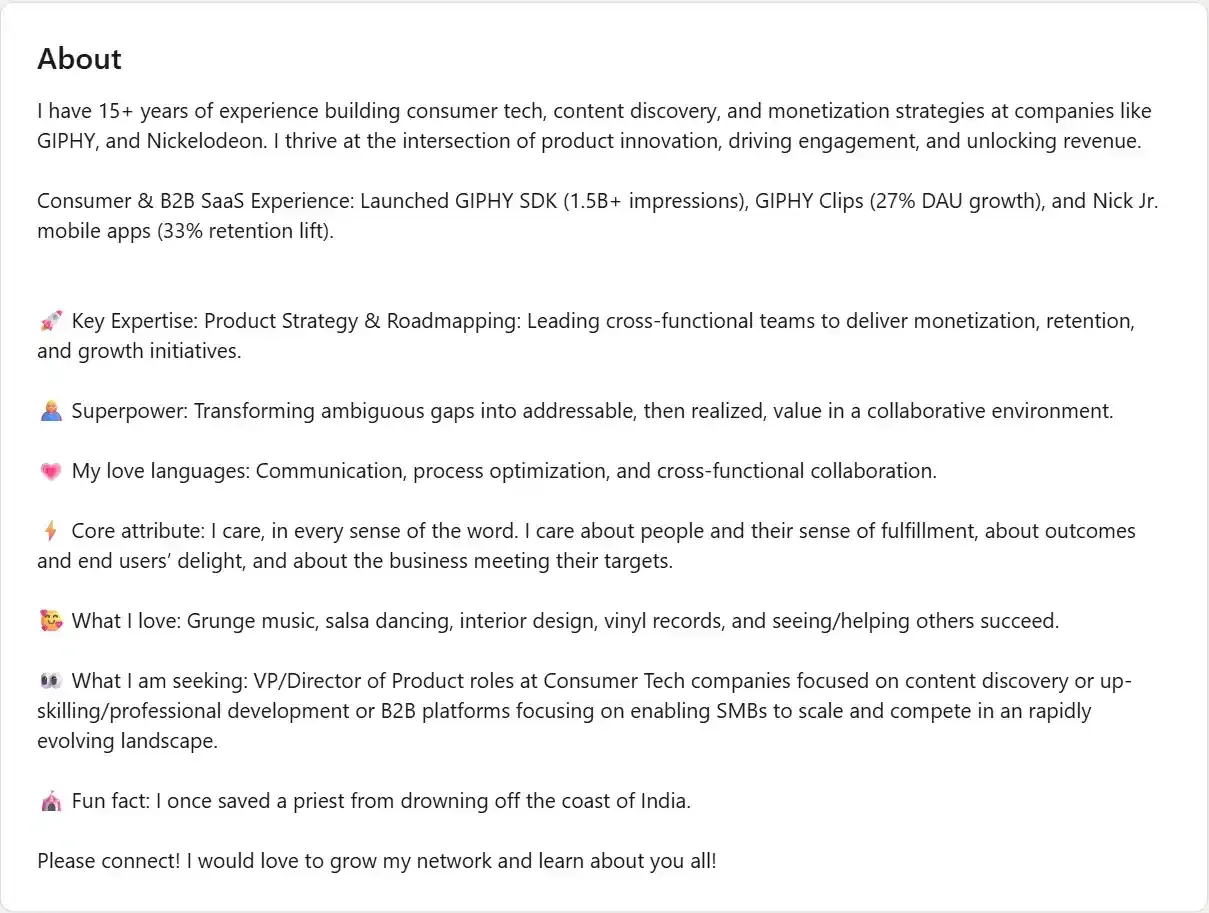
The About Section (Career Story + Leadership Philosophy)
Use a simple, skimmable structure. Aim for 150–250 words.
1) Hook (2–3 sentences)
State who you are, the problems you solve, and your target role/industry.
Example: “Director of Product turning complex data platforms into revenue. I help fintech teams reduce churn and speed time-to-market.”
2) Value Proposition (3–4 strengths)
List strengths that match your job description language.
Examples of Strengths: Strategic planning • Operating cadence • GTM execution • Platform modernization.
Example Value Proposition: I align roadmaps to P&L through strategic planning, portfolio roadmapping, GTM execution, and operating cadence that keeps teams shipping.
3) Quantified Achievements (3–4 bullets)
Translate scope into professional achievements and business outcomes.
- Cut time-to-market 58% by instituting quarterly portfolio roadmapping and weekly operating reviews—moved from monthly to weekly releases and 3× roadmap throughput across 8 squads.
- Reduced churn by 2.3 pts after re-sequencing the roadmap to prioritize retention levers; paired with GTM plays, this unlocked +$18.4M ARR in upsell and expansion.
- Lifted NRR from 102% → 109% by launching tiered packaging and a coordinated GTM execution (PMM + Sales Enablement), generating $62M qualified pipeline with a +8 pt win-rate gain.
- Lowered platform cost 21% and incidents 37% by deprecating 6 legacy services and modernizing data pipelines; partner SLA improved from 97.2% → 99.6%.
4) Leadership Style (2–3 sentences)
Show how you lead—your
leadership philosophy.
Example: “Calm operator, data-first decisions, high-clarity rituals. I build teams that ship reliable platforms and measurable value.”
5) Call to Action (1–2 sentences)
Invite the right contact.
Example: “Open to senior roles in B2B SaaS. If you’re tackling churn or platform scale, let’s connect.”
This about section is your compact career story and on-page value proposition. A clear summary that helps optimize your LinkedIn profile for the roles you actually want.
Featured Section—Executive Presence
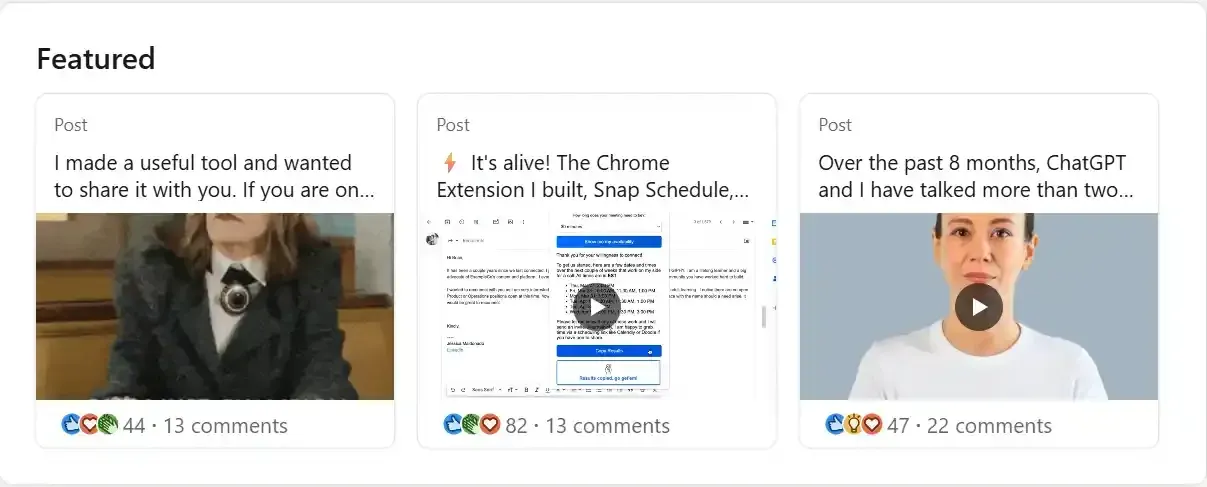
- What to pin (choose 1–3):
- 60–90s intro video that states your target role, value proposition, and one quantified win.
- One-page value deck (PDF) with scope, 3 proof points, and industries served.
- Press / talk / panel that signals thought leadership to executive recruiters and potential employers.
- Simple video script (30/30/30):
- 30s — Who & Where: “I’m a [current job title] focused on [problem set] in [industry].”
- 30s — Proof: “Recently, we [action] → [metric] across [business/line].”
- 30s — Direction: “I partner with [target companies/functions]; open to senior roles driving [outcome].”
File hygiene: Add strategic keywords in titles and descriptions (e.g., platform modernization, pricing architecture). Use clear cover images so items pop in the LinkedIn feed and on your LinkedIn profile.
Recommendations
- Who to ask: 1 leader (or board member/VP), 1–2 industry peers, 1 direct report. You’re curating social proof across levels to reinforce your professional brand and leadership style.
- What to ask for: One sentence of scope, 1–2 sentences of impact with metrics, 1 sentence on collaboration/values.
- Copy/paste template (make it easy):
“Would you be open to a brief recommendation for my LinkedIn profile? Prompt: In 3–4 sentences, describe the business context, what we achieved (with a metric), and one line on how I lead (e.g., strategic planning, cross-functional alignment). Happy to write a recommendation for you as well.”
Pro tip: Stagger requests over 2–3 weeks to keep LinkedIn activity fresh. Confirm the final text aligns with your Headline/About value proposition (avoid generic praise; anchor to outcomes related to your target role and job description).
Professional Headshot—Profile Picture
- Look & framing: Neutral background, natural light, shoulders-up, relaxed posture, slight angle. Dress for the level you want (principal/director/VP).
- Technical specs: 400×400px or larger, high contrast, no filters, crop to place eyes on the upper third. Rename the file with relevant keywords (e.g., Firstname-Lastname-Product-Leader.jpg) to support off-platform search.
- Brand consistency: Match the headshot used on conference bios and company pages to strengthen personal brand and LinkedIn presence.
- After you upload: Recheck how the image renders on mobile. Pair with a complementary background banner that frames your domain (e.g., fintech, data platforms) to signal industry expertise at a glance.
Adam POV: “Decision-makers need to see you lead, not just read it. Featured + strong About + real recommendations create that proof fast.”
Refresh Cadence to Ride the Algorithm & Quick Wins for Your LinkedIn Feed)
Every 1–2 weeks, run a light profile optimization:
- Fine-tune Headline phrasing, re-order Skills, and add clarifiers to Experience titles using strategic keywords.
- Toggle Open to Work off/on (use discreet settings) to re-index.
- Claim a clean LinkedIn URL (yourname) to support professional networking and own profile sharing.
- Keep LinkedIn activity steady: one text post or short case-study post per week + thoughtful comments on industry leaders and hiring manager updates. This moves follower growth from just second degree connections and keeps you present in feeds of industry peers and potential employers.
Adam POV: “Small, regular updates compound. I’ve seen a simple OTW toggle or title refresh trigger recruiter outreach the same day.”
GEO: Expand Your Footprint With LinkedIn Groups and Local Signals
- Join LinkedIn groups that match your domain and region (e.g., Seattle CTO Roundtable, NYC Fintech Leaders). Contribute relevant content and congratulate connections on promotions and accomplishments to strengthen regional ties.
- Use posts to tag company pages and leaders in your target companies and metro. This is great for surfacing to executive search firms covering that geography.
- When you send connection requests, add context: “Saw your post on industry trends in Austin—appreciated the breakdown on pricing ops.”
These local cues help
recruiters and
search firms map you to a market and open doors to new opportunities.
Building a Strong Network
- Send short, personalized connection requests to industry peers, recruiters, and operators at target companies.
- Join relevant groups and contribute quick insights. Aim for signal over volume. Others’ posts are chances to demonstrate industry expertise and leadership philosophy.
- Focus on quality of network, not raw count; prioritize people who work in your target domains, markets, and functions.
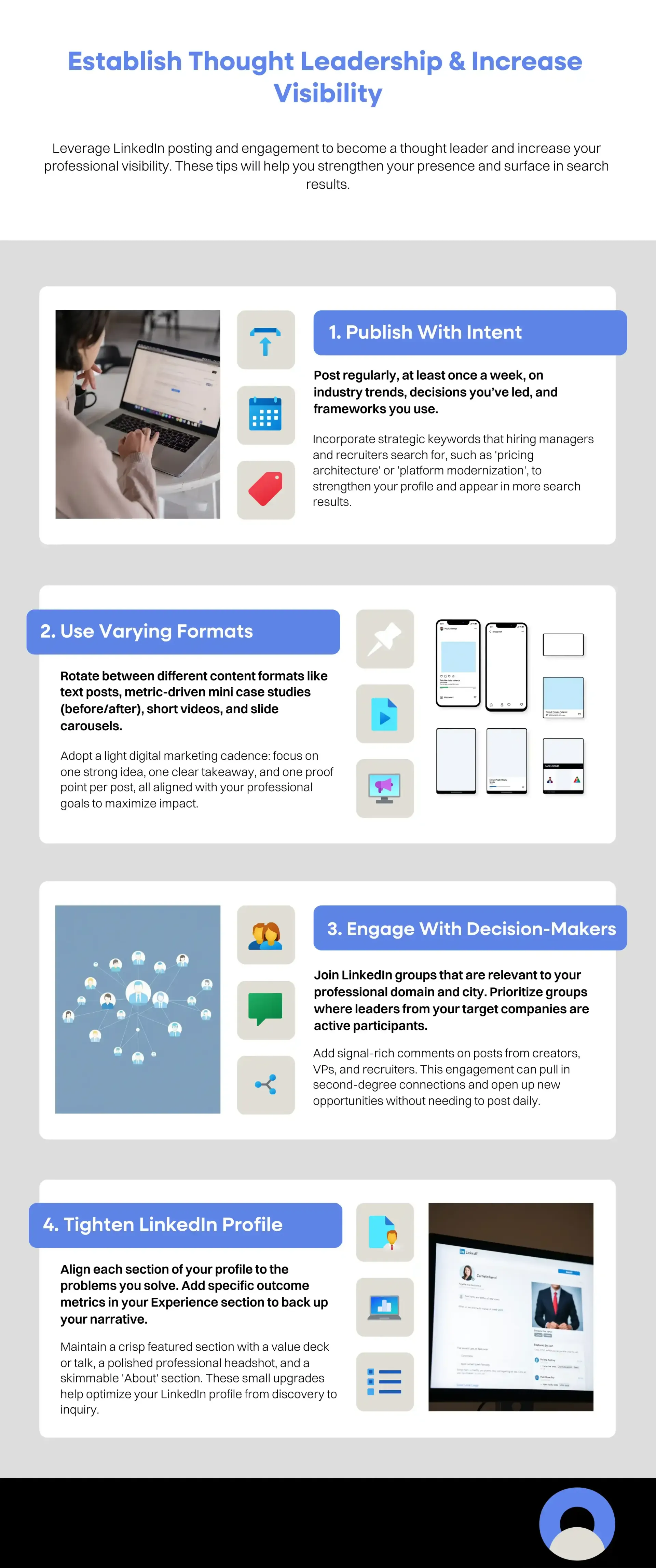
Establish Thought Leadership & Increase Visibility
Publish With Intent
- Post regularly at least 1x/week on industry trends, decisions you’ve led, and frameworks you use (e.g., strategic planning).
- Thread in strategic keywords that hiring managers and executive recruiters actually search (pricing architecture, platform modernization, operating cadence) to strengthen your linkedin presence and surface in search results.
Vary Formats to Showcase Expertise
- Rotate text posts, metric-driven mini case studies (before/after), short videos, and slide carousels.
- Think light digital marketing cadence: one strong idea, one clear takeaway, one proof point—aligned to your professional goals.
Engage Where Decision-Makers Are
- Join LinkedIn groups that map to your domain and city; prioritize relevant groups where leaders at target companies participate.
- Add signal-rich comments on others’ posts (creators, VPs, recruiters). This pulls in second degree connections and opens new opportunities without daily posting.
Tighten Profile Hygiene to Convert Views
- Align each section to the problems you solve; add outcome metrics in Experience to back your narrative.
- Keep a crisp featured section (one value deck or talk), polished profile photo / professional headshot, and a skimmable about section—small upgrades that help optimize your LinkedIn profile from discovery to inquiry.
Measuring Success (quick tips)
- Use LinkedIn analytics to track follower growth, profile views, and LinkedIn post performance.
- Watch “Search Appearances” to see if your strategic keywords are attracting the right potential employers and executive recruiters.
- Iterate monthly: refresh keywords, adjust your marketing strategy, and repin skills based on the job market and the roles you’re targeting.
Key Takeaway
Senior leaders don’t win on clever prose. They win on clarity, relevance, and proof. If you want to surface in the right searches and convert views into interviews, make your Job Titles, Headline, and Skills say exactly what problems you solve, then back it up with quantified outcomes and a light refresh cadence. Do that, and the right people will find you.
Ready to compete at the top of the search and find your next role? Apply to work with Broda Coaching.
P.S. To ensure you ace the interviews you'll get from my LinkedIn profile optimization strategy, check out my guide to giving great interview answers.
References
- Broda Coaching Client Data. 2025
- LinkedIn Talent Solutions. Future of Recruiting 2024 (report + summary). Highlights skills-first hiring and evolving recruiter workflows. LinkedIn Business Solutions+1
- LinkedIn Talent Solutions. 2024 Hiring Product Updates (Wave 2) — interest signals like Open to Work visibility in Recruiter. LinkedIn Business Solutions
- LinkedIn Product Updates. AI-Assisted Search & Projects (Aug–Sep 2024) — Recruiter projects and search filters generated from a job description. LinkedIn Community
- Onrec (reporting LinkedIn research, 2025). Profiles with professional photos receive significantly more views, underscoring the value of a professional headshot. Onrec