The State of the Hiring Market in 2026: What Senior Level Professionals Need to Know
TL;DR
- 2026 isn’t a “bad” market—it’s a risk market: slow hiring + longer interview loops mean companies default to safer, more proven senior hires.
- “Qualified” isn’t enough: to win offers, you need to look proven in the role’s exact problem space (same pain point + similar environment).
- Measured impact is the differentiator: lead your resume and interviews with outcomes (before/after, KPIs moved, time saved, revenue protected, cost reduced, risk mitigated).
- Relationships beat applications at Director+: pipelines often form before job postings go public—strategic networking and recruiter relationships create earlier access.
- AI skills = leverage, not tools: the advantage is leading AI-driven workflow redesign, productivity lift, and guardrails—not just “using ChatGPT.”
- Real client example: a client landed a senior master data leadership role through authentic networking + LinkedIn optimization, then used Adam’s BetterWork interview prep + 1:1 coaching to navigate rounds and negotiate confidently.
- Main takeaway: 2026 rewards senior professionals who look low-risk and high-upside—position sharper, network smarter, and build a system that proves impact, signals relevance, and creates access.
Introduction
If you’re a senior-level professional paying attention, you’ve probably felt it already:
- slow hiring
- longer interview loops
- more “we’ll wait for the perfect candidate”
- and a job search that takes more endurance than it used to
The post pandemic hiring boom is over. What we’re living in now is a “low-hire, low-fire” environment where the labor market stays afloat… but doesn’t move quickly.
The 2026 hiring market for senior-level professionals is expected to be characterized by slow-and-steady, cautious, and highly intentional recruiting.
Yes, there are still job opportunities. But the crucial difference in 2026 is how you need to show up to earn them—starting with a strategy session to navigate this market.
Job Market and Labor Market Reality in 2026
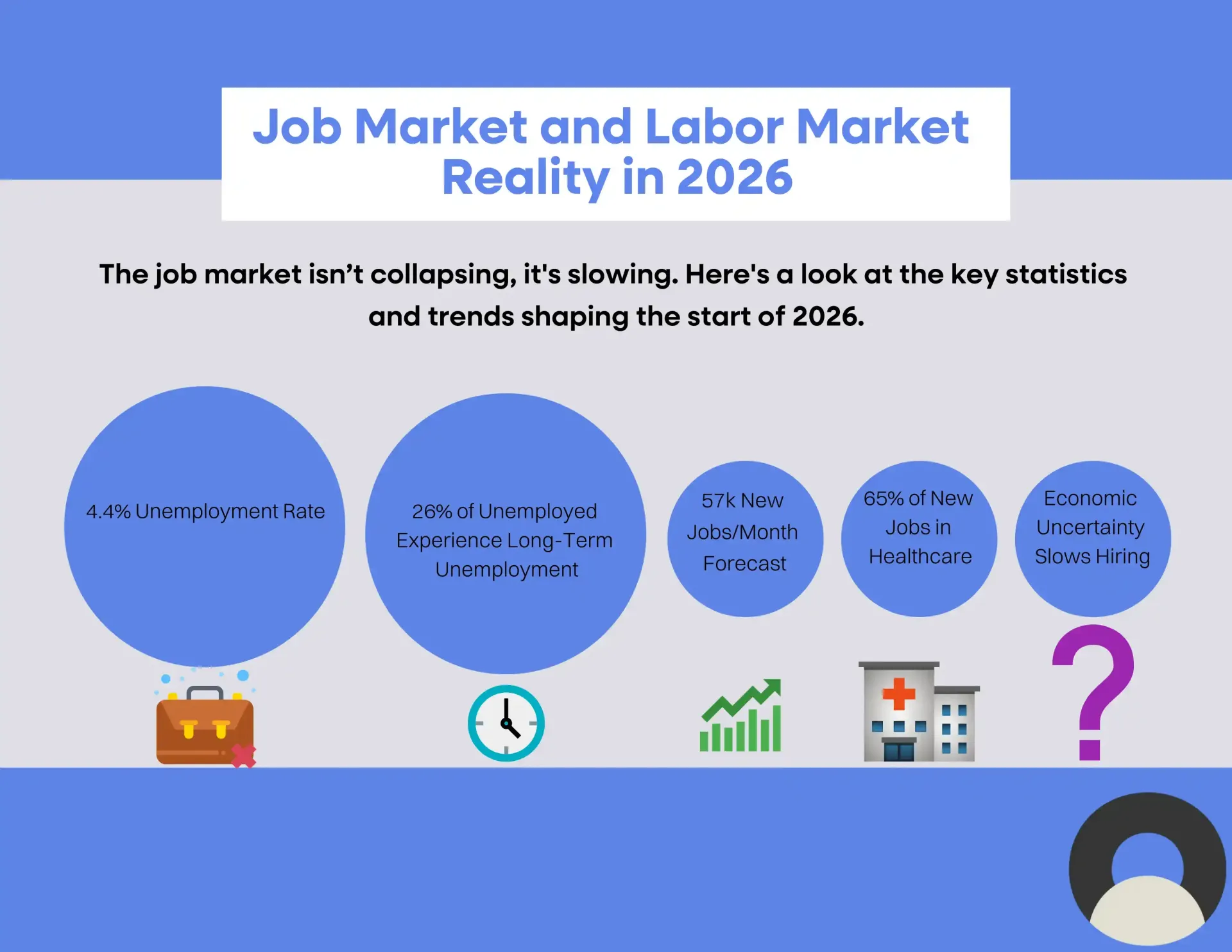
The job market isn’t collapsing. It’s slowing.
The Bureau of Labor Statistics reported 50,000 jobs added in December 2025 with an unemployment rate of 4.4%, and a meaningfully higher share of long term unemployment (26% of unemployed out 27+ weeks). Fewer open positions are available as many senior-level professionals are staying in their current roles due to market uncertainty.
And forecasters are calling for modest job growth to start 2026, about 57,000 net-new jobs per month in Q1 2026, which is slow relative to recent years.
This matters because when hiring slips below the pace needed to absorb college graduates, career returners, and other labor force entrants, the market gets tighter for everyone, including strong candidates.
Healthcare is adding jobs while sectors like leisure and hospitality, retail, manufacturing, and transportation are shedding them. As an example, of the roughly 610,000 jobs added to the U.S. economy in 2025, around 65% were in the healthcare sector.
We’re also seeing ongoing economic uncertainty tied to factors like tariff pressures and shifting policy conditions; another reason many employers are cautious with hiring intentions.
What Job Seekers Should Expect in a Tight Labor Market
In a tight labor market, for many employers, senior-level hiring becomes conservative.
Both employers and senior candidates are focusing on long-term fit, cultural alignment, and stability in roles.
Here’s what I mean by that:
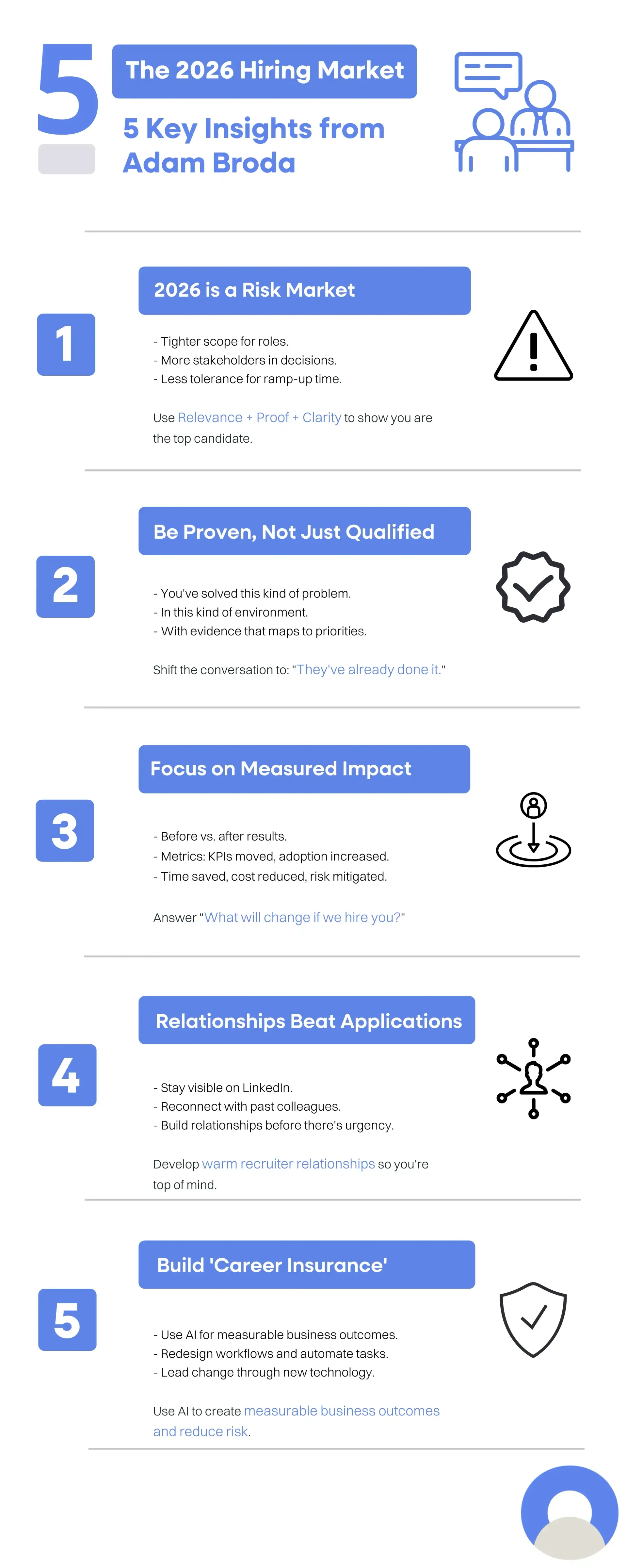
1) 2026 Isn’t a “Bad” Market. It’s a Risk Market.
Senior-level hires are expensive.
They’re high visibility.
And in cautious cycles, companies default to “less risky.”
That “risk” shows up in a few predictable ways in 2026:
- Tighter scope: roles are written for a very specific outcome, not a broad leader.
- More stakeholders: more decision makers, more interviews, more chances for someone to say “not sure.”
- Less tolerance for ramp time: hiring managers want evidence you can deliver quickly without months of learning the environment.
So, the question becomes:
How do you, as a job seeker, reduce perceived risk fast?
Relevance + proof + clarity.
- Relevance: make it obvious you’ve done this work in this type of environment (industry, scale, complexity).
- Proof: lead with measurable impact—what changed because you were there (before/after, metrics, outcomes).
- Clarity: explain your value in plain language so a hiring manager can repeat it to others without translating your story.
You’re not being interviewed just for experience.
You’re being evaluated on
judgment under pressure and on clear wins, because in a risk market, companies hire senior-level talent to reduce uncertainty, not add to it.
Skills-Based Hiring, Job Openings, and the “Proven” Problem
Skills based hiring is everywhere in 2026; at least in how it’s talked about.
But at the senior level, teams still want the same thing:
2) “Qualified” isn’t Enough. You Need to be Proven in Their Exact Problem Space.
I tell clients this all the time:
Strong impact matters, but relevance gets offers.
Why? Because when job openings are limited, and the applicant pool is deep, decision makers don’t want to “take a chance.” They want the candidate who feels like the safest bet to solve their problem with the least ramp time.
Senior-level professionals should highlight transferable skills such as scaling teams or driving transformation rather than just industry pedigree.
In 2026, “qualified” usually means:
- You’ve led teams.
- You’ve delivered results.
- You’ve worked at a senior level.
But “proven” means something more specific:
- You’ve solved this kind of problem (the same pain point).
- In this kind of environment (industry, scale, complexity, constraints).
- With evidence that maps directly to the role’s priorities.
This becomes even more pronounced when companies are managing headcount reductions, tighter budgets, or a mandate to hire only for critical roles. In those situations, hiring managers aren’t rewarded for creativity; they’re rewarded for certainty.
So if you’re trying to pivot (industry, function, environment), your job is to make the pivot feel like a domestic replacement, not reinvention.
A practical way to do that:
- Mirror the language in the job posting.
- Lead with 2–3 comparable wins that match their KPIs.
- Name the constraints you’ve worked under that match theirs (regulatory, legacy systems, global stakeholders, tight timelines, etc.).
That’s how you shift the conversation from “Could they do it?” to “They’ve already done it.”
If you want to ensure you have skills that hiring managers look for in senior-level professionals, check out my article on the skills senior-level professionals need now.
Hiring Managers are Optimizing for Confidence, not Potential
Most senior-level candidates lose offers for one of two reasons:
- They don’t feel specific enough for the role.
- They don’t tell the right stories.
3) Your Resume + Interviews Need One Thing More than Anything Else: Measured Impact.
Not format. Not fonts.
Impact.
In a selective 2026 job market, hiring managers don’t struggle to find “experienced” candidates. They struggle to find the person they can trust to walk in and move the needle—fast.
That’s why
systems and data tell your story just as effectively as adjectives.
Data is your shortcut to trust because it reduces ambiguity. It answers the question every decision maker is thinking:
“What will change if we hire you?”
So instead of leading with responsibilities, lead with outcomes, and back them up with numbers wherever possible:
- Before vs. after: What was the baseline, and what improved?
- Metrics: KPIs moved, adoption increased, throughput improved, quality went up.
- Time saved: Cycle time reduced, turnaround sped up, manual work eliminated.
- Revenue protected: Churn reduced, renewals saved, pipeline recovered, risk avoided.
- Cost reduced: Vendor spend lowered, waste removed, productivity gained.
- Risk mitigated: Compliance gaps closed, incidents reduced, controls strengthened.
This is how you build
strong job security (the kind you can actually control):
Demonstrate
measurable value that a hiring manager can repeat, defend, and justify.
The Hiring Landscape: Rising Demand, Constrained Labor Supply, and Demographic Demand Surges
Even in a slow market, demand isn’t evenly distributed.
We’re seeing rising demand in areas tied to:
- Health care
- The aging population
- And sectors where the population ages faster than we can backfill talent through training pipelines (including medical education pathways)
At the same time, labor supply constraints remain real; partly due to demographics and changes in immigration flows that influence foreign born workers and the broader foreign born workforce contribution to labor force growth.
Translation: The market can remain constrained even while hiring feels slow.
Relationships, Job Postings, and Why Applications Alone Don’t Work at Senior, Principal, and Director Levels
Here’s the hard truth:
Senior level roles get filled through:
- Referrals.
- “Quiet” searches.
- Internal movement.
- Recruiter ecosystems.
4) Relationships Beat Applications (Especially at Director+).
Yes, you should still apply.
But in 2026,
applications alone won’t carry the weight, especially once you’re Director+.
Here’s why: by the time you see a role on a public job board, the pipeline is often already forming. Hiring managers may have:
- Internal candidates in motion.
- A recruiter short list they trust.
- A few referrals they’re prioritizing.
- And a clear “type” of candidate they want to see.
So, if you’re only reacting to job postings, you’re usually late and competing in the noisiest part of the market.
Strategic networking will outperform traditional job applications in the current labor market.
Real strategic networking looks like:
- Staying visible through thoughtful, consistent LinkedIn activity.
- Reconnecting with past colleagues and leaders who can vouch for you.
- Building relationships with people inside your target companies before there’s urgency.
- Developing warm recruiter relationships so you’re top-of-mind when the right role opens.
In a slow year, this is how you create abundant opportunities: you stop relying on the front door, and you start building access to the conversations happening behind it.
Artificial Intelligence, AI Tools, and What “AI Skills” Really Signal in 2026
AI is changing the hiring process and the work. Key demand areas for senior-level professionals in 2026 include AI-adjacent roles, technology, healthcare, and specialized leadership.
Companies are using AI tools to screen, summarize, schedule, and prioritize candidates. AI will streamline recruiting processes while human connection remains crucial for vetting senior talent.
At the same time, AI-driven hiring tools are now required to be audited for bias and maintain human oversight due to regulatory changes.
And AI is also changing what companies want in leaders.
But here’s what most professionals miss:
5) The Best Senior-Level Professionals Build “Career Insurance” Before They Need It.
In 2026, senior-level career insurance isn’t just “having a strong resume.” It’s having leverage; options you can activate when the market gets cautious.
Part of that is recognizing reality: AI adoption is uneven, and AI skills are concentrated. Some teams are moving fast. Others are barely experimenting. That means the advantage isn’t “I’ve used ChatGPT.” Most people have.
The advantage is being the leader who can use artificial intelligence to create measurable business outcomes and reduce risk:
- Redesign workflows to remove bottlenecks and automate routine tasks.
- Measure productivity lift (time saved, cycle time reduced, quality improved).
- Build guardrails and judgment into the system so AI doesn’t create compliance, brand, or customer-risk issues.
- Lead change through technological advancements—getting adoption without breaking trust, process, or culture.
That’s career insurance because it makes you valuable across employers, industries, and hiring cycles.
And it’s important to say this clearly: slower hiring isn’t only about AI. Even without automation, many employers are operating in a cautious, “low-hiring, low-firing” environment with moderated wage pressure; consistent with what job seekers are feeling in the market right now.
A Real Example From My Career Coaching
I coach senior-level professionals through career transitions and job searches every day.
In this market, my clients succeed when they:
- Prove impact through metrics, outcomes, and describing the before and after.
- Show relevance by proving they’ve done the work their target role performs in the same environment/industry.
- Network consistently and authentically to create long-term relationships, referrals, and a warm network of recruiters.
For example, during the holiday season of 2025, when hiring really slows down, one of my clients accepted a senior master data leadership position.
That opportunity started with two things:
- Authentic networking.
- LinkedIn profile optimization.
Without those, the recruiter would have never come across him as a candidate.
What happened next after the opportunity arose is just as important.
He followed my BetterWork program guidance to prepare for interviews the right way. We also had multiple 1:1 sessions to prep for different stages of the process: early recruiter conversations, stakeholder interviews, and leadership-level rounds, so he could communicate his impact clearly and stay consistent under pressure.
When it came time to close, we used the same structure to negotiate the offer with clarity and confidence, so he didn’t just “get through” the process, he controlled it.
Staying Ahead in the Job Market: The Main Takeaway for 2026
2026 rewards senior-level professionals who look low-risk and high-upside.
You need to position more sharply and network smarter.
So, your job is to build a system that does three things:
- Proves impact (metrics, outcomes, before/after).
- Signals relevance (you’ve done their work in their environment).
- Creates access (relationships, referrals, warm recruiter networks).
That’s how you win in a year where:
- hiring activity is selective.
- wage growth is moderating.
- remote work policies vary by employer.
- and even top candidates can get stuck in long interview cycles.
If you’re a senior-level job seeker and your job search feels harder than the previous year, you’re not imagining it.
Apply to work with me to build leverage in 2026 with my Better Work program.
Sources
- U.S. Bureau of Labor Statistics (BLS). The Employment Situation — December 2025. Published January 9, 2026.
- U.S. Bureau of Labor Statistics (BLS). Job Openings and Labor Turnover Summary (JOLTS). Published January 7, 2026.
- SHRM. 2026 Labor Market Outlook: Stuck in Place. Published January 8, 2026.
- Indeed Hiring Lab. Indeed’s 2026 US Jobs & Hiring Trends Report. Published November 20, 2025.
- Federal Reserve (Board of Governors). Beige Book (January 2026). Published January 14, 2026.
- Federal Reserve Bank of San Francisco. The Recent Slowdown in Labor Supply and Demand (Economic Letter). Published January 12, 2026.
- Robert Half. Labor Market Outlook for Early 2026. Published December 30, 2025.
- Investopedia. Why 2026 Could Be Tough for Job Hunters and Employers… Published December 24, 2025.
- Reuters. US job openings slide…; job openings lowest since September 2024; “chief economist” commentary. Published January 7, 2026.
- LinkedIn Economic Graph. Labor Market Report: Building a future of work that works. Published January 2026.
- Brookings. Macroeconomic implications of immigration flows in 2025 and 2026 (January 2026 update). Published January 13, 2026.