Personal Branding Guide

Adam Broda • March 21, 2025

Personal Branding Tips (4 min read)

A group of business people are posing for a picture together.

Every single interaction with a hiring team is an opportunity to show off strengths, skills, strong character traits, leadership abilities, problem-solving potential, and the ability to generate return on investment.


All traits that HM's desire. 


Personal Brands are part of how you market yourself, and how you want to be understood or represented in the market. They summarize who you are, what matters to you, and what you bring to the table; both personally and professionally.


The four components of a Personal Brand (that we research, and teach) are:


  • Your Passions
  • Your Skills & Strengths
  • Your Value (or the ability to create it)
  • Your Personality


Personal branding strategies help keep your marketing story organized and consistent. Consistency is important to how you present yourself, and your own personal narrative, to an audience (or audiences).


The first step towards effectively making that presentation is to create a Personal Branding Statement (PBS). The PBS is a modern-day elevator pitch candidates use to quickly and effectively summarize themselves in an effort to create further interest.


We use the PBS (or elements of it) across multiple materials like resumes, LinkedIn profiles, and networking messages.


Let's take a look at a GOOD vs. BAD PBS example that would be used at the top of a resume. 
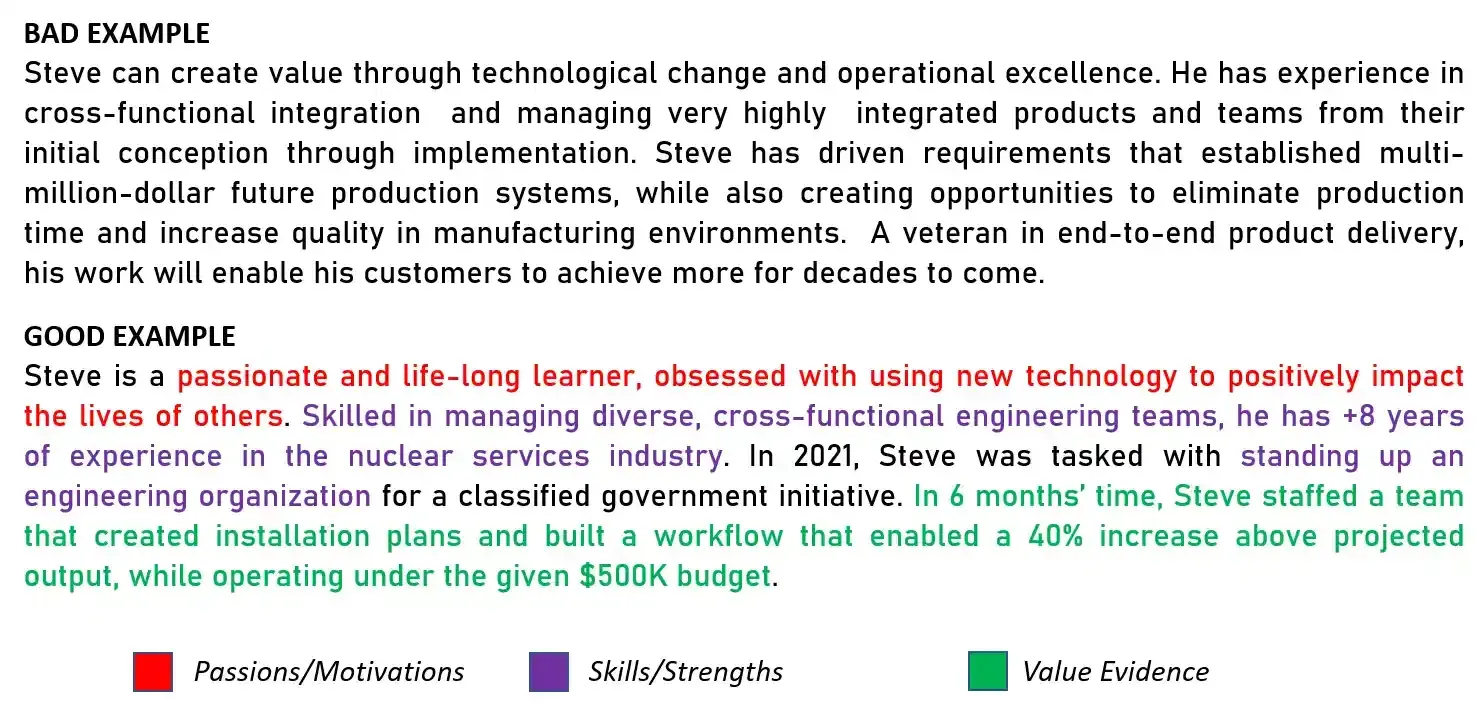

Steve is a passionate and life long learner obsessed with using new technology to positively respect the lives of others.

Now that you understand the concept, we encourage everyone to try writing their own version. At a minimum, a PBS is comprised of 3 sentences.


Here's what you need to do to create your own: 


  • Create 1 sentence describing what you’re passionate about. What motivates you to perform?
  • Create 1-2 sentences describing what you’re really good at. The skills someone would want to hire you for. 
  • Create 1-2 sentences discussing an example of when you combined Passions/Skills to create value and/or tangible results. We call this the hook, and the intent is to provide evidence to your audience/reader to read further (into a resume) or keep listening (as an interviewer).


Professional Woman Writing Drafts of Personal Brand Statement at Desk

As you write...


Don’t overthink the PBS structure; let it work for you and your audience. Your first draft can be very rough, and that's OK.


Additionally, we are typically customizing the PBS to appeal directly to a specific hiring audience (company/job role), be prepared to tweak this structure frequently.


 Happy writing! 


Adam Broda strategically coaches senior level professionals, Better Work is positioned to help.
By Adam Broda June 14, 2026
TL;DR The best career coach for a senior-level professional is not the one with the biggest marketing budget. It is the one with real executive-level experience, a clear methodology, and proof they have helped people at your level land roles. A coach is not a recruiter and not a resume writer. A coach builds your strategy, positioning, and decision-making. Know the difference before you pay anyone. Get clear on your own goals first. Target role, target industries, minimum compensation, timeline, and skill gaps. A coach can sharpen your direction, but they cannot want it for you. Screen for outcomes, not vibes. Ask for client results, success patterns, and references from people who looked like you when they started. Credentials and certifications are a minor signal at best. What matters is real senior-level hiring experience, so weight that far more heavily. Treat the chemistry call as a working session. You are evaluating fit, and a strong coach is evaluating your readiness too. Walk away from anyone who hides pricing, refuses references, or promises a guaranteed job. Those are red flags. Senior-level coaching is an investment. Run the math on return, not just the sticker price.
Career Coach Adam Broda Sitting Helping Client Tell Career Change Story
By Adam Broda May 14, 2026
Changing careers? Learn how to translate your experience, highlight transferable skills, and tell a clear story that makes you a lower-risk, high-value hire.
Career Coach Adam Broda Sharing Importance for Networking for Relationships with Coaching Clients
By Adam Broda April 14, 2026
Build a senior-level networking system that leads to stronger applications, better referrals, and more career momentum through intentional relationship-building.
Career Coach Adam Broda Describing Senor-Level Career Change Strategy
By Adam Broda March 28, 2026
Senior-level career change in 2026? Use Adam Broda’s 16-week strategy: ROI positioning, inevitable pivot narrative, build access, and upskill with AI literacy.
Top Career Coach Adam Broda goes over his career coaching program Better Work.
By Adam Broda March 14, 2026
2026 senior hiring is selective, not dead. Learn which industries still hire leaders—healthcare, manufacturing, finance, tech—and how to win. AI trends included.
Career Coach Adam Broda Discussing the 2026 Job Market
By Adam Broda February 28, 2026
2026 is a risk market for senior hires. Learn to win offers with relevance, measured impact, strategic networking, and AI leverage—plus a real client story.