
The Industries Still Hiring Senior Level Professionals in 2026
TL;DR
- 2026 job market: “Low-hire / low-fire” — senior hiring is more selective, not gone.
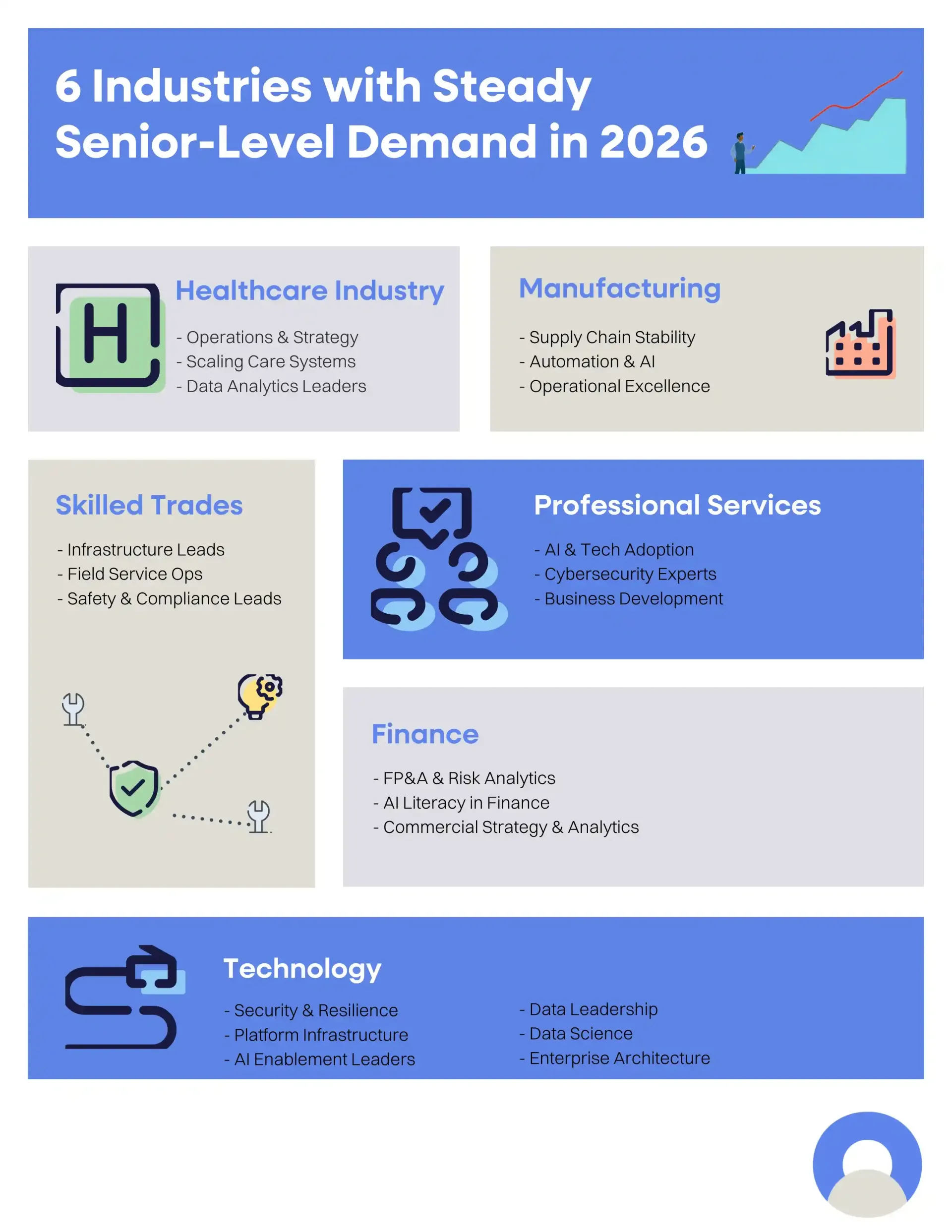
- Where hiring holds: Industries tied to durable, mission-critical problems (healthcare, manufacturing/supply chains, skilled trades, finance, infrastructure-heavy tech).
- Tech reality check: Job postings are down (~36% since early 2020), but computer & mathematical occupations are ~20% above pre-pandemic employment → structural rebalancing, not collapse.
- AI impact: AI is reshaping job titles; demand is strongest for leaders who can bridge business + technical, implement secure AI, and deliver measurable outcomes.
- Adam’s takeaway: Stop chasing hot industries. Start chasing durable problems — prove measurable impact, use networks/recruiters, and don’t rely on “apply and wait.”
Introduction
The broader job market in 2026 isn’t “crashing.”
But it
is changing.
Hiring is slower. Job postings are pickier. And senior-level interviews feel more surgical than they did during the post-pandemic peak.
That’s the bad news.
The good news is this:
Senior hiring hasn’t stopped; it’s just more selective.
Hiring didn’t disappear.
It concentrated.
In this blog, I’ll break down the industries still hiring senior-level professionals in 2026, why they’re holding steady demand, and what job seekers should do to compete in a market shaped by economic uncertainty, budget constraints, and structural rebalancing.
Executive Summary: 2026 Job Market Snapshot
Here’s the 2026 job market reality senior leaders need to internalize:
The 2026 job market is described as 'low-fire, low-hire', indicating a cautious approach to hiring among employers.
- Employers are prioritizing specialized expertise and risk reduction over “potential.”
- The tech hiring market has experienced a significant pullback, but that doesn’t mean tech is dead. It means structural rebalancing versus unsustainable growth.
- Certain sectors still show strong demand because the work is mission-critical and can’t pause.
One reason the “selectivity” feels so intense: AI is now being treated like an operating layer for businesses, and leadership is expected to drive measurable value, not hype. Gartner research cited by HBR notes that only 1 in 50 AI investments delivers transformational value, and only 1 in 5 delivers any measurable ROI. That’s why companies are hungry for leaders who can bridge technical and business needs, implement secure AI, and avoid expensive misfires. (HBR)
If your career strategy is still “apply and wait,” you’re competing in the smallest lane.
What are the Labor Market Signals, Labor Statistics, and Hiring Trends to Watch in 2026?
Most job seekers watch headlines.
Senior-level job seekers watch signals.
Here are the indicators I care about when I’m assessing the labor market and where job openings will concentrate:
1) Job Openings vs. Hires (the “selectivity” gap)
Job openings can exist while hiring stays slow. That’s what creates long interview loops, frozen reqs, and “we’re still evaluating candidates.”
This is why senior-level recruitment feels heavier in 2026.
2) Actual Employment vs. Job Postings
Job postings can fall while actual employment stays strong in certain categories.
Indeed reported a 36% decline in job postings since early 2020, while actual employment in computer and mathematical occupations remains nearly 20% higher than pre-pandemic levels. This is a sign that what we’re seeing is a correction from the post-pandemic peak, not a dramatic collapse. (Indeed)
3) AI Adoption Patterns
AI disruption is real, but it’s not evenly distributed.
Indeed Hiring Lab’s January 2026 update shows the market is mostly flat/declining — but jobs with AI mentions are bucking that trend. Their AI Tracker hit 4.2% in December 2025, and nearly 45% of data & analytics postings include AI-related terms (vs. ~15% in marketing and ~9% in HR). That tells you where the “pockets of growth” are. (Indeed Hiring Lab)
AI proficiency is required for senior roles across all sectors to drive efficiency.
4) Wage Growth and Salary Growth
Premium compensation is still on the table for leaders who can prove outcomes.
Broad-based wage growth isn’t the story of 2026. Selective salary growth is; for roles tied to market demand, risk reduction, and measurable outcomes.
Why the Industries Still Hiring Aren’t Always the Loudest Ones
Most people chase the industries making noise.
That’s not where stability comes from.
In 2026, some of the most durable employment opportunities show up in industries that:
- operate in long cycles (multi-year programs and capex).
- have backlogs (work already funded and scheduled).
- can’t pause operations because headlines changed.
Quiet industries often hire the steadiest.
And they matter because they build the infrastructure society relies on: healthcare, energy reliability, security, industrial capacity, and critical digital infrastructure.
Healthcare Workers and the Healthcare Industry: Steady Demand for Senior Roles
If you want one category that keeps showing up in high demand lists, it’s healthcare.
And it’s not complicated why:
- Care delivery complexity grows.
- An aging population increases utilization.
- System strain increases demand for leadership.
- Patient care doesn’t wait for the economy to recover.
- Digital health expansion increases operational and data requirements.
The healthcare and life sciences sector continues to hire leadership roles to manage sector growth and technological advancements in patient care.
Senior Healthcare Roles Hiring in 2026
You’ll see high demand for leaders across operations, clinical strategy, transformation, and analytics:
- Director / VP of Operations (hospital, clinic network, payer ops)
- Director of Clinical Programs
- Senior Program Manager (care delivery, access, workforce)
- Revenue Cycle / Billing Transformation leaders
- Quality, Safety, and Compliance leadership
- Data Analytics leaders supporting patient outcomes
Yes,
registered nurses remain a core backbone, but senior demand isn’t just clinical.
It’s also for leaders who can scale systems, reduce risk, and stabilize performance under pressure.
Certifications and Credibility Signals
At the senior level, certifications don’t replace experience.
But they can reduce perceived risk.
Think: leadership in compliance, quality, safety, and operational transformation.
Networking Channels for Healthcare Executives
For senior roles, don’t rely on job hunting through postings alone.
Instead:
- Target hospital system leaders and functional heads.
- Build warm introductions through professional associations.
- Connect with recruiters who specialize in health care leadership.
Because healthcare remains one of the clearest lanes for long-term demand and job security; if you position yourself as an operator who drives outcomes.
Manufacturing Industry: Senior Talent Still in Demand (especially in supply chains)
The manufacturing industry is still hiring, but it’s not the same hiring story as the 2021 job market.
This is a “do more with less” environment.
When costs rise, margins tighten, and supply chains stay volatile, companies invest in leaders who can:
- Improve operational efficiency.
- Stabilize production.
- Support supply chains.
- Reduce downtime and quality issues.
- Lead automation without breaking the business.
Senior Manufacturing Roles Hiring in 2026
- Plant Manager / Site Leader
- Director of Operations / Operational Excellence
- Supply Chain Director (planning, procurement, logistics)
- Quality Director
- Engineering / Maintenance leaders
- Program leaders for automation and modernization
In 2026, senior roles in manufacturing focus on automation and sustainability initiatives.
Automation and AI in Manufacturing Leadership
Artificial intelligence matters here, but not in a flashy way.
This is less about creative roles and more about:
- Predictive maintenance
- Forecasting
- Scheduling
- Quality inspection support
- Data analytics for throughput, yield, and cost
The senior leaders who win in this lane know how to translate data into decisions.
Specialized Engineering and Manufacturing Spotlight: Semiconductors
Semiconductors are a clean example of durable demand meeting a talent shortage.
The Semiconductor Industry Association projects the U.S. semiconductor workforce could see job growth by ~115,000 jobs by 2030, with a significant risk that many roles go unfilled without accelerated talent development. That’s a real driver of leadership demand; operators who can scale teams, build training pipelines, and deliver on capacity. (SIA)
Growing Demand for Senior Leaders of Skilled Trades
Skilled trades don’t get enough attention in senior career conversations.
But they should.
The work is tied to real-world infrastructure, and it’s harder to automate or outsource. That’s why trades leadership can be one of the more durable paths for job security in 2026.
Senior-level opportunities show up as:
- Regional field leadership.
- Service operations leadership.
- Safety and compliance leads.
- Construction project leadership.
- Maintenance leadership in industrial environments.
For many job seekers, trades leadership is a strong pivot lane if you have transferable skills in operations, people leadership, and execution.
As automation increases, these types of roles requiring specialized human judgment and human connection become more valuable; especially in safety-critical environments.
Professional Services: Hiring for Senior Staff and Specialized Expertise
Professional services firms still hire in 2026 for one main reason:
When companies don’t know what to do next, they hire advisors.
But senior hiring in consulting is also more selective.
It concentrates around leaders who can:
- Sell (business development)
- Deliver (execution)
- Specialize (industry + functional expertise)
High demand exists for AI specialists, data scientists, and cybersecurity experts to manage digital transformation.
In Demand Senior Job Titles in Professional Services
- Partner-track leaders.
- GTM / Revenue leaders in B2B advisory.
- Senior Manager / Director (Transformation, Ops, Strategy).
- Practice leads in AI adoption, data analytics, supply chains, and compliance.
The winners here tend to sit at the intersection of specialized expertise and human connection, emotional intelligence, stakeholder alignment, and the ability to translate complex insights into compelling narratives.
Finance: Job Openings for Senior Accountants, FP&A, and Risk Analytics
Finance is one of the most overlooked “still hiring” categories for senior-level professionals.
Robert Half’s 2026 analysis highlights persistent shortages in accounting talent and skills gaps in areas like AI literacy and data analytics, while finance leaders prioritize roles tied to forecasting, controls, and data-driven decision-making. They also note senior accountant and staff accountant among the top roles shaping 2026 hiring strategies, and that employers are using highly skilled contract talent to stay flexible. (Robert Half)
In plain terms: finance leaders are hiring for roles that blend commercial strategy with analytics — and for senior professionals who can move the organization from intuition-based decisions to measurable performance.
The Tech Hiring Market: Senior-Level Job Titles Still Hiring (Infrastructure > “Nice-to-Have” Product Work)
Let’s be honest:
Tech hiring has changed.
There was a post pandemic peak.
Then a significant pullback.
And now we’re watching the market stabilize at something closer to “normal.”
That’s not a dramatic collapse.
It’s a correction after unsustainable growth.
And the signal I want you to notice is this:
Some tech categories may be down in job postings, but actual employment in key areas can remain meaningfully above pre pandemic levels. That’s why “tech is dead” is a lazy take.
Where Senior-Level Tech Demand Shows Up in 2026
Think: foundational systems, security, and revenue-critical infrastructure.
- Security leadership (risk and resilience)
- Platform / Infrastructure leadership
- Data leadership (analytics, governance, measurement)
- AI enablement leaders (responsible adoption, workflow integration)
- Enterprise architecture
Senior-Level Tech Job Titles to Watch
If you’re targeting career advancement in tech, the safest senior lanes often map to:
- Solution Architect
- Data Scientist (especially applied / business-facing)
- Full stack developer / stack developer (for revenue-critical systems)
- Head of Data / Analytics
- Security Program Leader
- Engineering Manager (platform / infrastructure)
Again: this isn’t about chasing hype.
It’s about focusing on jobs tied to critical systems.
My Amazon Lesson: Why Execution Beats “Perfect Fit” in Senior Hiring
When I joined Amazon in 2020, I joined a new internal business that was hiring fast.
And here’s what surprised me:
A big chunk of the early leadership hires weren’t “perfect background matches.”
They were strong operators.
Many of the L7 leaders brought in during the first waves were Program Managers, even if they’d come from totally different lanes.
Not because the bar was lower.
Because the business needed leaders who could:
- Build structure fast.
- Align stakeholders.
- Create clean reporting.
- Deliver outcomes with limited time and messy inputs.
That moment taught me something I’ve seen again and again since:
When the work is important and the timeline is real, companies hire leaders who can execute, not leaders who can look the part.
That’s why certain industries keep hiring senior talent even when the broader job market cools.
Where Job Openings Concentrate in 2026 Job Opportunities
Senior job openings concentrate where the work is:
- Regulated, mission-critical, or safety-critical.
- Tied to long-term funding cycles.
- Operationally complex.
- Connected to infrastructure and resilience.
You’ll also see more contract and fractional senior openings in areas like:
- Interim operations leadership.
- Transformation leadership.
- Program leadership.
- Change management.
- AI adoption enablement.
This is one reason the hidden market keeps growing.
What Senior-Level Job Seekers Should Realize in 2026
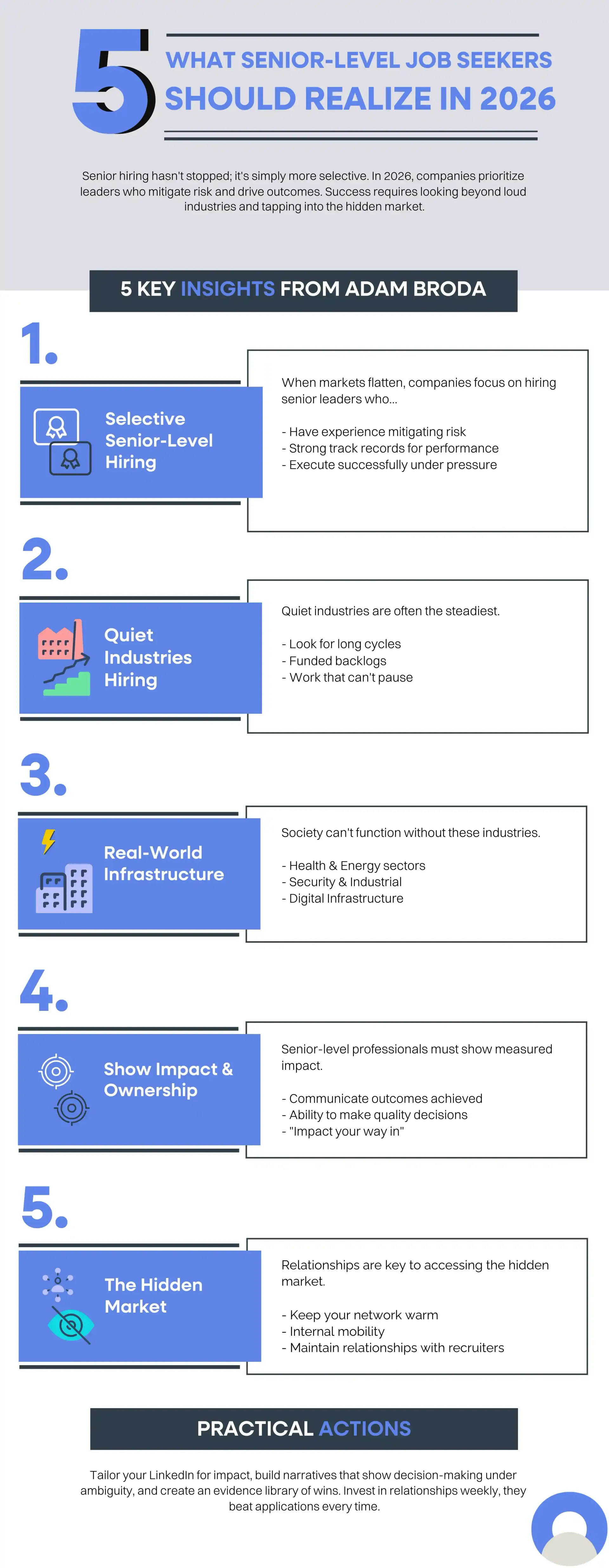
Here are the five points I want senior-level job seekers to internalize:
1) Senior Hiring Hasn’t Stopped: It’s Just More Selective
When markets flatten, companies don’t hire “nice to have” leaders.
They hire leaders with a track record of mitigating risk.
Hiring didn’t disappear; it concentrated.
2) The Industries Still Hiring aren’t Always the Loudest Ones
Look for long cycles, funded backlogs, and work that can’t pause.
Quiet industries often hire the steadiest.
3) “Why These Industries Matter” = They Build Real-World Infrastructure
Health outcomes. Energy reliability. Security. Industrial capacity. Digital infrastructure.
These sectors matter because society can’t function without them.
4) Your Positioning Needs Measured Impact & Ownership
At senior levels, you’re not hired for credentials.
You’re hired for outcomes, decision quality, and cross-functional execution.
You can’t “title your way” into a senior role. You have to “impact your way” in.
5) The Hidden Market is Bigger Than Most People Think
Warm networks. Internal mobility. Recruiter sourcing. Contract-to-hire lanes.
If your strategy is still “apply and wait,” you’re competing in the smallest lane.
Practical Actions (Non-Negotiables)
- Tailor your resume and optimize your LinkedIn profile to show measurable impact and scope (team size, budget, complexity).
- Build executive-level interview narratives that emphasize decision-making under ambiguity.
- Create a simple evidence library: wins, metrics, before/after, stakeholder stories.
- Invest in relationships weekly (not when you panic).
Relationships still beat applications.
Senior Compensation and Negotiation Trends: Beyond Base Salary
In 2026, negotiation isn’t just about base pay.
Senior comp structures still include:
- bonus
- equity (when available)
- sign-on / make-whole
- severance protections
- remote work flexibility (when possible)
- title and scope alignment
- budget and headcount commitments
If you’re in a lane with steady demand and specialized skills, you can still secure premium compensation.
But the strongest leverage comes from proof of market demand:
your results, your scarcity, and your ability to reduce risk.
How Employers Source Senior Candidates in 2026
Here’s what I see consistently:
- Executive search is active but selective.
- Internal promotion is common for leadership roles.
- Recruiters source “low-risk” hires who already look like they’ve done the job.
That means your job is to look like the safest bet.
Not by being generic.
By being specific.
Industry + function + outcomes.
Monitoring Job Openings and Market Signals
Set a cadence.
Weekly:
- Scan job openings and posting frequency in your target job titles.
- Track which companies repost roles (signal of churn or difficulty filling).
- Track recruiter activity and outreach trends.
Monthly:
- Reassess your target list based on demand momentum.
- Build 5–10 new relationships aligned to your target lane.
Consistency beats intensity.
FAQ
1) Is senior hiring actually down in 2026?
It’s not “down everywhere.” The 2026 job market is low-hire / low-fire, which means employers are hiring more selectively and moving slower. Senior hiring didn’t disappear, it concentrated in industries where the work is mission-critical.
2) What are the industries still hiring senior level professionals in 2026?
The most durable senior demand shows up in:
- Healthcare / life sciences
- Manufacturing + supply chains (including semiconductors)
- Skilled trades / infrastructure operations
- Finance (FP&A, risk analytics, compliance tech)
- Infrastructure-heavy tech (security, platform, data, AI enablement)
3) Why do these industries matter more than “hot” industries?
Because they support real-world infrastructure: patient care, energy reliability, security, industrial capacity, and critical digital systems. These sectors can’t “pause” when headlines change.
4) Is the tech hiring market dead?
No. Tech is experiencing structural rebalancing after the post-pandemic peak. Postings are down, but employment in key technical categories can still remain elevated, especially in roles tied to infrastructure and risk.
5) What senior tech roles are still in demand?
The most resilient lanes tend to be:
- Cybersecurity / security leadership
- Platform / infrastructure leadership
- Data leadership (analytics, governance, measurement)
- AI enablement (secure adoption and workflow integration)
- Enterprise architecture
- Common titles: Solution Architect, Data Scientist, Head of Data/Analytics, Security Program Leader, Engineering Manager (platform).
6) How is AI changing senior hiring?
Companies want leaders who can bridge business + technical needs, implement secure AI, and deliver measurable outcomes (not hype). That’s why AI fluency, governance, and performance measurement are becoming increasingly important even outside “tech” roles.
7) What senior roles are strongest in healthcare?
Senior-level demand is concentrated in leadership roles that stabilize and scale patient care systems:
- Operations leaders (hospital, clinic, payer ops).
- Clinical program leadership.
- Revenue cycle / billing transformation.
- Quality, safety, and compliance.
- Data analytics leaders tied to outcomes.
8) Why are manufacturing and supply chains still hiring senior leaders?
Because volatility and cost pressure require leaders who can drive operational efficiency, improve throughput, and reduce risk. Automation and sustainability initiatives also increase demand for experienced operators.
9) What’s the best strategy for senior job seekers in 2026?
Stop relying on “apply and wait.” The strongest strategy is:
Position around measurable impact + ownership.
Target roles tied to revenue, risk, resilience, or regulated outcomes.
Build relationships weekly (recruiters + warm networks).
Maintain an evidence library (metrics, wins, before/after stories).
10) Where do most senior-level job opportunities come from right now?
A large portion comes from the “hidden market”:
- Warm networks
- Internal mobility
- Recruiter sourcing for low-risk hires
- Contract/fractional lanes that convert to full-time
11) How should I “prove” I’m a low-risk hire at the senior level?
Lead with outcomes and decision quality:
- Scope (budget, headcount, scale)
- Measurable results (growth, cost reduction, risk reduction)
- Cross-functional execution
- Clarity under ambiguity
If you can’t quantify it, document it.
Final Recommendations for Senior-Level Job Seekers in 2026
I’ll leave you with the main takeaway:
Stop chasing “hot industries.” Start chasing “durable problems.”
If an industry has:
- Regulation, risk, safety, or security pressure.
- Long-term funding cycles.
- Real operational complexity
…it will keep hiring senior leaders.
Your job is to position yourself like one:
- Show measured impact.
- Show decision-making.
- Show how you reduce risk and drive outcomes.
That’s what still wins in 2026.
If you're looking to find your next senior-level role, apply to work with me.
Sources
- U.S. Bureau of Labor Statistics (BLS). Job Openings and Labor Turnover Survey (JOLTS): Job Openings and Labor Turnover – December 2025 (published 2026).
- U.S. Bureau of Labor Statistics (BLS). JOLTS Table A: Job openings, hires, and total separations by industry (updated through Dec. 2025 preliminary).
- Indeed Career Advice. The Best Jobs in the US for 2026, According to Indeed (Jan 2026).
- Indeed Hiring Lab. Indeed’s 2026 US Jobs & Hiring Trends Report (Nov 2025).
- Indeed Hiring Lab. January 2026 US Labor Market Update: Jobs mentioning AI are growing amid broader hiring weakness (Jan 2026).
- LinkedIn Economic Graph. Labor Market Report: Building a Future of Work That Works (Jan 2026).
- LinkedIn News. LinkedIn Jobs on the Rise 2026: The 25 fastest-growing roles in the U.S. (Jan 2026).
- World Economic Forum. The Future of Jobs Report 2025 (Jan 2025).