
How to Tell Your Story When You’re Changing Careers
TL;DR
- Changing careers isn’t starting over. It’s repositioning the value you already have.
- Your career story should connect your past experience to the new role in a way hiring teams can quickly understand.
- Don’t lead with hopes, dreams, or apologies. Lead with actions, results, and transferable skills.
- Use clear language to explain what you actually did, the problems you solved, and the outcomes you created.
- Build your story around context, challenge, action, result, and future direction.
- Avoid sounding defensive or constantly emphasizing that you’re “new” to the field.
- Tailor the same core story for networking, interviews, LinkedIn, and your resume.
- The goal is simple: show the hiring team why your past experience makes you a lower-risk, high-value fit for the new role.
Introduction
Changing careers can feel complicated.
Not because you lack experience.
But because most people struggle to explain how their old career connects to their new career.
That’s the real challenge.
You may have the skills.
You may have the accomplishments.
You may have the leadership experience.
You may have the work ethic, knowledge, and confidence to do the job.
But if the hiring team can’t understand your career story, they may not realize why you’re a good fit.
This is where storytelling matters.
Not the dramatic kind.
The clear kind.
The kind that helps a recruiter, interviewer, colleague, or hiring manager hear your past experience and immediately understand how it applies to the new role.
Because when you’re changing careers, your responsibility is not to explain every detail from your past.
Your responsibility is to translate the value.
A strong career story is not just a timeline of job changes.
It should help people understand your values, your decisions, your accomplishments, and the direction you’re moving next.
That matters in interviews.
It matters in networking conversations.
And it matters when someone is trying to explain your background to another person after the conversation ends.
Why Your Career Story Matters During A Career Change
Career changers often worry they need to justify the transition.
They’ll say things like:
“I know I don’t have direct experience.”
“I’m trying to break into the industry.”
“I’m new to this world.”
“I’m hoping someone will take a chance on me.”
I get why people say this.
But I wouldn’t lead there.
That language puts the focus on risk.
The same thing happens when career changers spend too much time talking about hopes and dreams.
I’m all for ambition.
But in a hiring conversation, your future goals need to be supported by past actions and results.
The hiring team doesn’t just want to hear what you hope to become.
They want to understand what you’ve already done that makes the next step believable.
Instead, the goal is to help employers understand what you bring with you.
Your career story should connect your past roles to your future goals. It should demonstrate why your experience matters, even if it came from one industry and you’re now targeting another.
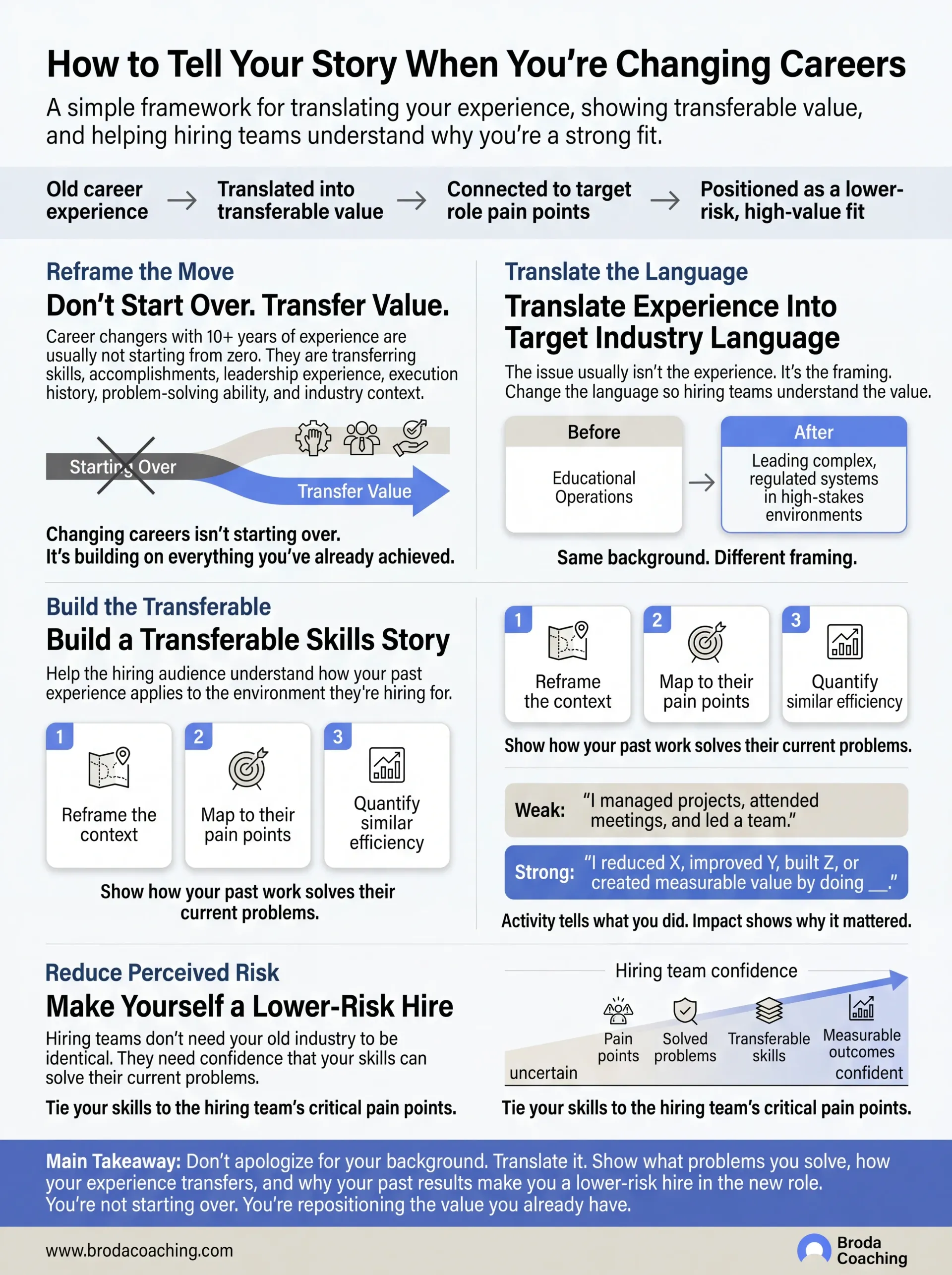
Changing careers isn’t starting over.
It’s building on everything you’ve already achieved.
That’s the point most career changers miss.
You’re not deleting the old career.
You’re repositioning it.
Don’t Frame The Career Change As Starting Over
If you have 10+ years of experience, you’re usually not starting from zero.
You’re transferring.
That’s why I’d be careful with how often you use words like “change” or “transition” when you’re talking to employers.
Those words are not bad.
But if every other sentence reminds the listener that you’re changing careers, you may accidentally train them to see you as less experienced than you really are.
At some point, the conversation needs to move from the transition to the value.
You’re transferring:
- skills
- accomplishments
- leadership experience
- execution history
- problem-solving ability
- industry context
The mistake is describing your past work too literally.
For example, someone might say:
“I worked in educational operations.”
That might be true.
But it may not help a hiring manager in learning technology, product management, operations, or program management understand the value.
A stronger version might be:
“I led complex, regulated systems in high-stakes environments.”
Same background.
Different framing.
That’s the shift.
You’re not changing the facts.
You’re changing the language so the target audience can understand why your experience is relevant.
My Career Story: Moving From Aerospace Into Big Tech
When I moved from aerospace into Big Tech, I had to learn this myself.
If I described my background too literally, it sounded like I belonged in aerospace.
But when I translated the work into business language, the story changed.
I wasn’t just managing aerospace engineers.
I was building zero-to-one systems designed to operate in resource-constrained environments.
That mattered because Big Tech teams also need leaders who can create structure, build processes, and operate through ambiguity.
That was the transferable skill story.
Not:
“I came from aerospace.”
But:
“I know how to build systems, lead teams, and create process where none exists.”
That language helped connect the past to the future.
And that’s what career changers need to do.
How Career Changers Can Tell Your Career Story Clearly
Here’s a simple framework I’d use.
Use a structure that covers:
- context
- challenge
- action
- result
- future direction
Where were you?
What problem were you solving?
What did you do?
What changed because of your work?
How does that connect to the role you want next?
That’s enough.
You don’t need complicated language.
In fact, the clearer the language, the easier it is for the listener to understand your story, remember it, and repeat it to someone else.
1. Reframe The Context
Start by looking at your old career and asking:
What was I really doing?
Not the title.
Not the industry label.
The actual work.
Were you creating structure?
Solving messy problems?
Managing stakeholders?
Developing systems?
Leading change?
Improving efficiency?
Building trust with customers?
Turning chaos into process?
That’s the story.
For example:
Instead of:
“I managed a small team in aerospace.”
Try:
“I built operating systems for technical teams working under tight constraints.”
Instead of:
“I worked in education.”
Try:
“I led complex programs across regulated environments with multiple stakeholder groups.”
Instead of:
“I worked in customer support.”
Try:
“I identified recurring customer pain points and improved processes that reduced friction for users.”
The more clearly you can describe the real work, the easier it is for employers to understand the transition.
2. Map Your Skills To The New Role
Once you reframe the context, map your experience to the target role.
This is where a career change becomes much easier to explain.
If you’re interested in product management, don’t just say:
“I want to become a product manager.”
Explain what already connects.
Maybe you’ve worked with customers.
Maybe you’ve led cross-functional projects.
Maybe you’ve gathered requirements.
Maybe you’ve influenced technical teams.
Maybe you’ve helped launch a first project, internal tool, or process improvement.
Those things matter.
This is also where upskilling can help.
If you’ve taken a course, earned a certification, completed a personal project, joined a professional group, or built something relevant to the new field, mention it.
Not as the main story.
As supporting evidence.
It shows you’re not just interested in the new direction.
You’re already taking action.
The hiring team needs to hear how your past work connects to the new role.
A simple way to say it:
“My background is in operations, but the common thread has been identifying user pain points, building cross-functional solutions, and improving business outcomes. That’s why I’m now focused on product management.”
That’s a clear story.
It connects past experience to future direction.
3. Quantify Similar Efficiency
Hiring teams pay for efficiency.
They want people who can create value, reduce risk, and solve problems faster.
So when possible, quantify the impact.
Instead of saying:
“I improved a process.”
Say:
“I improved a manual process that reduced turnaround time by 30%.”
Instead of:
“I led a team project.”
Say:
“I led a 6-person team that delivered the project three weeks ahead of schedule.”
Instead of:
“I helped with customer issues.”
Say:
“I identified the top three customer pain points and helped reduce repeat support tickets by 18%.”
Measured impact builds confidence.
It gives the interviewer something specific to remember.
It also helps reduce perceived risk, which is especially important when you’re changing careers.
Lead With Impact, Not Activity
A lot of career changers explain their experience like this:
“I managed projects, attended meetings, worked with stakeholders, and led a team.”
That’s activity.
It tells me what you did.
But it doesn’t tell me why it mattered.
This is also where many career changers lose the thread.
They explain the emotion behind the move.
They explain the dream.
They explain why they’re excited.
But they don’t explain the evidence.
Excitement is fine.
Evidence is better.
A stronger answer leads with impact.
“I reduced implementation delays by 25% by rebuilding the intake process and creating a weekly stakeholder review.”
That tells me:
- what changed
- how you created value
- why the work mattered
- where your skills transfer
This applies to resumes, LinkedIn, interviews, networking conversations, and your 30-second elevator pitch.
The more senior you are, the more this matters.
At higher levels, hiring teams are not just buying your task list.
They’re buying judgment, execution, communication, leadership, and business outcomes.
How To Tell Your Career Story In Interviews
In interviews, especially when someone says “tell me about yourself,” you don’t need to walk through your entire life.
You need a focused transition.
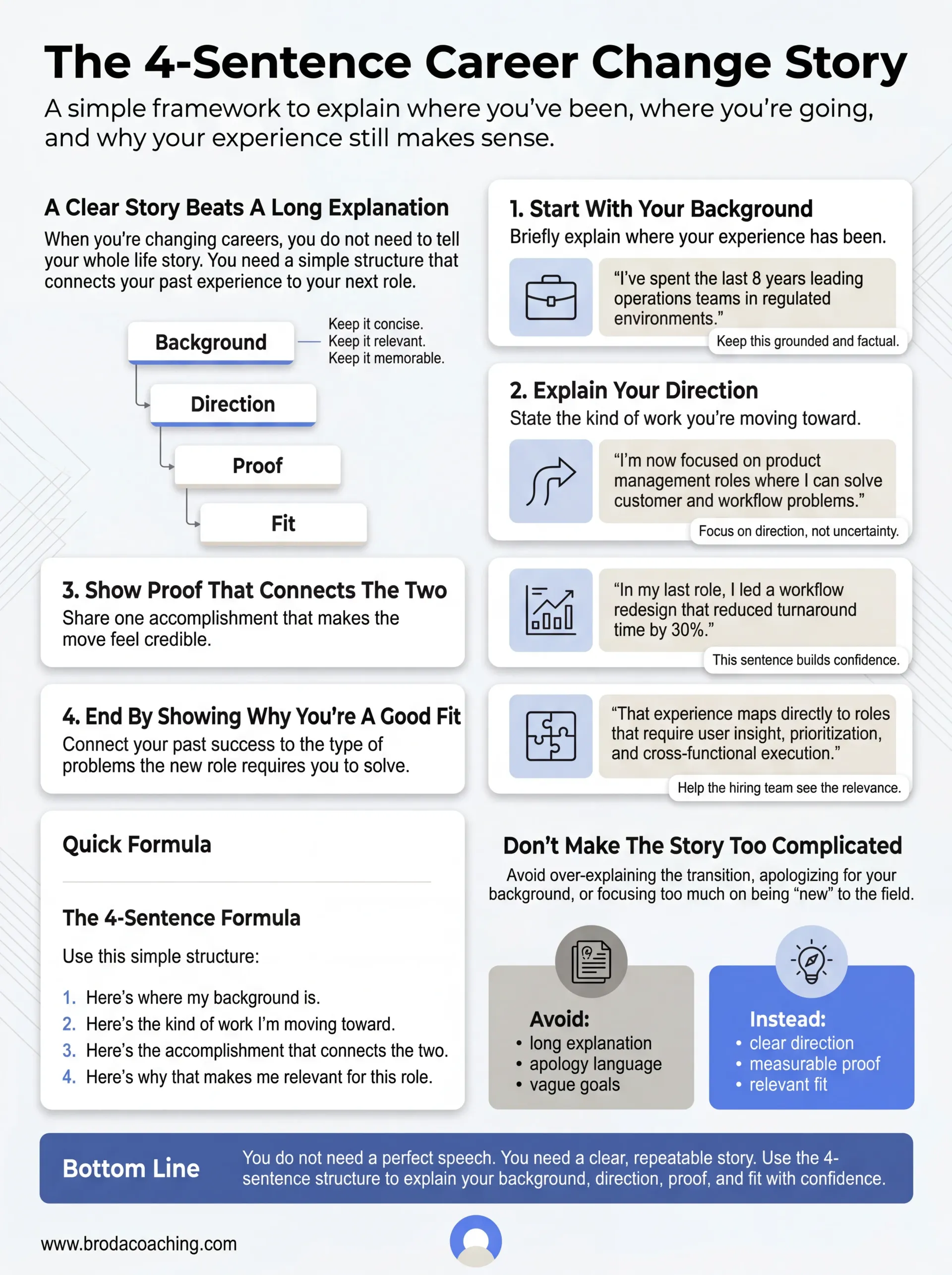
A simple four-sentence structure can help:
- Here’s where my background is.
- Here’s the kind of work I’m moving toward.
- Here’s the accomplishment that connects the two.
- Here’s why that makes me relevant for this role.
That structure keeps the answer short.
It also helps you avoid rambling, over-explaining, or sounding defensive.
Here’s a structure I like:
- Start with your current focus or role.
- Briefly explain your career goal.
- Connect your past accomplishments to the new role.
- End by showing why you’re a good fit.
Example:
“I’ve spent the last eight years leading operations teams in regulated environments, where my work focused on building systems, improving processes, and managing cross-functional execution. Over time, I realized the work I enjoyed most was solving customer and business problems through better tools and scalable systems, which is why I’m now focused on product management. In my last role, I led a workflow redesign that reduced turnaround time by 30%, and I see a strong connection between that work and the product manager role here, especially around user pain points, prioritization, and cross-functional delivery.”
That answer works because it gives enough detail without over-explaining.
It has a clear story.
It shows direction.
It explains relevance.
And it helps the interviewer understand the move.
Check out my blog post on giving great interview answers to get a leg up.
How To Position Yourself As A Good Fit
Career changers often feel like they need to prove they belong.
I’d think about it differently.
Your job is to show the hiring team that you understand their pain and have solved similar problems before.
Hiring teams don’t need your old industry to be identical.
They need confidence that your skills can solve their current problems.
And that confidence usually comes from transferable strengths.
Leadership.
Problem-solving.
Communication.
Systems thinking.
Stakeholder management.
Execution.
Those skills matter across industries.
Your job is to show how they have already created value in your past work, then connect them to the problems in the new role.
That means you need to study the target role.
Read job descriptions.
Look for repeated language.
Pay attention to the problems they mention.
Are they looking for someone who can scale systems?
Improve customer experience?
Build operational rhythm?
Influence without authority?
Develop processes?
Lead ambiguous projects?
Create measurable outcomes?
Once you figure that out, connect your experience to those needs.
That’s how you become more memorable.
Not by saying:
“I’m passionate and curious.”
Those are fine qualities.
But they’re not enough.
Say:
“I’ve done similar work in a different environment, and here’s the result.”
That’s stronger.
Story Types For Career Changers
Not every career changer is in the same moment.
Some people know exactly where they’re going.
Some are still figuring it out.
The story should match the stage.
Exploratory Career Story
Use this if you’re still undecided.
The key is to frame exploration as deliberate learning.
Example:
“I’m exploring a move from operations into product-focused roles because I’ve consistently enjoyed work that involves customer problems, process design, and cross-functional execution. I’m currently speaking with people in product management to better understand where my background is most relevant.”
That sounds thoughtful.
Not scattered.
It also invites advice, conversation, and informational meetings.
Focused Career Story
Use this if you know your target.
Example:
“I’m moving from operations into product management, with a focus on internal tools and workflow automation. My background is in leading process improvements across cross-functional teams, and my most recent project reduced manual review time by 30%. I’m now looking for a product role where I can apply that same problem-solving approach to building better systems for users.”
That’s clear.
It names the new career direction.
It gives a relevant project.
It explains fit.
Staying Or Growth Story
Not everyone is changing careers.
Some people are staying in the same field but want a new challenge.
That story might sound like:
“I’m not looking to leave the industry, but I am looking for a role with more ownership, broader scope, and more strategic responsibility. My focus is on finding a team where I can keep building systems, developing people, and solving higher-impact business problems.”
That works because it explains growth without sounding negative.
Tactics To Tell Your Career Story In Different Settings
Your career story should change slightly depending on the setting.
Not the truth.
The length and tone.
The core narrative should stay consistent.
But the emphasis should shift based on the audience.
A recruiter may need a quick fit summary.
A hiring manager may need proof of impact.
A networking contact may need enough context to understand who they should introduce you to.
Same story.
Different angle.
Networking Conversations
Keep it short.
Open with a one-line pitch.
Example:
“I’m moving from operations into product management, and I’m trying to learn from people who’ve made similar moves or work closely with product teams.”
Then ask for a small next step:
“Would you be open to a 15-minute conversation?”
After the conversation, follow up with a tailored thank-you message.
Mention something specific they said.
Keep the relationship warm.
Interviews
For interviews, practice telling your story in 60–90 seconds.
Not 5 minutes.
Not your full biography.
A focused version.
Then prepare two concise impact anecdotes.
One should show transferable skills.
One should show measurable impact.
For example:
- a project where you created structure from ambiguity
- a moment where you led a team through change
- a time you solved a customer or business problem
- an accomplishment that mirrors the new role
Use the STAR method if it helps.
But don’t let the framework make you robotic.
The goal is to speak clearly and confidently.
LinkedIn And Resume
Your LinkedIn and CV should support the same story.
That means your headline, summary, and resume bullets should point toward the new role.
For LinkedIn:
Use a headline that signals your new focus.
For your resume:
Tailor bullets to the target role.
For your summary:
Briefly explain your career direction without apologizing.
Example:
“Operations leader moving into product management, with experience building scalable processes, leading cross-functional teams, and improving user-facing workflows.”
That’s simple.
It tells people where you’ve been, where you’re going, and why the connection makes sense.
Check out my blog post on the best LinkedIn Profile Optimization techniques to take your LinkedIn to the next level.
Mistakes Career Changers Make When Changing Careers
Here are a few things I’d avoid.
1. Over-Explaining Personal Reasons
You don’t need to share every life detail.
Family changes. Burnout. Bad bosses. Frustration. Personal struggle.
Some of that may be true.
But the interviewer doesn’t need all of it.
This doesn’t mean you need to hide your life.
It means you need to decide what belongs in the professional story and what belongs in a private conversation with a trusted person.
Pick one or two people who can hear the full version.
Everyone else gets the focused version.
Keep the focus on the professional move.
2. Apologizing For The Career Change
Avoid phrases like:
“I know I don’t have the normal background.”
“I’m sorry if this is a weird transition.”
“I realize I’m not the obvious fit.”
That weakens the story.
Don’t apologize.
Translate.
3. Getting Defensive
Sometimes career changers get defensive without realizing it.
They over-explain.
They justify every decision.
They sound frustrated about their old industry, old boss, or old company.
I’d avoid that.
Stay calm.
Keep the story positive.
You don’t need to convince someone your past was bad.
You need to show them why your next move makes sense.
4. Emphasizing Newbie Status
You may be new to the industry.
But you are not new to work.
You are not new to solving problems.
You are not new to creating value.
So don’t introduce yourself like a beginner if your experience says otherwise.
Avoid constantly reminding the listener that you’re new.
Say less about being “new to the field.”
Say more about the relevant problems you’ve already solved.
5. Dwelling On Unrelated Past Roles
Some details from the past may not matter anymore.
That’s okay.
You don’t need to bring every chapter with you.
Pick the most relevant accomplishments and connect them to the new role.
Practice Telling Your Career Story
You probably won’t get this right in your head.
You need to practice.
Write the 30-second version.
Say it out loud.
Record yourself.
Practice with a trusted contact.
It can also help to create a holding line.
Something simple you can say when you don’t want to go into more detail.
For example:
“I’m exploring a move into roles where I can use my operations background to solve more product and customer problems. I’m still being thoughtful about the right fit, but that’s the direction I’m focused on.”
That kind of answer keeps you in control of the conversation.
It gives people enough context without forcing you to share plans before they’re ready.
Notice where you ramble.
Notice where you sound unsure.
Notice where the story gets interesting.
Then tighten it.
The more you practice telling your career story, the more natural it becomes.
And when it becomes natural, you’ll have more confidence in networking conversations, recruiter calls, interviews, and casual moments where someone asks:
“So, what are you looking to do next?”
And if the story still feels hard to say out loud, go create something concrete.
Take the course.
Build the project.
Write the case study.
Volunteer for the adjacent work.
Many career changers find it easier to talk about the new path once they have a specific project or outcome to point to.
A concrete example gives the story weight.
You want to be ready for that question.
Not with a perfect speech.
With a clear answer.
Final Point: You’re Not Starting Over
If you’re changing careers, don’t apologize for your background.
Translate it.
Show the hiring team what problems you solve, how your experience transfers, and why your past results make you a lower-risk hire in the new role.
You’re not starting over.
You’re repositioning the value you already have.
That’s the idea.
And once you understand that, your career story gets a lot easier to tell.
Ready To Tell A Stronger Career Story?
If you’re changing careers and struggling to explain your value, you don’t have to figure it out alone.
The right story can change how recruiters, hiring managers, and interviewers understand your background.
Not by exaggerating your experience.
But by translating it clearly.
If you’re ready to reposition your career story, build stronger materials, and create a job search strategy that helps you move toward better work…