
Relationships > Applications: The Senior-Level Networking System That Actually Works
TL;DR
The senior-level networking system that actually works is not random outreach. It is a targeted process that helps you build relevant relationships, gather better information, and submit stronger, more informed applications.
Here are the five key points I’d use to build that system:
- Build a target-company relationship map before you start applying.
- Use content and thoughtful engagement to warm up relationships before the ask.
- Lead with relevance, not introductions.
- Make it easy for people to help you.
- Turn every networking conversation into better application material.
Introduction: Building Relationships With Purpose
Over the years, I’ve seen a clear pattern with senior-level job seekers: the ones who network strategically tend to apply better, not just more.
They’re not sending the same resume everywhere.
They’re using conversations to understand the team, the business problem, and the language that matters most to the hiring audience.
I’ve also seen this from the hiring side.
The candidates who stand out are often the ones who have already done the work to understand the environment they’re stepping into. Sometimes that comes through a referral. Sometimes it comes through how tailored and relevant their application is. Either way, relationships often improve the quality of the application before it is ever reviewed.
That’s why I encourage senior-level professionals to stop thinking about networking as a side activity. When done well, it becomes one of the best tools for building stronger applications, creating warmer entry points, and positioning yourself as a more credible, lower-risk hire.
For senior leaders, senior executives, and mid career professionals, professional networking is not about collecting names.
It is about building relationships that create better access, better information, and better timing.
That is the purpose of this post.
To show you how to treat networking like a real system.
One that helps job seekers convert conversations into stronger applications.
The Job Market Reality: Why Relationships Beat Random Outreach
Today’s job market is crowded.
At the senior level, companies can afford to be selective. They are not only looking for capability. They are looking for relevance, judgment, and lower-risk hires.
That is why relationships matter.
Referrals and networking continue to play a meaningful role in hiring, especially for senior-level roles where trust, context, and relevance matter.
A cold application may show experience.
A strong network can show context.
And context opens doors.
At the senior level, many roles are filled through warm introductions and referrals passed through intermediaries, long before the broader applicant pool gets serious attention. In many cases, that means strong candidates are entering the conversation without having to fight through the most competitive part of the application process.
Random outreach usually creates random results. A targeted process creates career momentum.
It helps senior-level professionals identify specific companies, connect with the right decision makers, and learn what the team actually values before hitting apply.
This is where effective networking starts to separate itself from generic professional connections.
The goal is not to meet everyone.
The goal is to build meaningful professional relationships with the right people.
Start With Your Existing Network
Before you go searching for new contacts, start with your existing network.
Most professionals already know more relevant people than they realize.
Former managers. Mentors. Recruiters. Peers. Skip-level leaders. Former clients. Other professionals in adjacent functions. People from industry events. People you met during coffee chats. Even casual interactions from real life can matter later if you remember key details and follow up well.
Start with a simple audit.
Ask yourself:
- Who already works at my target companies?
- Who has worked with senior leaders in my target industry?
- Who knows key decision makers?
- Who has visibility into the kind of business opportunities I want?
- Who is well connected to executives or industry leaders?
Then prioritize those contacts by relevance and influence.
Not every name in your address book deserves the same amount of attention.
Some people are closer to decision makers.
Some understand your job titles and target function.
Some can offer valuable insights that improve how you position yourself.
That is where personal networking becomes strategic.

How to Network Effectively: Career Coach Adam Broda’s 5 Key Points
1) Build a target-company relationship map before you start applying
Senior-level networking works best when it is narrow and intentional.
Start by identifying a list of specific companies.
Then map the people connected to those opportunities:
- hiring managers
- recruiters
- peers in similar functions
- skip-level leaders
- second-degree connections
This gives your network structure.
It also gives every outreach message a reason.
Instead of trying to be attractive to the entire market, focus on a smaller list of companies where your background actually fits.
That is a better use of time.
And it usually leads to
stronger connections.
2) Use content and thoughtful engagement to warm up relationships before the ask
One of the easiest ways to reduce friction is to stop showing up cold.
Follow target-company leaders and thought leaders on platforms like LinkedIn.
Read the relevant article they share.
Engage with posts using short, thoughtful comments.
Share insights when you have something useful to add.
Senior-level professionals do not need to become full-time content creators.
But thoughtful engagement on social platforms can help you become familiar before you ever send a direct message.
Credibility often starts before the first DM.
This is one of the most overlooked parts of relationship building.
3) Lead with relevance, not introductions
Too many networking messages sound the same.
“Would love to connect.”
“Wanted to introduce myself.”
“Would appreciate any advice.”
That is not enough.
Effective networking starts with relevance.
Show the person why the conversation matters to them.
Maybe you share an industry background.
Maybe you solve a problem their team is dealing with.
Maybe you have experience in a similar environment.
Maybe you were introduced through shared interests or mutual contacts.
Lead with that.
A good first message should tell someone why you are worth replying to.
Not because you need help.
Because the conversation is actually relevant.
4) Make it easy for people to help you
If someone is willing to help, do not create extra work for them.
When asking for a referral or conversation, be clear and concise.
Include:
- the job link
- a one-paragraph fit summary
- 2–3 proof points tied to the role
- a simple explanation of why you are interested
This helps advocates understand your value quickly.
It also helps them draft messages internally, forward your materials, or explain your fit to hiring teams.
The clearer your positioning is, the easier it is for someone to support you.
5) Turn every networking conversation into better application material
The best networking does more than create access.
It improves your materials.
Every useful conversation can help you extract company language, understand pain points, refine profile signals, and improve your story.
That means your resume gets better.
Your LinkedIn headline gets better.
Your outreach gets better.
Your interviews get better.
This is why relationships are key for successful applications at the senior level.
When leveraged correctly, relationships improve the quality and relevancy of your application.
Building Relationships, Not Just Swapping Business Cards
A lot of professionals still treat networking like an event activity.
Meet someone.
Exchange business cards.
Move on.
That does not build relationships.
Strong professional relationships require a give-before-you-get mindset.
A strong senior leader’s networking approach usually starts by creating value for others first. That might mean sharing a relevant article, making an introduction, offering insight, or supporting someone else’s work before asking for anything in return. Over time, that is how goodwill and trust are built.
Be useful.
Share a relevant article.
Offer a quick introduction when appropriate.
Send a thank-you note.
Highlight someone else’s thought leadership.
Join communities where meaningful connections happen naturally over time.
The people with the strongest networks usually do not just ask.
They contribute.
They stay in industry conversations.
They make occasional check-ins part of their rhythm.
They remember key details about people’s work, goals, and recent changes.
Positive relationship maintenance often looks like reaching out with no immediate ask at all — just a quick note, a shared article, a congratulations message, or a simple check-in to stay connected.
That is how meaningful relationships are built.
Digital Platforms and Thought Leadership That Support Relationship Building
Digital Platforms Can Warm Up the Right Relationships
Digital platforms, particularly LinkedIn, are one of the best tools available to senior-level professionals.
Use them intentionally.
Many senior-level professionals use platforms like LinkedIn not just to stay visible, but to establish themselves as thought leaders in their space. Done well, that visibility helps reinforce credibility before a conversation, a referral, or an application ever begins.
Follow industry leaders, senior leaders, and hiring teams at your target companies.
Comment when you have something useful to say.
Share insights from your own experience.
Publish short posts around your domain expertise, executive coaching lessons, industry observations, or leadership patterns you’ve seen in the field.
You do not need to overdo it.
A few thoughtful posts can be a powerful tool for strengthening your professional brand and showing other professionals how you think.
That matters.
Because senior-level hiring is not only about qualifications.
It is also about
perception.
Effective Networking Starts With Relevance
If you are going to reach out, make it specific.
A simple formula:
- mention the shared context
- tie your background to a company problem
- include one concise proof point
Example:
“Hi Sarah, I’ve spent the last 8 years leading cross-functional operations in highly regulated environments, and your post about scaling execution across multiple teams caught my attention. I recently led a portfolio that reduced delivery risk across three business units, and I’d enjoy learning more about how your team is thinking about similar challenges.”
That works better than a generic introduction because it signals relevance.
Follow Up the Right Way
Follow Up Without Becoming Noise
A lot of professionals lose momentum because they either never follow up or they overdo it.
You need a simple cadence.
Try this:
Step 1: Initial message with relevance and one proof point.
Step 2: Follow up 5–7 business days later with a brief note and a useful update.
Step 3: Final follow up 7–10 days later with a polite close and a low-pressure next step.
That is enough.
You do not need six messages.
You do need consistency.
When someone does help you, send a short thank-you note.
Example:
“Thank you again for taking the time. I appreciated your perspective on the team and the role. It gave me a clearer view of how to position my background, and I’m grateful for the guidance.”
Simple works.
Turn Conversations Into Stronger Applications
This is where most job seekers leave value on the table.
A networking call should not end when the meeting ends.
Review your notes.
What language did they use?
What problems did they repeat?
What priorities sounded equally important?
What job titles, team structures, or profile signals came up more than once?
Then revise your materials.
Update your resume bullets to better match the company’s terminology.
Adjust your LinkedIn headline to reflect the targeted role signal.
Refine your fit summary.
Improve your referral blurb.
This is how networking improves applications.
Not by magic.
By intelligence.
The strongest candidates are often the ones who turn conversations into positioning.
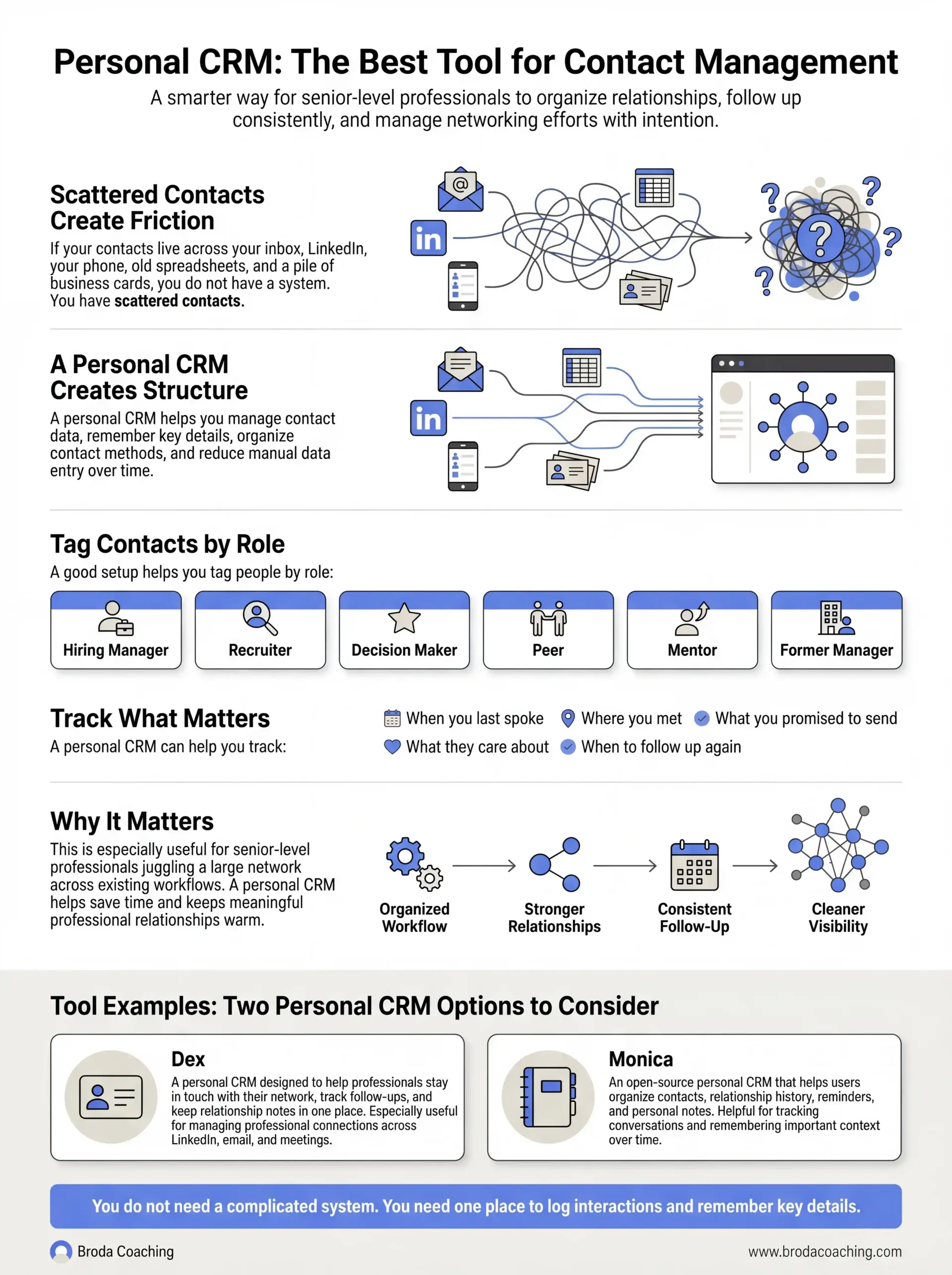
Personal CRM: The Best Tool for Contact Management
Personal CRM for Scattered Contacts and Better Contact Management
If your contacts live across your inbox, LinkedIn, your phone, old spreadsheets, and a pile of business cards, you do not have a system.
You have scattered contacts.
A personal CRM can help.
It gives you a better way to manage contact data, remember key details, organize contact methods, and reduce manual data entry over time.
A good setup lets you tag people by role:
- hiring manager
- recruiter
- decision maker
- peer
- mentor
- former manager
It can also help you track:
- when you last spoke
- where you met
- what they care about
- what you promised to send
- when to follow up again
This is especially useful for senior-level professionals juggling a large network across existing workflows.
If you want to save time and keep meaningful professional relationships warm, a personal CRM is one of the best tools you can adopt.
Two personal CRM options senior-level professionals can consider are Dex and Monica.
Dex is a personal CRM designed to help professionals stay in touch with their network, track follow-ups, and keep relationship notes in one place. It is especially useful for managing professional connections across LinkedIn, email, and meetings.
Monica is an open-source personal CRM that helps users organize contacts, relationship history, reminders, and personal notes. It can be a helpful option for senior-level professionals who want a simple system for tracking conversations and remembering important context over time.
You do not need a complicated system.
You need one place to log interactions and remember key details.
Industry Events, Business Cards, and Event Management
Industry Events Still Matter for Building Relationships
Industry events are still valuable.
Especially for senior level professionals trying to build stronger visibility in a narrow space.
But do not attend events just to collect new contacts.
Go with a purpose.
Know which executives, thought leaders, or other professionals you want to meet.
Look for executive circles, invite-only sessions, smaller breakouts, or environments where genuine relationships are more likely to form.
When you do meet someone:
- capture their contact details
- scan business cards into your CRM within 48 hours
- save phone numbers, emails, and LinkedIn profiles
- note where you met and what you discussed
- send a follow up within three days with event-specific context
If the event uses QR or NFC tools for contact capture, use them.
The easier you make contact management, the more likely you are to keep momentum.
Because a stack of business cards is not a network.
A system is.
Executive Circles, Decision Makers, and Strategic Visibility
Executive Circles Help You Reach Decision Makers Faster
At the senior level, the quality of the room matters.
You should not only be networking horizontally with peers.
You should also be thinking about proximity to decision makers.
That might include executive circles, peer groups, industry communities, invite-only events, leadership roundtables, or curated spaces that match professionals by function or level.
These environments can open doors more quickly because they place you closer to key decision makers and executives who influence hiring, partnerships, and visibility.
Do not force it.
But do be intentional.
A short advisory chat with the right leader can be more valuable than ten generic conversations with the wrong audience.
Tactical Templates You Can Use Today
Here is a simple referral blurb template:
“I’m exploring senior-level opportunities in product/operations/program leadership and came across this role at [Company]. My background includes [X years] leading [relevant scope], with recent work that delivered [proof point 1] and [proof point 2]. Based on what I understand about the team’s focus, I believe my experience in [specific area] could be relevant. I’m happy to send a tailored resume if helpful.”
Here is a simple thank-you note:
“Thank you again for your time and perspective. I appreciated the conversation and found your insight on the team’s priorities of [X, Y, and Z] especially helpful. I’ll keep you posted, and I’m grateful for the connection.”
Keep it simple.
Keep it relevant.
Measure, Iterate, and Optimize
You do not need twenty networking metrics.
Track two each week:
- number of relevant outreach messages sent
- number of quality conversations generated
Then do a biweekly review.
Look at:
- response rates
- which messages got replies
- which contacts led to introductions
- which conversations improved your application materials
- which channels produced the strongest connections
Then iterate.
Maybe your outreach needs a stronger hook.
Maybe your target-company list is too broad.
Maybe your follow up is too passive.
Maybe your thought leadership is helping more than you realized.
Treat networking like a system.
Because it is one.
Best Tools for Personal Networking
The Best Tools to Support Your Existing Workflows
You don't need a huge tech stack.
Just a few tools that fit your existing workflows.
A practical starter stack:
- Personal CRM: Dex or Monica
- Contact capture: a browser extension or mobile scanner that saves LinkedIn profiles, emails, and contact details
- Calendar-linked follow up: any simple tool that syncs reminders with your calendar
- Address book cleanup: one place to consolidate phone numbers, contact data, and notes from new contacts
The best tools are the ones you will actually use.
Prioritize CRM sync, easy note capture, and simple calendar links.
That will save time and reduce manual data entry.
Main Takeaway
The senior-level networking system that actually works is not random outreach.
It is a targeted process that helps you build relevant relationships, gather better information, and submit stronger, more informed applications.
If you are a senior-level professional trying to create career momentum, do not treat networking like a side task.
Treat networking like strategy.
Because the right relationships can strengthen your applications before anyone even reads them.
If you’re ready to build a more strategic job search, stronger applications, and a networking system that actually works, apply now for my BetterWork program. We help senior-level professionals create the clarity, positioning, and momentum needed to compete for better opportunities.
Sources
- SmartRecruiters — Recruitment Benchmarks 2025 Report
- LinkedIn — How Talent Professionals Can Grow Their LinkedIn Networks
- Yale School of Management — Navigating a Self-Directed Search
- University of Pittsburgh Career Central — Building a Network: Digital and In-Person Strategies for Students, Recent Graduates, and Postdocs
- Rice Business — How To Build a Lasting MBA Network
- Bay Atlantic University — Networking in D.C.: How Students Can Build Career Connections Early
- University of South Florida Career Services — Networking & Informational Interviews
- Georgetown University Pivot with Purpose — Conversations that Open Doors: Networking with Bill Fitzgerald
- Edelman — 2025 Edelman-LinkedIn B2B Thought Leadership Impact Report
- Dex — Personal CRM for Job Seekers
- Monica — Personal CRM done right