How Executives Can Scale Their Influence Beyond Their Current Role
TL;DR
Scaling leadership isn’t about doing more; it’s about doing the right things that create visibility, impact, and long-term success.
To scale your influence beyond your current role, executives must:
- Develop other leaders to extend reach and build internal leadership capability.
- Think like an owner and make enterprise-level decisions, not just functional ones.
- Lead with emotional intelligence to build trust, drive culture, and navigate complexity.
- Focus on high-impact programs that align with business priorities and customer experience.
- Champion customer-centric leadership by connecting team culture to real customer outcomes.
- Leverage continuous growth through feedback, strategic learning, and internal development pipelines.
The best leaders don’t rely solely on execution; they shape strategy, develop top talent, and drive sustainable success across the organization.
Introduction
Most leaders are promoted for what they do; execution, results, and strategy. But the executives who scale their influence don’t just do the work. They shape it. They create momentum across an organization by thinking bigger than their current role, enabling others, and moving initiatives that actually matter.
Whether you're a senior leader eyeing the C-suite or already navigating it, here’s how to scale your leadership and extend your impact, without burning out or plateauing.
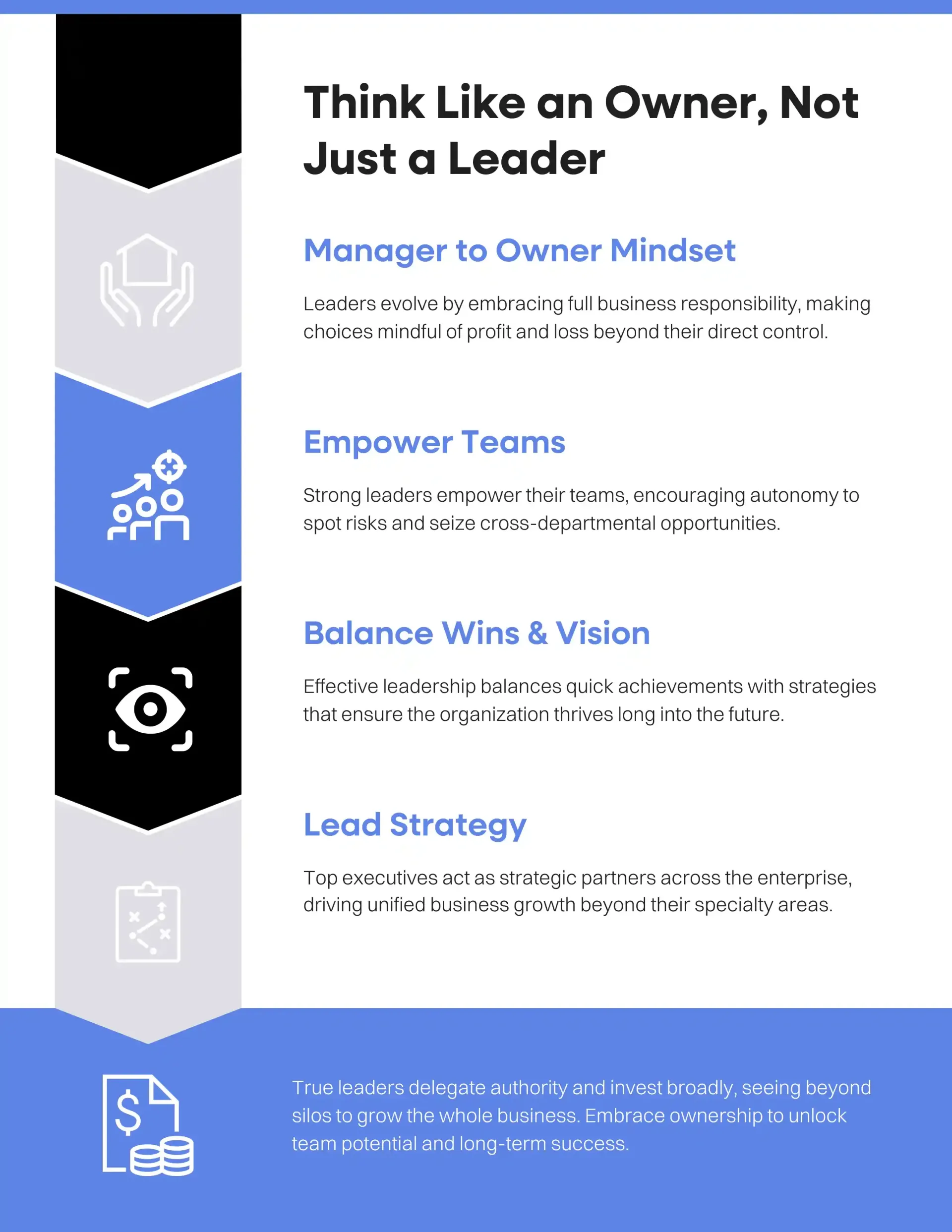
Think Like an Owner, Not Just a Leader
One of the clearest signs of leadership development maturity is when senior leaders stop seeing themselves as functional managers and start acting like business owners. However, senior executives often inadvertently foster a dependency culture by retaining ultimate decision authority. This can limit the growth and autonomy of their teams.
When you think like an owner, you:
- Make decisions with P&L awareness, even if you don’t control the budget.
- Proactively flag risks and identify cross-functional opportunities.
- Balance short-term wins with long-term organizational success.
In most organizations, business success depends on leaders who can step beyond their silo and operate as enterprise-minded partners. C-suite leaders and senior leadership teams don’t just want subject matter experts, they want peers who can drive strategy.
It’s a mindset shift. Most leaders don’t need more technical skills. They need to learn how to delegate decision authority and become visibly invested in the whole business, not just their department.
Promote Leadership Development to Extend Your Reach
Scaling leadership isn’t about doing more; it’s about enabling more. This means ensuring activities directly propel the most important outcomes without continuous executive intervention, allowing leaders to focus on strategic priorities.
The most effective leaders multiply their influence by developing others. That means:
- Sharing credit often and visibly.
- Creating leadership development plans for your team.
- Advocating for high-potential employees across the organization.
- Building mid-level leaders who can operate without constant oversight.
- Creating spaces where curiosity is rewarded and differences are valued, fostering an environment where diverse perspectives drive innovation.
When you help others grow, you become known as someone who builds talent, not just manages it. That’s how your leadership capability scales. It’s not about being the smartest person in the room, it’s about building rooms full of people who can lead independently. To achieve this, design the organizational structure first, independent of current team members, to ensure scalability and alignment with long-term goals.
Many organizations overlook this point: the best succession planning starts with role models who actively develop others, not just delegate tasks.
Create Business-Impacting Programs
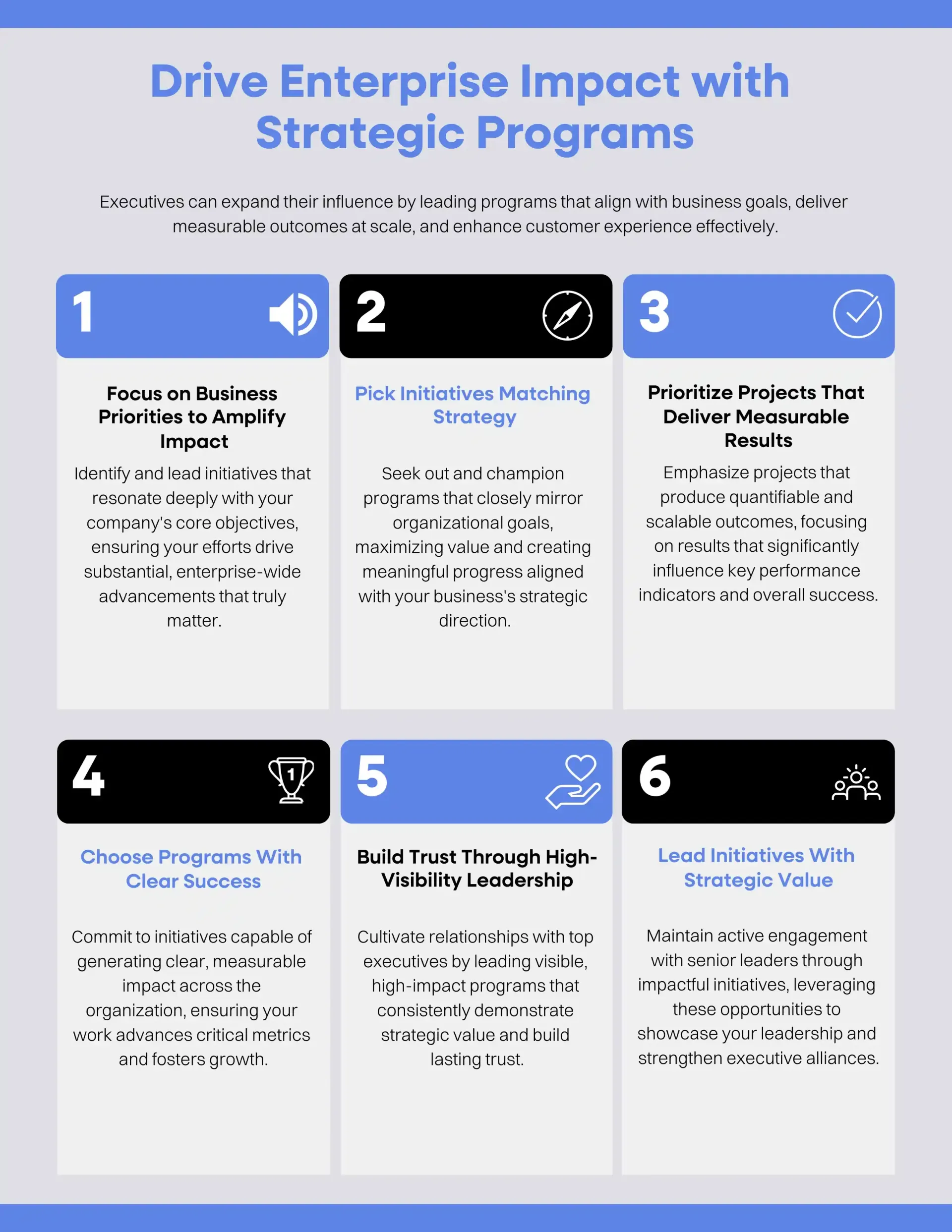
If you want to scale your influence, you need to move the needle at the enterprise level.
That means finding (or creating) programs that:
- Align with business priorities.
- Deliver measurable results at scale.
- Positively impact the experience of customers.
In 2021, I had the opportunity to lead a network-wide initiative at Amazon that affected nearly 800,000 employees. It wasn’t just a big project, it was the right project. It put me in direct contact with C-suite leaders and over 10 VPs. That single initiative helped me unlock visibility, build trust at the highest levels, and ultimately led to a promotion in one of the most competitive environments in the world.
I said “no” to multiple smaller projects to prioritize that one. The tradeoff? Worth it.
The right opportunities often bring the correct balance of visibility and scale.
This is how executives can scale their influence beyond their current role, by choosing programs that matter more than tasks that simply fill the calendar. Prioritizing work that delivers business success gives you a strategic edge that builds trust quickly with executive teams. Not every leader can do this. If you can, you'll accelerate your leadership development and ensure long-term career success.
Leveraging Continuous Growth to Scale Leadership
If you're not learning, you're not leading. That’s not just a cliché, it’s a core requirement in today’s executive landscape.
The best leaders treat growth as an operating system, not a side project. They embed it into their teams, culture, and personal leadership routines.
Here’s what continuous growth looks like in practice:
- Self-Assessment and Reflection: The most effective leaders set time aside to evaluate performance. Not just what went well, but what needs to evolve.
- Feedback as Fuel: C-suite and senior leaders who actively seek candid feedback from peers, teams, and even customers, grow faster than those relying solely on instinct.
- Strategic Learning: Staying ahead of emerging trends, whether it’s AI, changing market forces, or new decision making models, is a non-negotiable for staying relevant
- Internal Training Programs: Strong leadership builds internal academies, mentorship pipelines, and peer-led learning spaces to ensure leadership development doesn’t stall at the mid-level.
Growth isn’t about checking boxes on a competency chart, it’s about staying adaptable, humble, and hungry. When executive teams embrace continuous improvement, they build resilience into the culture. And in most organizations, that resilience is what creates a competitive edge during disruption.
If you’re serious about scaling leadership, prioritize intentional leadership development; not just for yourself, but for every layer of leadership under you.
Need help in this area or others? Consider working with a career coach to accelerate your development.
Emotional Intelligence Is the Accelerator
Leadership without emotional intelligence (EQ) is like strategy without execution. It doesn’t go far.
Leaders must manage stress, build relationships, and create psychological safety for their teams. Emotional intelligence enables:
- Constructive feedback and uncomfortable conversations.
- Awareness of team dynamics and stress levels.
- Better decision-making under pressure.
Harvard Business School emphasizes EQ as a core trait in effective C-suite leaders. It’s no longer a “soft” skill, it’s a competitive advantage.
Many leaders, especially new managers and mid-level leaders, benefit from training programs that emphasize emotional intelligence development. And for senior leaders, this becomes less about personal growth and more about cultural impact. Your ability to model EQ affects how your entire leadership team shows up.

Customer Experience: A Strategic Imperative
Here’s the truth: If your programs don’t improve customer outcomes, they’re unlikely to matter long-term. It doesn’t matter how innovative your strategy is. If it doesn’t show up for the customer, it won’t create lasting impact. Organizational culture is not a backdrop to strategy; it is the stage on which strategy is performed, making it essential to align culture with customer-focused initiatives.
To scale your influence, connect your ideas to the brand promise and the voice of the customer. This means:
- Using customer feedback to guide strategy: Build systems to capture and act on real-time customer insights, not just surveys that sit on a shelf. Let the data drive decision-making.
- Translating employee feedback into better service delivery: Employees on the front line often have the clearest view of what’s working and what’s broken. Their input is critical for improving the customer experience (CX).
- Championing a customer-centric culture from the top down: Leaders must model this daily. It’s not just a value; it’s a leadership behavior that shows up in meetings, metrics, and priorities.
CX isn’t just a department’s job. It’s a leadership responsibility. Many leaders underestimate how closely CX is tied to internal culture. When teams feel supported and aligned, it translates into better outcomes on the front lines—stronger retention, more loyalty, and long-term business growth.
Leaders must create conditions where employees can consistently deliver on the brand promise. That’s when customer trust and your influence scale.

Leadership Strategies That Actually Work
Effective leadership isn’t about being perfect. It’s about being intentional.
Here’s what the best leaders do consistently:
- Make smart bets on high-impact programs: Not every initiative deserves your time. Great leaders focus on the few priorities that align with organizational objectives and offer scale, visibility, and measurable results.
- Lead with clarity, empathy, and accountability: Teams perform best when expectations are clear, support is real, and accountability is shared, not forced. The combination builds trust and drives sustainable success.
- Stay ahead of emerging trends (including generative AI and market shifts): Most leaders don’t need to be futurists. But they do need to scan the horizon and adapt quickly. Staying informed is how leaders protect their competitive edge.
- Foster buy-in from cross-functional teams: You can’t scale leadership without influence across the org. The best leaders build relationships that drive alignment, not just compliance. Buy-in beats top-down every time.
Leadership teams that prioritize candid feedback, leadership development, and bold decision-making tend to outperform those relying solely on legacy thinking. This isn’t just about innovation, it’s about building the kind of leadership muscle that lasts in fast-changing environments.
The most effective leadership development doesn’t come from theory. It comes from role modeling, creating space for new ideas, and setting a culture of continuous learning, especially in the C-suite, where decisions ripple across the entire business.
FAQ
What does it really mean to scale your influence as a leader?
Scaling your influence means your impact extends beyond your team or function. It’s about driving enterprise-level outcomes, developing other leaders, and aligning your work with organizational objectives. Executives who scale well are seen as strategic partners, not just high performers.
What if I’m not in the C-suite yet. Can I still apply these strategies?
Absolutely. In fact, leaders who reach the C-suite started scaling their leadership long before getting the title. The earlier you develop a business owner mindset, invest in others, and lead cross-functionally, the faster you position yourself for senior roles.
How do I identify the right programs to focus on?
Look for opportunities that align with enterprise goals, create measurable business impact, and offer visibility with senior leadership. If it helps the customer experience, builds cross-functional alignment, and addresses a real business priority, it’s worth considering.
What role does emotional intelligence play in executive influence?
It’s foundational. Leaders must navigate conflict, support stress management, give constructive feedback, and build trust, especially in high-stakes environments. EQ accelerates all other leadership capabilities and is key to building resilient, high-performing teams.
How can I continue growing when I already feel maxed out?
Growth doesn’t always mean “doing more.” Sometimes it’s about doing less of what no longer moves the needle. Leverage feedback, reflect often, and focus your energy on what drives long-term success. Continuous improvement is a mindset, not just a to-do list.
Why is customer experience considered a leadership issue?
Because customers feel the result of your decisions, directly or indirectly. Leaders must build cultures that support great service, align internal processes with customer needs, and ensure that the brand promise is delivered at every touchpoint. That starts at the top.
What’s the first step I can take this quarter to scale my leadership?
Start by identifying one high-impact initiative that aligns with business goals, stretches your skill set, and increases your visibility. Then, develop one person on your team to lead a part of it. That’s how you scale yourself while elevating others.
Achieving Long-Term, Scalable Success
If you want to build a legacy of impact, here’s the formula:
- Pick the right projects—visibility + scale = promotion
- Multiply your influence—develop others intentionally
- Think like an owner—make business-wide decisions
- Invest in EQ—it accelerates everything else
- Put the customer first—always
C-suite leaders, senior leaders, and new managers alike must embrace these strategies to stay relevant, create competitive edge, and drive organizational success.
Leadership roles come with more complexity than ever. But with the right mindset and a focus on sustainable success, any leader can scale their influence far beyond the org chart.
Remember, the right opportunities often bring the correct balance of visibility and scale.
If you're ready to scale your influence and find your next executive role, Apply Now to work with my team and I through our Better Work program at Broda Coaching.