
How to Find the Best Career Coach as a Senior-Level Professional
TL;DR
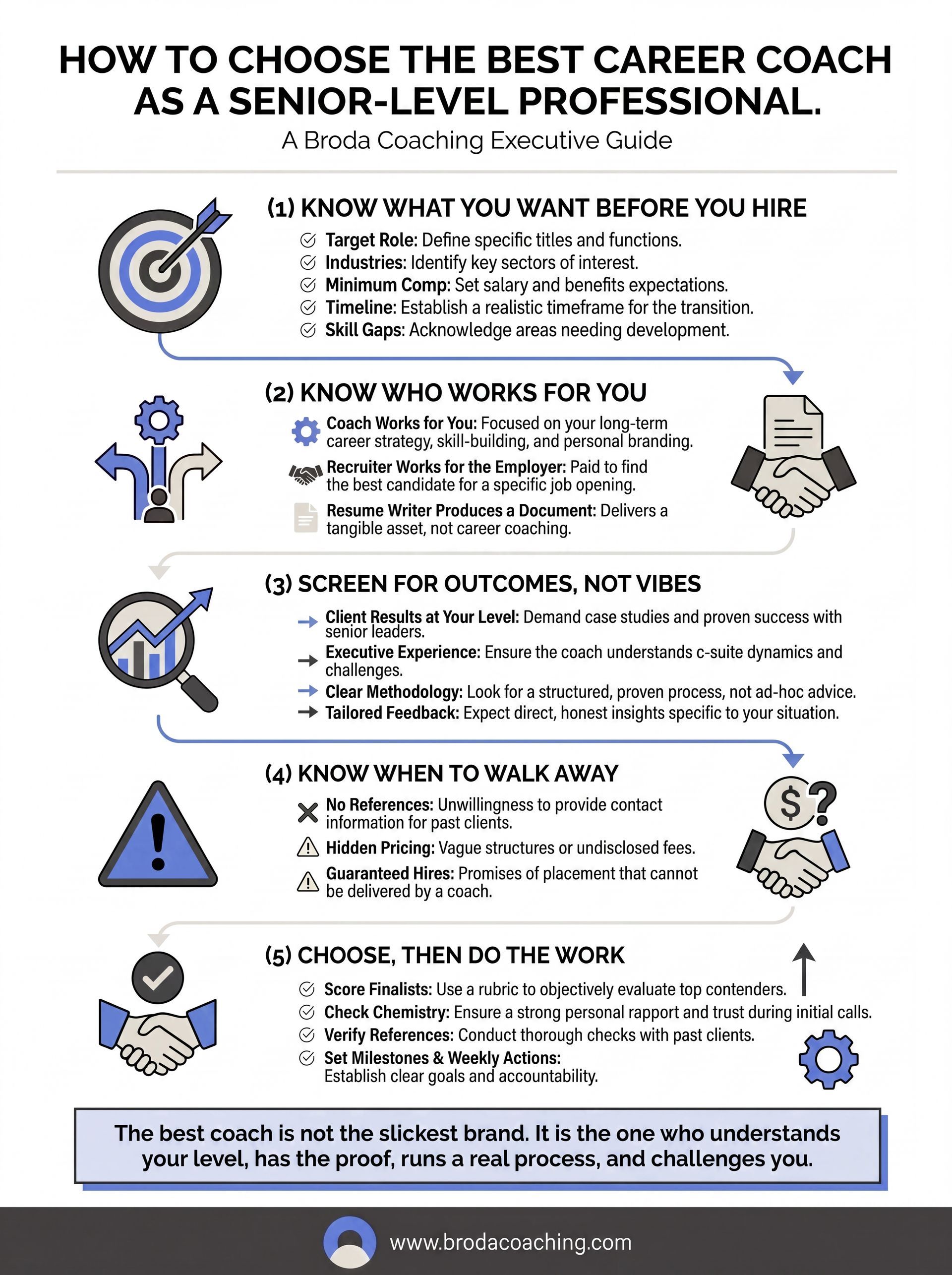
- The best career coach for a senior-level professional is not the one with the biggest marketing budget. It is the one with real executive-level experience, a clear methodology, and proof they have helped people at your level land roles.
- A coach is not a recruiter and not a resume writer. A coach builds your strategy, positioning, and decision-making. Know the difference before you pay anyone.
- Get clear on your own goals first. Target role, target industries, minimum compensation, timeline, and skill gaps. A coach can sharpen your direction, but they cannot want it for you.
- Screen for outcomes, not vibes. Ask for client results, success patterns, and references from people who looked like you when they started.
- Credentials and certifications are a minor signal at best. What matters is real senior-level hiring experience, so weight that far more heavily.
- Treat the chemistry call as a working session. You are evaluating fit, and a strong coach is evaluating your readiness too.
- Walk away from anyone who hides pricing, refuses references, or promises a guaranteed job. Those are red flags.
- Senior-level coaching is an investment. Run the math on return, not just the sticker price.
Introduction
A career coach for a senior-level professional is someone who helps you clarify what you want, frame your value to the market, and run a focused job search or career change with strategy instead of guesswork.
For senior, principal, and director-level professionals targeting $150K to $350K+ roles, the right coach does more than fix a resume.
They help you make better decisions and create momentum in a search that can stall.
They help you see your value the way the hiring side sees it.
And they help you compress a search that, at the senior level, often runs longer than people expect.
That is the real reason this decision matters.
I have sat on the hiring side. During my years leading teams at Boeing and Amazon, I reviewed thousands of resumes and led hundreds of interviews. I have also coached hundreds of senior-level professionals since 2019.
So I want to be direct with you about how to choose well.
Because hiring the wrong coach costs you more than money.
It costs you time you do not have.
This guide walks through what a senior-level coach actually does, how a coach differs from a recruiter or resume writer, how to find strong candidates, how to screen them, what questions to ask, what red flags to avoid, what it should cost, and how to work with a coach once you hire one.
What a Senior-Level Career Coach Actually Does
Most people picture resume edits and LinkedIn tweaks.
That is the smallest part of the work.
A strong senior-level coach helps you with the things that actually move a job search:
- Direction. What do you want next, and why? Career growth without direction leads to burnout.
- Positioning. How do you frame your experience so the hiring side sees a lower-risk, high-value hire?
- Strategy. Which companies, which roles, which entry points, and in what order?
- Access. How do you reach decision makers instead of disappearing into an applicant pool?
- Execution. Resume, LinkedIn, outreach, interviews, and negotiation, all pointed at the same target.
- Decision support. How do you evaluate offers, weigh compensation, and avoid a lateral move that looks like progress on paper?
That last one matters more than people realize.
At the senior level, you are not just trying to get a job.
You are trying to get the right job.
A good coach is a thinking partner for that decision, not just a service provider who polishes documents.
It is also worth being clear about what a coach is not.
A coach is not a therapist. They are not there to process the emotional weight of a layoff in a clinical sense, though a good one will acknowledge that the search is hard.
A coach is not a mentor in your specific company or function, working for free out of goodwill.
A coach is a paid professional whose job is to help you get a measurable result.
Keep that frame, and you will make a better choice.
Career Coach vs. Executive Recruiter vs. Resume Writer
This is where a lot of senior-level professionals waste money.
They hire one when they needed another.
Here is the difference.
- A career coach works for you. You pay them. Their job is your strategy, your framing, and your outcome across the whole search. They are on your side of the table the entire time.
- An executive recruiter works for the employer. They get paid when they fill a role for a company. A good recruiter can be a valuable relationship, but their loyalty is to the client paying the placement fee, not to you. Treat them as a channel, not a coach.
- A resume writer produces a document. That is the scope. A skilled one is worth it for the writing, but they are not building your strategy, running interview prep, or helping you decide between offers.
You may end up working with all three. Just know which problem each one solves.
If you need someone to own your strategy and stay accountable to your result, you need a coach.
If you want to be considered for roles a company is actively filling, you want recruiter relationships.
If you only need a sharper document, you want a writer.
Most senior-level professionals who feel stuck do not have a document problem. They have a strategy and framing problem.
That is a coaching problem.
Before You Start: Clarify Your Career Change Goals and Career Path
The best coach in the world cannot want your next chapter for you.
Before you hire anyone, get clear on your career goals. The clearer you are about your own career and life goals, the faster the right coach can help, and the easier it is to spot the wrong one.
- Define your target role and industries. Not "something better." Be specific. A senior-level career change is much easier to coach when you can name the direction, even loosely. If your real aim is more career satisfaction rather than a bigger title, say that out loud. It changes the whole search.
- Map your transferable skills. Where has your experience created value, and which of those transferable skills carry into new industries? Writing this down helps you create a clear place for a coach to build on.
- Set a minimum compensation number. What total package, including base, bonus, and equity, makes a move worth it? Write it down before emotion enters the picture.
- Set a realistic timeline. This one matters. The average job search process takes roughly four to six months for most professionals, and at the senior level it runs longer. For senior roles in tech, finance, and government, a search of six to nine months is common, and VP and top-level searches can run longer because of board-level approvals and confidential processes. The overall U.S. median job search sits around eleven weeks, but the average stretches toward six months because senior and long-duration searches pull it up. Plan for the senior reality, not the optimistic average.
- List your skills and your gaps. Where are you genuinely strong, and where do you need to upskill? In 2026, AI and data literacy keep showing up as the gap that quietly disqualifies otherwise strong candidates. A coach can help you build a plan, and the right course or credential can significantly impact how you are perceived, but you need to be honest about where you stand.
Do this work first.
It gives every coaching conversation a clearer direction, and it helps you screen coaches more sharply, because you will know whether they actually understand your target. It also steers you toward the right career coach faster, since you can test any coach against a real goal instead of a vague one.
Where to Find Experienced Career Coaches for Your Career Search
Once you know what you want, here is where to look for experienced coaches who fit your career search.
- LinkedIn. Use LinkedIn to find industry-specific coaches. This is the strongest channel for senior-level professionals. Search for coaches who specialize in your level and function, then read what they actually publish. Do they understand senior hiring, or are they writing entry-level advice? Their content tells you fast.
- Your own network. Ask trusted peers who have made a move recently. Networking with peers often leads to the best personal coach recommendations, and a referral from someone whose situation looked like yours is worth more than any ranking list.
- Specialized directories. Search directories focused on executive and senior-level coaching rather than general life coaching. The narrower the focus, the more relevant the names.
- Workshops and talks. Attend workshops to evaluate a coach's expertise before you commit. Watching a coach teach is one of the fastest ways to see how they think, and how they differ from other coaches, before you ever book a call. A free consultation or discovery call comes later. The teaching tells you more.
A quick word on credentials.
Anyone can call themselves a coach. There is no legal requirement to be certified, and some coaching certificates amount to a few weekend workshops.
So a credential is a weak signal on its own.
It tells you nothing about whether someone understands what a director-level hiring panel is looking for.
That is the part that matters. Weigh real hiring and executive experience far more heavily than any certificate.
How to Screen and Evaluate a Good Career Coach
Here is where you separate marketing from substance.
- Review real outcomes. Coaching effectiveness can be assessed through client testimonials and success rates, so seek reviews from former clients to assess a coach's effectiveness. Look at case studies, documented results, and the patterns behind them. You are looking for real results, not just kind words. Did people at your level land roles? In what timeframe? At what compensation? A coach who has done this work has the market knowledge to answer plainly.
- Verify executive-level experience. This is the one most people skip. Has the coach actually operated at or near the level you are targeting, or coached enough people who have? Coaching specialization for senior-level professionals should focus on executive leadership, and the best executive coaches usually have a background in corporate executive roles. Can they speak credibly about executive leadership, corporate politics, and the way senior decisions actually get made inside a company? You want a coach whose knowledge of senior hiring is firsthand. Effective coaching at this level involves navigating complex corporate politics, so someone who has never been near a senior hiring decision will struggle to set you up for one.
- Confirm the methodology and coaching style. A strong coach has a real method, not a vibe. Ask how they work and what their coaching style is. Do they start by getting clear on what you actually want, or do they jump straight to resume edits? The best ones get clear on what you want before they touch a document. Senior-level coaching should prioritize personal branding and tailored feedback, because at your level, perception is part of the hire.
- Check for real tools and tailored feedback. Does the coach bring frameworks, tools, templates, and direct feedback, or just encouragement? You want both support and challenge. A coach who only cheers you on is not earning the fee.
This is also where you confirm the right fit. A coach who is great for a mid-career manager may not be the right career coach for a director or C-suite move. Match the coach to your level, not just the rating. Mid-career advice and senior-level advice are not the same thing.
Weigh Experience Over Credentials
Here is the honest version.
A coaching certificate can show that someone invested in training. That is worth something.
But no certificate proves a coach understands senior-level hiring, executive compensation, or how a director gets selected over three other qualified finalists.
For that, you need real hiring and operating experience.
The strongest senior-level coaches have sat on the hiring side, or close to it. They have watched how these decisions actually get made, who gets cut, and why. That firsthand read is what you are paying for, not a line on a certificate.
Weigh it accordingly.
Questions to Ask on a Chemistry Call
Most top-tier executive coaches offer complimentary discovery calls, sometimes called a chemistry call or a free consultation.
Treat it as a working session, not a sales pitch you sit through.
You are evaluating fit. A strong coach is also evaluating whether you are ready to do the work.
That mutual evaluation is a good sign, not a turnoff.
Here are the questions I would ask:
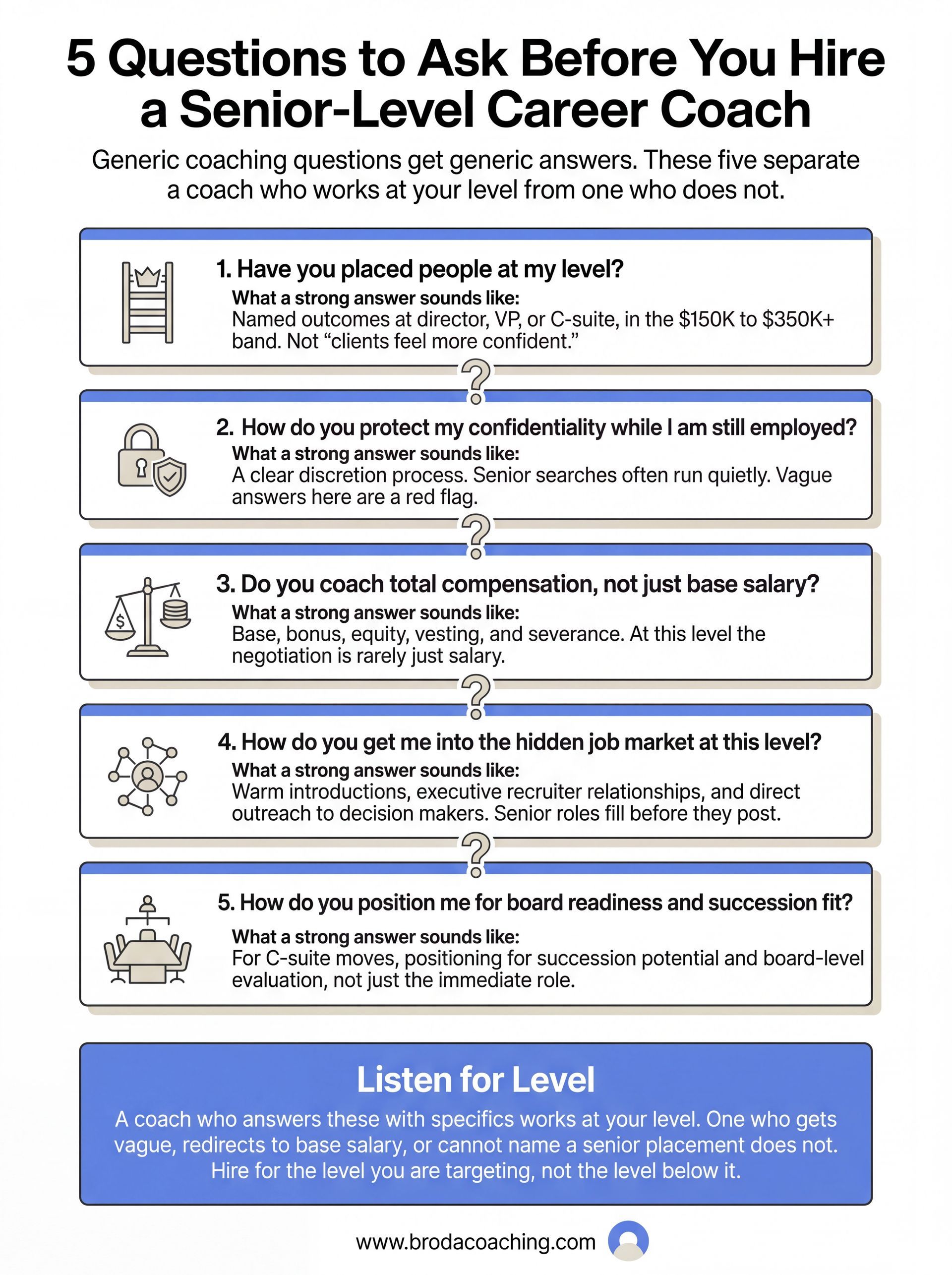
- How do you measure client outcomes? You want specifics. Roles landed, timelines, compensation gains, not just "people feel more confident."
- What does a typical engagement look like? Length, cadence, what is included, and what is not.
- Can you give me examples of career transition wins at my level? You are listening for whether their wins look like your goal.
- How do you handle confidentiality and discretion? This matters more at the senior level, especially if you are exploring quietly while still employed.
- How do you challenge clients? A good coaching relationship is built on trust, accountability, and honest pushback. You want a coach who will tell you the hard thing.
Pay attention to how they answer.
A strong coach is direct, specific, and comfortable saying "that is not what I do" when something is outside their scope.
A weaker one gets vague, oversells, or agrees with everything you say.
The chemistry call is part of the coaching experience.
Use it to gauge fit, and to gauge your own readiness for the work.
Red Flags: When to Walk Away
Some signals should end the conversation.
- No verifiable references. If a coach cannot connect you with past clients or show real, checkable outcomes, be cautious. Substance leaves a trail.
- Hidden pricing. A coach who will not discuss fees until they have you emotionally invested is using a sales tactic, not a coaching practice. You should be able to understand the investment clearly and early.
- Guaranteed hires or guaranteed raises. This is the biggest one. No honest coach can guarantee you a job, and coaches should avoid promising specific job placements or salary increases. They do not control the hiring teams, the market, or the timing.
Anyone promising a guaranteed placement is either misunderstanding their role or misleading you.
A good coach increases your odds and improves your decisions.
They do not control the outcome.
If someone tells you otherwise, walk away.
How Much Does a Senior-Level Career Coach Cost?
Let's talk numbers, because vague answers help no one.
Coaching rates vary widely. General career coaching often runs roughly $80 to $225 per hour, while many experienced executive coaches charge between $300 and $500 per hour, and specialized senior-level work can go higher. For context, industry surveys put average coaching fees around $200 to $250 per hour, with senior and executive work landing well above that.
Full senior-level engagements are usually priced as packages, not single hours, because the work spans months. Package rates for coaching can cost several thousand dollars or more.
Group coaching rates are typically lower than one-on-one sessions, which can be a smart entry route if budget is tight, as long as you still get tailored feedback and real tools you can use.
Pricing models vary too. Not every option is a flat coaching fee. Some career services use a placement model. For example, the executive job-search firm Endeavor charges a $1,000 initiation fee for its services and then takes a percentage of your first-year income after a job placement. A model like that can work, but read the terms closely, because a percentage of a senior-level salary adds up fast.
A comprehensive senior-level engagement over several months commonly lands in the five-figure range, often somewhere between roughly $7,500 and $30,000 depending on scope, seniority, and what is included.
Premium executive coaching for the most senior leaders goes higher still.
So how do you decide if it is worth it?
- Run the return, not just the cost. Coaching can yield significant returns on investment. If coaching helps you land a $250K role two months sooner, the math is not close. Two months of a senior-level salary usually dwarfs the entire fee. Research on coaching has pointed to returns of several times the investment, and at senior compensation levels, that math compounds. You will also see figures floating around that clients often increase their compensation by 10% or more. Treat numbers like that as market context, not a promise. As noted above, be wary of any coach who guarantees a specific salary increase.
- Ask for a detailed fee breakdown. What exactly are you paying for? Sessions, materials, feedback, access, duration. Get it in writing.
- Consider a short trial. Some coaches will structure a smaller initial engagement so you can test fit before committing to the full program.
Price is not the same as value.
A cheap coach who does not understand senior hiring is expensive.
A well-matched coach who shortens your search and improves your offer pays for themselves.
How to Work With Your Coach During the Job Hunt and Career Transition
Hiring the coach is the start, not the finish.
A good coach provides personalized support throughout the job search process, but to get your money's worth, set the relationship up well.
- Set a meeting cadence. A senior search and career transition benefit from structured, recurring support over months, not a one-time burst. Agree on rhythm up front.
- Set clear session goals. Walk in knowing what you want from each session. The coaching provides personalized support across the entire process, but the work goes faster when you arrive focused.
- Expect homework assignments. Good coaching happens between sessions. Expect homework assignments, drafts, and outreach to do on your own. A coach who never gives you anything to work on is not pushing you.
- Share an updated resume early. Give them current material to work from. Coaches help improve your resume and LinkedIn profile so both aim at the new job you want, not the one you have.
- Update your LinkedIn profile together. Your headline, summary, and experience should signal the role you want next, not just describe your current role.
- Practice outreach messaging. Especially for the hidden job market. Executive coaching should focus on hidden job markets and deep networking, because much of senior hiring happens through warm introductions and referrals before roles ever hit the public applicant pool. A coach can help you build outreach that leads with relevance instead of asking for favors, which is how new opportunities tend to surface at this level.
Running Mock Interviews and Interview Coaching That Move the Needle
This is one of the highest-leverage uses of a coach.
Interview coaching is where a lot of the gain hides. Sharper interview materials and stories can meaningfully increase the interviews and offers you generate. Some coaches and industry data go further and claim focused coaching can triple interview invitations for job seekers. Treat the exact multiple as marketing, but the direction is real: clearer framing gets you into more interview processes, and into them with more confidence.
Here is how to use mock interviews well:
- Record them. You will catch things on playback you cannot feel in the moment.
- Request behavioral frameworks. Ask your coach to drill you on structured answers so you stay clear and keep your confidence under pressure during the interview process.
- Refine your executive stories for impact. At the senior level, the people hiring are buying judgment, leadership, and business outcomes, not a task list. Your stories should lead with impact, not activity.
Done well, this is what lets you walk into a high-stakes conversation with real confidence instead of a rehearsed script.
Do not wait until you have an interview booked.
Practice before you need it.
C-Suite and Confidential Searches
If you are operating at or near the C-suite, a few things change.
- Confidentiality is non-negotiable. If you are exploring while still employed, make sure your coach treats discretion as a hard requirement. Ask directly how they protect it.
- Recruiter introductions become valuable. A well-connected coach may be able to steer you toward the right executive recruiters for your space. Use those relationships as a channel, while keeping your coach as your strategist.
- Compensation and equity get complex. At this level, the negotiation is rarely just about base salary. Equity, vesting, bonus structure, and severance terms all matter. A strong coach helps you think through the whole package.
- Board readiness and fit come into play. For the most senior roles, you may be evaluated on succession potential and board-level fit, not just the immediate job. Frame yourself accordingly.
The higher you go, the more the search is about relationships, trust, and discretion.
Choose a coach who understands that world.
Your Decision Checklist
When you are down to your finalists, run this. Remember you are choosing a person you will work closely with, so fit and trust matter as much as the resume of the coach.
- Score each finalist against your criteria. Outcomes at your level, relevant experience, clear methodology, real references, and pricing you understand.
- Check chemistry on a live call. Did they challenge you, or just agree with you?
- Verify references from similar clients. Talk to someone who started where you are.
Once you choose, set the coaching engagement up to move.
- Schedule a kickoff session. Align on goals, scope, and timeline.
- Set measurable milestones. Define what progress looks like at 30, 60, and 90 days.
- Assign deadlines to those milestones. A goal without a date is a wish.
- Commit to weekly actions. Coaching works when you do the work between sessions. That steady follow-through is the point.
A coach can build the strategy with you.
You still have to run it.
Frequently Asked Questions
Is a career coach worth it for senior-level professionals?
For many senior-level professionals, yes. At $150K to $350K+ compensation levels, shortening a search by even a few weeks or improving an offer can return many times the cost of coaching. The value comes from better strategy, sharper framing, and stronger decisions, not just resume edits.
How long does senior-level career coaching take?
Most senior engagements run over several months, often three to six, because that mirrors the length of a senior search. VP and executive searches can run six to twelve months, so coaching is usually structured as an ongoing engagement rather than a one-time session.
Should I choose a coach based on certifications?
Certifications can show a coach invested in training, but they are not required and they do not prove someone understands senior-level hiring. Weight real executive and hiring experience far more heavily than any credential. A certificate does not tell you whether a coach knows how a director or VP actually gets hired.
What is the difference between a career coach and an executive coach?
A career coach focuses on your job search, transition, and framing to land a role. An executive coach typically focuses on developing your leadership and performance once you are in a role. Some coaches do both, so ask which problem the engagement is built to solve.
Can a coach guarantee I will get a job?
No. A coach can improve your strategy, materials, and odds, but they do not control hiring teams, the market, or timing. Treat any guaranteed-placement promise as a red flag.
How much does a senior-level career coach cost?
Executive and specialized coaching commonly runs $220 to $550+ per hour, and full senior-level engagements are usually packaged in the five-figure range depending on scope and seniority. Evaluate the return against your target compensation rather than the hourly rate alone.
Main Takeaway
The best career coach for a senior-level professional is not the one with the slickest brand.
It is the one who understands your level, has the proof to back it up, runs a real system, and will challenge you when you need it.
- Get clear on what you want first.
- Screen for outcomes, not vibes.
- Check for both training and real hiring experience.
- Walk away from hidden pricing, missing references, and guaranteed-job promises.
- And once you choose, do the work.
The right coach does not hand you a job. They help you make better decisions, frame your value clearly, and run a sharper search. That is what shortens the timeline.
Ready to Work With a Senior-Level Career Coach?
If you are a senior, principal, or director-level professional trying to make your next move with more direction and less guesswork, you do not have to figure it out alone.
The right coaching relationship can change how recruiters and the people hiring see you, and how confidently you navigate the search.

If you are ready to build a clear direction, stronger framing, and a job search strategy designed for senior-level professionals, apply to work with me and learn more about Better Work.
Sources
- U.S. Bureau of Labor Statistics: Employment Situation, Duration of Unemployment (Table A-12): https://www.bls.gov/news.release/empsit.t12.htm
- Career Agents: Average Job Search Duration by Industry (2026): https://careeragents.org/blog/average-job-search-duration/
- Noomii: How Much Does Career Coaching Cost (2026): https://orgs.noomii.com/how-much-does-career-coaching-cost/
- High Performance Orgs: Executive Coaching Cost, Fees & Pricing (2026): https://highperformanceorgs.com/how-much-does-executive-coaching-cost/