
How to Rebrand Yourself After a Layoff as a Senior Leader
TL;DR
- A layoff doesn’t end your leadership brand—it exposes whether you’ve been branding your title or your value.
- Stabilize first: protect your mental health with structure, self-care, and support.
- Rebrand fast: define a clear value proposition (the problems you solve + outcomes you drive).
- Build a quantified “impact bank” of signature wins and measurable results.
- Make your brand consistent everywhere: align your resume, LinkedIn, and interview stories to one narrative.
- Network as distribution, not job-asking—use relationships to access the hidden job market.
- Keep optionality (if needed) with select consulting to protect momentum and reduce pressure.
- Stay relevant with focused learning that signals credibility and forward motion.
Introduction
A layoff can feel personal.
Even when it’s not.
There’s an initial shock. Your routine disappears. Your calendar goes quiet. You suddenly have free time you didn’t ask for. And your brain starts doing what it always does in uncertainty: filling in the gaps with worst-case scenarios.
Losing a job can trigger feelings of shock, confusion, anger, and regret.
So, before we talk job search strategy, let’s name the reality:
This is a career transition. And it deserves time to process, without letting the transition period turn into a confidence leak.
Because businesses will keep doing business things.
And senior leaders need a professional brand that travels with them that they can use to find a new job.
Coping With Job Loss and Mental Health
Job loss hits more than your income.
It hits identity, self-esteem, and well-being.
And it’s not “soft” to take mental health seriously here, it’s practical. Job insecurity is strongly associated with stress, and stress can affect how you show up in networking discussions, interviews, and conversations with decision-makers.
Acknowledging the grief process is important for those who have lost their jobs, as it involves genuine feelings of loss.
A few basics I recommend during the first few weeks:
- Prioritize physical health (sleep, movement, sunlight).
- Keep your days structured (even if you’re not working your current job anymore).
- Build a support loop: family members, former colleagues, friends you can be honest with.
- If you have access to outplacement services or career coaching, use them (it reduces isolation and speeds clarity).
Taking time to process emotions after a layoff is important before starting a job search.
Establishing a daily routine that includes job search activities, physical exercise, and personal care can help maintain mental health during a job search.
Many executives resist seeking professional support during transitions, viewing it as a weakness, but it is a strategic investment in recovery.
Isolation can impair your journey, and social contact is nature's antidote to stress.
Staying positive isn’t a vibe. It’s a strategy.
Career Strategy and Job Search: How to Rebrand Yourself After a Layoff as a Senior Leader
Most senior leaders default to identity language after job loss:
“Former VP at X.”
That’s a weak brand anchor. Your title is context. Your professional value proposition is the brand.
1) Move from “Title” → “Value” in 30 minutes
Step A: Pick your problem lane (what you fix)
Write down 2–3 business problems you solve best (think money, time, risk): stalled growth, margin pressure, execution chaos, leadership gaps, integration/change.
Step B: Pick your outcome lane (what you build / grow / protect)
Choose 1–2 outcomes you reliably drive: revenue growth, profitability, operating cadence, retention, scale/quality, risk reduction.
Step C: Write one clear value statement
Use this formula (and keep it plain):
“I help [who] solve [problem] to achieve [measurable outcome] in [context].”
This becomes your anchor for your resume, LinkedIn profile, and networking discussions.
Developing your professional value proposition (PVP) is the first step towards creating your professional brand.
Measured Impact Narrative: Make Your Last Role “Proof,” Not a Job Description
Senior executives don’t win in the current job market by listing responsibilities. They win by proving ROI.
Focus on accomplishments rather than responsibilities by replacing duties with measurable achievements.
2) Build a measured impact bank (your source-of-truth)
Step A: Pull proof from real artifacts
Review your calendar/QBRs/OKRs/board updates and list 10 initiatives + 10 decisions you drove.
Document key metrics and achievements while still having access to transition data for future positioning.
Step B: Select 3–5 signature wins that decision makers care about
Pick wins tied to revenue, margin, speed, retention, risk, or org performance. If it doesn’t connect to money/time/risk, it won’t land with potential employers.
Step C: Convert each win into an executive story (one paragraph)
Use a situation-action-result framework to document significant career wins as confidence anchors.
Then turn it into one outcome-first bullet:
- “Improved ___ by ___ by doing ___ across ___.”
This “impact bank” fuels your resume bullets, LinkedIn About section, and stories for the interview process.
Build a “Low-Risk Hire” Perception
Post-layoff, the job market evaluates capability and risk. Your goal is to remove uncertainty.
3) Reduce perceived risk in three moves
Step A: Make your positioning narrow and repeatable.
One lane. One value statement. One clear senior role target. (Generalists sound riskier.)
Step B: Show a pattern, not a highlight reel.
Choose 3 wins that rhyme (same type of problem, same type of move, similar measurable result). This signals: “I can do it again.”
Step C: Pre-handle the layoff calmly.
Prepare a 15–20 second explanation: what changed (macro/restructure), what you delivered, what you’re targeting next. No bitterness. No over-explaining. Executive presence is calm and concise.
Upgrade Your Assets So Your Brand Is Consistent Everywhere
A strong personal brand isn’t a headline. It’s one story told consistently across the assets used in a senior level professional job search.
4) Create the “Brand Core,” then translate it
Step A: Build a one-page Brand Core
- 1 value statement.
- 3–5 signature wins (quantified).
- 3 proof themes (how you operate).
Step B: Map it into your assets
- Resume: summary = value statement; top bullets = signature wins.
- LinkedIn: headline + About mirror the same language and proof.
- Update your LinkedIn headline to highlight your expertise rather than indicating that you are seeking opportunities.
- Interview stories: 5 rehearsed stories pulled from the impact bank.
- Networking pitch: 10-second + 30-second version (value + one win).
- Optional deck: 4 slides (value, wins, how you operate, direction).
If you need help optimizing more than just your headline on LinkedIn, check out my complete guide on LinkedIn profile optimization for senior-level professionals.
5) Run a consistency audit before you go market-facing
Ask:
- Do all assets lead with the same value proposition?
- Do they use the same 3–5 signature wins (even if shortened)?
- Would a former colleague describe me the same way these assets do?
If yes, you’ll look less like a “job seeker” and more like the obvious hire.

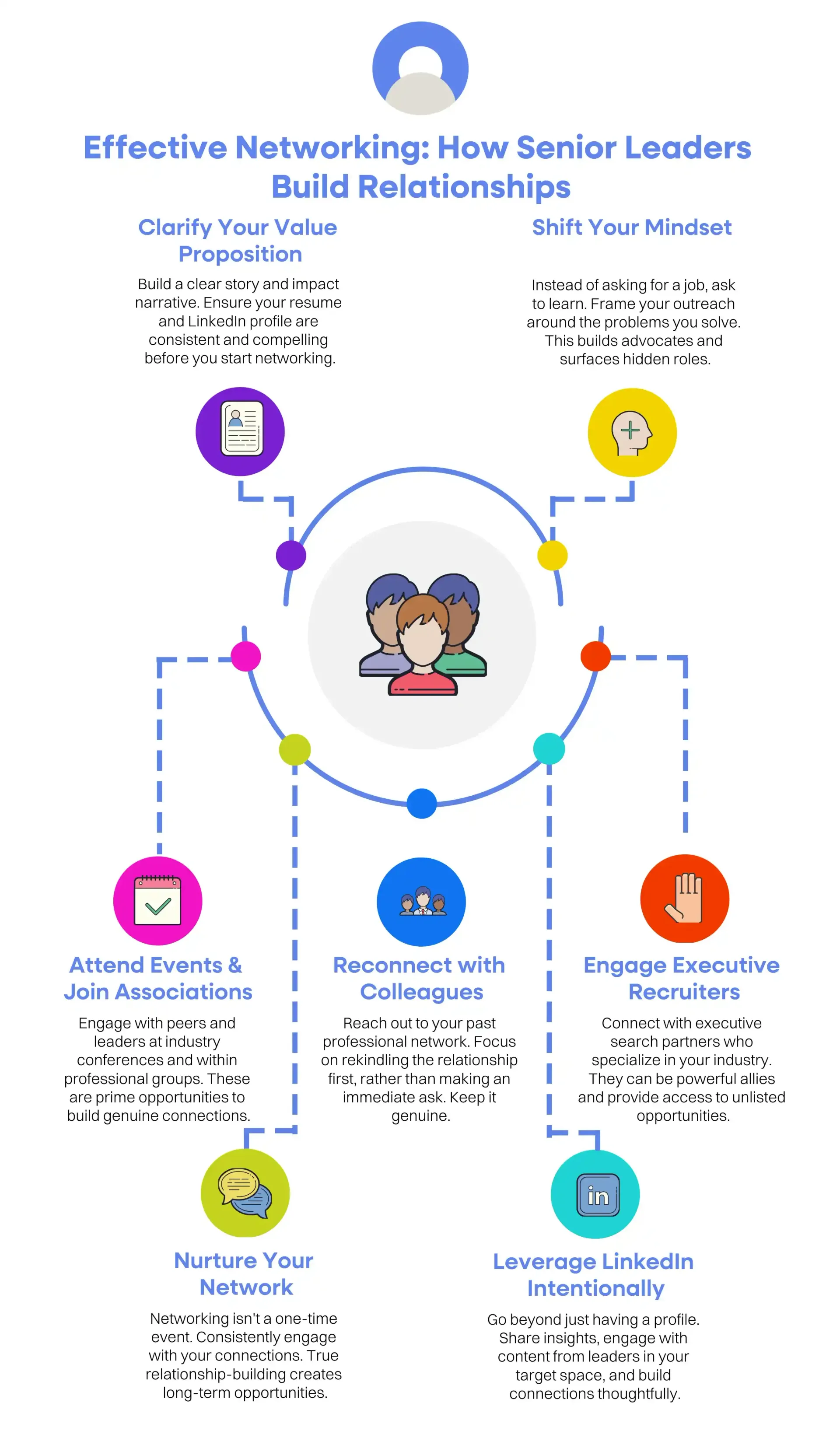
Effective Networking: Build Relationships (Don’t Just “Ask for a Job”)
At this point, you’ve done the hard part.
You’ve clarified your value proposition, built a measured impact narrative, and tightened your professional brand so it’s consistent on your resume, your LinkedIn profile, and in how you speak.
Now you have something most senior leaders don’t have after a layoff: a clear story worth repeating.
And that’s what networking is at this level: distribution.
Not begging. Not “checking openings.”
Getting
your story in front of the right decision makers, in the right rooms, with enough precision that people can immediately think: “I know where this person fits.”
The fastest rebrands happen when leaders shift from:
“Do you know who’s hiring?”
to:
“Here’s the problem space I solve; who should I be learning from?”
That one change does a lot:
- It builds advocates.
- It lowers the awkwardness.
- It increases response rates.
- It surfaces hidden job market roles faster.
Networking is critical for those losing a job, as it leads to significantly more job offers, shortened search times, and higher quality offers.
Approximately 70% of people secure their current job through networking, and 80% of job opportunities are not listed on job boards or public platforms.
Due to this reality, I created a comprehensive guide on how senior-level professionals can effectively network to find their next role.
Tactical Approaches
- Attend industry events.
- Join professional associations / industry associations.
- Reconnect with former colleagues (without making it transactional).
- Build connections on social media (yes, LinkedIn—done intentionally).
- Build relationships with executive search partners to support your job search.
- Networking discussions should include asking contacts if they know anyone in target organizations for introductions.
At the end of the day, you’re not “networking.”
You’re rebuilding a professional network that creates opportunities.
A Turning Point I Saw at Amazon
I remember watching a layoff wave hit Amazon; people who were high performers one week were locked out of their laptops the next.
And what stuck with me wasn’t just the emotion.
It was the pattern.
The leaders who recovered fastest weren’t always the “best” on paper.
They were the ones who already had career insurance:
- A reputation outside their org.
- A few strong advocates across teams/companies.
- A clear “this is what I do and why it matters” narrative.
- Proof of impact they could articulate in 30 seconds.
That was a turning point for me.
It reinforced something I’ve believed for a long time:
Businesses will keep doing business things.
So, as a leader, the move is to build a brand that can survive a forced exit and travel with you.
Career Transition Optionality: Consulting Projects and Multiple Income Streams
Not every leader needs consulting work or a Portfolio Career.
But many benefit from them during a transition period.
Why?
Because losing an income stream can create pressure that leaks into the job search.
A short runway can make you look frantic.
Determine your financial runway during a career transition to avoid impulsive decisions.
So, consider selective consulting projects that:
- Keep your skills sharp.
- Expand your professional network.
- Create new possibilities (including unexpected full-time offers).
- Improve financial stability and financial security.
Consider a Portfolio Career by exploring interim, advisory, or fractional leadership roles while searching for a permanent position.
Look into career coaching, peer groups, or short-term consulting to keep momentum and confidence high during a job search.
This isn’t about “settling.”
It’s about keeping control while you choose your next chapter.
Continuous Learning to Stay Relevant (Without Spinning Out)
Once your story is clear and your network is in motion, the next question is simple: Are you still building credibility while you search? That’s where continuous learning comes in; not to collect certificates, but to stay sharp and signal momentum.
You don’t need 12 certifications.
However, you do need to seek new certifications in high-demand areas to demonstrate adaptability after a layoff.
You also need to stay current; especially as new technologies reshape leadership expectations.
Pick one lane for continuous learning tied to your target:
- A strategic skill gap (data, AI adoption, go-to-market, ops transformation, etc.)
- A modern leadership capability (change leadership, stakeholder management, PE operating rhythm)
Then use it as proof of momentum in your outreach and interviews.
Updating skills isn’t just for competence.
It’s for confidence.

Understanding the Job Market and Hidden Job Market
All of this works better when you understand where roles are really filled. Let’s talk about the job market and the hidden job market most job seekers miss.
The current job market for senior executives is weird right now.
- Fewer senior role openings (relative to mid-level hiring).
- Longer interview process cycles.
- More “quiet” searches, especially through referrals and backchannels (the hidden job market).
Add in private equity dynamics and CEO departures, and you get a top-of-house environment where leadership seats move fast, and expectations are even higher.
Translation: many executives are competing for fewer visible job opportunities… while the best roles are often filled before they hit a job board.
This is why your professional network and visibility matter more than ever.
Main Takeaway
A layoff doesn’t end your leadership brand; it exposes whether you’ve been branding your title or branding your value.
Your job now is simple (not easy):
Clarify your value, prove it with impact, and make it visible to the market.
PS — If you’re stuck right now, don’t interpret that as failure. Most senior roles are filled through relationships and quiet searches. Your job is to build the system that makes those searches find you.
If you need help building this system and landing your next role, apply now to work with me.
Sources
- American Psychological Association. Work in America™ 2025 (job insecurity/stress findings).
- Böckerman, P. (2024). Unequal effects of corporate layoffs on mental health (SAGE Journals).
- Korn Ferry. The Other Turnover in the C-Suite (Nov 24, 2025).
- Korn Ferry. The Great CEO Exodus… Continues (Mar 12, 2025).
- Korn Ferry. The C-Suite: Itching to Leave? (Oct 14, 2025) (mentions PE dynamics and executive movement).
- LinkedIn News (Brendan Wong). Cracking the hidden job market (May 6, 2025).
- Forbes Coaches Council. Layoff Survival Guide: Career Transition Strategies for Executives (Apr 23, 2024).
- Right Management (ManpowerGroup Talent Solutions). Outplacement Services for Executives: A Strategic Lifeline (Jun 26, 2025).