Is Career Coaching Right for Me? Understanding the Benefits and When to Seek Help
Updated: July 3, 2026
TL;DR
- If you are qualified but not getting traction (slow search, no visibility, interviews that stall), career coaching can be the lever.
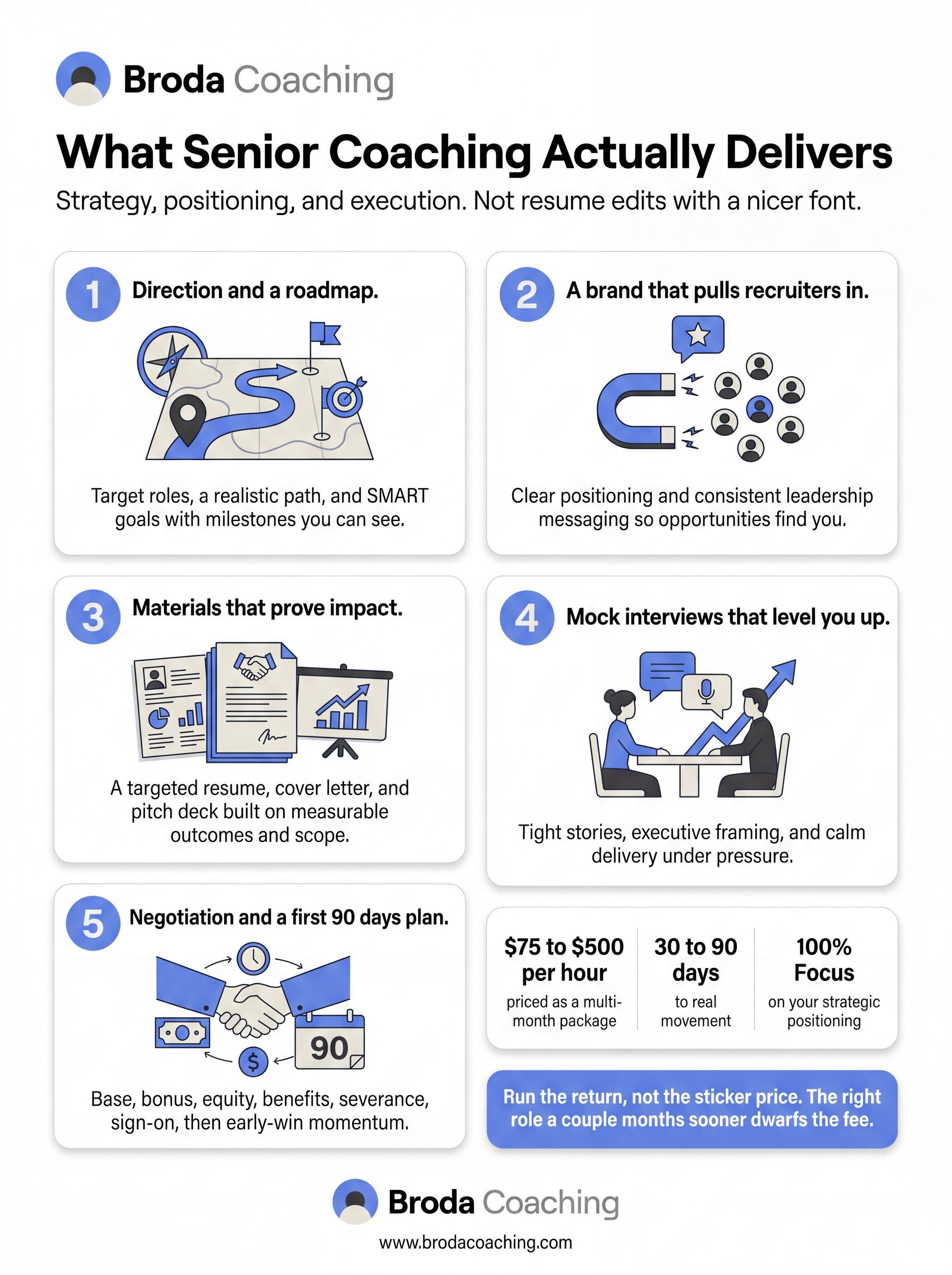
- Senior-level coaching is strategy, positioning, and execution. It is not resume edits with a nicer font.
- The 2026 market changed the math. AI does the first read of most applications now, so mass-applying is a dead end and being targeted is the whole game.
- Expect help with: knowing what you actually want and a real roadmap, your personal brand and LinkedIn, targeted materials (resume, cover letters, often a pitch deck that proves impact), mock interviews with honest feedback, and negotiation plus a first 90 days plan.
- My take: there is probably a coach for everyone. It depends on your objectives, not your job title. See if Better Work, is right for you.
Introduction
At the Senior, Principal, and Director level, the question usually is not "Am I qualified?"
It is some version of:
"Why am I not getting traction?"
"Why is this search taking so long?"
"Why do I feel stuck in a role I clearly outgrew?"
"Why do promotions feel political and invisible?"
If that sounds familiar, a career coach might be the thing that changes how the next six months go.
Career coaching can help at various stages of your professional life and at almost any career stage. This post is written for senior-level professionals. Higher expectations, fewer roles at the top of the funnel, and a market that got harder to read.
I have spent more than a decade on the hiring side, first leading engineering teams at Boeing and later as a product leader at Amazon, and I have coached hundreds of people at this level since 2019. So I want to be straight with you about when coaching helps, when it does not, and how to decide.
The 2026 Reality for Senior-Level Job Seekers
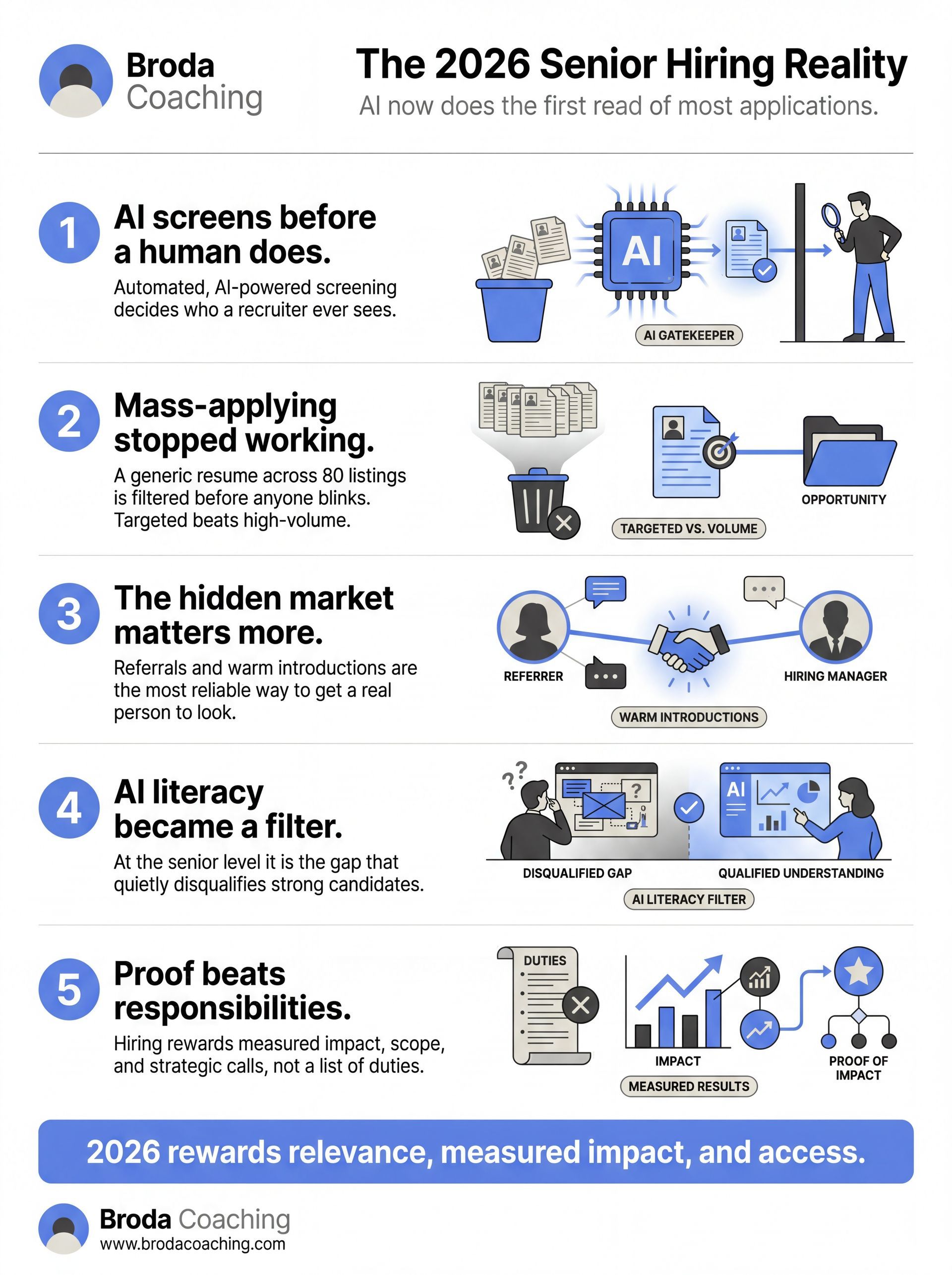
Before the benefits, one shift you have to understand: the 2026 market rewards precise targeting over volume, because AI now screens applications before a human ever sees them.
AI now does the first read of most applications. Most professionals I work with feel unprepared for that shift, and almost everyone tells me the search is taking longer than it used to. A big reason is that recruiters are buried, and automated screening (what used to be a simple applicant tracking system, now powered by AI) decides who a human ever sees.
That does a few things to a senior search:
Mass-applying stopped working. When a model reads first, a generic resume sprayed across 80 listings gets filtered before anyone blinks. Targeted beats high-volume, for the software and for the human behind it.
The hidden market got more important, not less. A referral or warm introduction is still the most reliable way to get a real person to look at you.
That is the entire premise behind the senior-level networking system I teach: relationships beat applications.
AI literacy became a quiet filter of its own. In my 2026 career change strategy, upskilling on AI is one of the pillars, because at the senior level it is increasingly the gap that disqualifies an otherwise strong candidate.
None of this means the market is dead. It means it is selective. I made that case in The State of the Hiring Market in 2026, and I will repeat the short version here: 2026 rewards relevance, measured impact, and access.
What a Career Coach Is and How a Career Coach Helps
A career coach partners with you in a structured, goal-oriented process to help you reach a career goal and get unstuck. Think of it as direction, strategy, and execution support, built around your real constraints: time, energy, market conditions, and internal politics.
It is worth saying what a coach is not.
A coach is not a therapist. A good one will acknowledge that a search is hard, but the work is about getting you a measurable result, not processing the deeper stuff a counselor is trained for.
A coach is not a recruiter. Recruiters work for the company paying the placement fee. A coach works for you.
A coach is not a resume writer. A writer produces a document. A coach owns the strategy behind it.
A career coach is also not a leadership coach, who focuses on how you lead once you are in the seat, and not the same as career counselors, who lean more toward assessment and processing a transition.
A quick word on titles too: plenty of people market themselves as a professional career coach, or even a certified professional career coach. That tells you they trained. It does not tell you they have ever hired anyone.
At the Senior, Principal, and Director level, coaching looks less like "career advice" and more like hiring a strategist to help you win a competitive, high-stakes search. A strong one is objective enough to name the blind spots you cannot see, works from your actual results instead of vibes, and can coach both the positioning and the execution.
When Does a Career Coach Add the Most Value?
Coaching earns its keep when your path is not standard, which describes most senior careers.
The value shows up in two places at once: strategy and execution. Plenty of people can hand you advice. Far fewer will build the plan with you and then hold you to running it. At your level you usually do not have a strategy problem you can think your way out of alone, and you do not have a motivation problem.
You have an access and positioning problem, and those are easier to solve with a second set of eyes that has sat on the hiring side. That is where a coach tends to have the most positive impact, and it is why many professionals at this level finally get unstuck.
What Are the Benefits of Career Coaching for Career Development and Career Success?
Here are the benefits that matter most when you are Senior and up.
1) A Personalized Career Strategy and Career Path Plan
Your path is rarely a template. A good coach tailors the plan to your target roles, your stage, your leadership brand, your industry constraints, and the time and energy you actually have.
Done right, it can meaningfully shorten the job search process, map your career goals to a realistic career path, and guide you through a full career change or into a new career.
2) Knowing what you want, and the nerve to commit
A coach helps you name your values, your strongest skills, the limiting beliefs getting in your way, and what "a successful career" or your version of a dream job even means for you now. This is how you stop drifting.
My team starts here on purpose, before anyone touches a LinkedIn headline, because growth without direction just leads to burnout.
3) A Roadmap + SMART Goals (Specific, Measurable, Achievable, Relevant, Time-bound)
Senior professionals do not need more ambition or raw leadership skills.
They need a roadmap with the right next steps in the right direction.
SMART goals (specific, measurable, achievable, relevant, time-bound) plus clear milestones make progress something you can see instead of something you hope for.
4) Accountability and steady support
Strong leaders still stall when they job hunt alone.
Coaching gives you structure, homework, regular check-ins, and ongoing support, plus the personalized support of a person in your corner when motivation dips.
As I say more bluntly elsewhere: it is not about effort, it is about direction.
5) Leadership and Communication Skills That Translate to Offers
At this level, most interviews are judgment calls.
- Can you lead through ambiguity?
- Influence executives?
- Drive outcomes?
- Manage risk?
Good coaching sharpens strategic thinking, executive presence, emotional intelligence, and high-stakes communication skills, and it de-risks you as a hire. Think of it as leadership development pointed straight at your next offer.
That last part is the quiet engine behind most senior offers.
What a Career Coach Can Help With at the Senior Level
The obvious basics are on the table:
- Writing resumes (targeted resumes for specific roles)
- Cover letters that do not sound like a form letter
- LinkedIn that strengthens your brand
- Interview prep
- Mock interviews
- Salary negotiations
Some programs include done-for-you deliverables like resumes, cover letters, and pitch decks, which can genuinely help you walk into job interviews ready.
But senior leaders usually need more than documents. You are evaluated on judgment, influence, and business impact, not task execution. Here is where the real leverage sits.
Targeted Resumes, Cover Letters, and a Pitch Deck That Prove Impact
Hiring teams at this level want proof, not responsibilities.
A strong package makes your impact undeniable through measurable outcomes (revenue, cost, cycle time, risk, customer metrics), scope (budgets, team size, cross-functional ownership), the strategic calls you made, and what changed because you were in the seat.
A career coach helps you translate that into a polished resume that reads like a leader, a cover letter that reinforces your positioning, and a short pitch deck that answers "why you" fast. The point is application materials that prove impact, not list duties.
One note on materials in 2026: AI tools can help you draft, but they cannot do the thinking. Use them as an assistant and then heavily edit, because a model does not know your wins and a recruiter can smell a generic, machine-built application from a mile away.
A personal brand that pulls recruiters toward you
LinkedIn is often the first credibility check.
The goal is not "more posts." It is a stronger signal:
- A strong personal brand with clear positioning
- Visible proof points
- Consistent leadership messaging
- A professional network that actually knows what you do, so opportunities find you.
That is professional growth you can see. If you are rebuilding after a layoff, I walk through this in how to rebrand yourself as a senior leader.
A job search strategy built for how senior hiring really works
Senior hiring is a precision game, not a volume game.
Fewer roles, more internal competition, more stakeholders, more politics.
Coaching helps you build a focused target list, a relationship building plan that opens the hidden market and puts you in front of hiring managers, and a cadence you can actually sustain.
Interview Preparation with Constructive Feedback
Good answers are not enough at this stage.
You need tight stories with a clear decision and outcome, executive-level framing, and calm delivery under pressure.
Mock interviews with constructive feedback are where most senior leaders make the biggest jump in the interview process, because you finally see what you are really communicating, and you build real confidence before the job interviews that count.
If you want a head start, here is my guide to giving great interview answers.
Negotiation, offers, and a first 90 days plan
At your level, salary negotiations are about scope and leverage, not just base pay, and they are often where higher compensation is won or lost.
A coach helps you negotiate the whole package (base, bonus, equity, benefits, severance, sign-on), justify your number, and build a first 90 days plan.
That plan matters more than people think. It lowers the risk for the hiring team and sets you up to build momentum early.
How Do You Know If You Need a Career Coach?
You likely need a career coach when your effort is high but your results are low. These are the patterns I see most often in senior job seekers:
- You are feeling stuck in your current role but cannot name the next move.
- You want a promotion but have no visibility.
- Your network has gone quiet and the right roles feel out of reach.
- You are sending job applications from your current job and getting nothing back.
- You are getting interviews but not offers, and you do not know why.
- You are navigating a career change and struggling to position it.
- You are burned out and need to reset your professional goals without blowing up your life.
If your effort is high and your results are low, you do not need more hustle. You need a better process.
When Should You Seek Help: Career Change or Your Current Role?
The signals differ depending on where you are pointed.
If you are making a career change or career transition, seek help when you cannot explain the pivot in a way that sounds inevitable instead of risky, when you lack access to your target companies, or when your materials still describe the old you. (I broke down the storytelling piece in how to tell your story when you are changing careers.)
If you are trying to grow inside your current company, function, or the same field, seek help when you keep getting passed over despite strong work, when your impact is real but invisible, or when you need to build executive presence and a sponsor network you do not have yet.
Quick decision rule: if you have done the basics and you are still stuck, that is usually the moment a coach earns the fee.
Coaching Sessions: What to Expect
The best senior programs adapt to your situation, schedule, and goals. A typical arc runs from direction and career strategy, to personal brand and your LinkedIn profile, to targeted resumes and cover letters, to interview prep and mock interviews, to negotiation and an onboarding plan.
You should expect direct feedback, repeatable frameworks, real goal setting, accountability, and a plan you can execute. You should also expect homework. Coaching works when you do the work between sessions, not just during them.
How Do You Choose the Right Career Coach?
Choose a career coach with real hiring experience at your level, a repeatable process, proven outcomes, and a communication style that fits you.
If you are Senior, Principal, or Director, here is the filter I would use.
- They understand your stage, because director-level hiring is a different animal.
- They can explain a repeatable process instead of promising to "figure it out as we go."
- They can show proof of outcomes.
- They offer real personalization, not one-size templates.
- They can coach both strategy and execution. And it is a bonus if they know your target industries.
Check testimonials and outcomes. The best coaches can point to proven experience and clear patterns, not just kind words. Then test fit with an introductory career coaching session before you commit, and pay attention to the coach's communication style on that first call, because you are going to spend real time with this person. A good career coach feels direct and useful, not salesy.
Two cautions. First, be wary of guarantees. Coaches cannot promise specific raises or job guarantees, and anyone who does is selling you something. Second, weight real hiring and operating experience heavily. A certificate shows someone trained.
It does not prove they know how a director gets picked over three other finalists, and that is the thing that separates
the right career coach from all the other coaches who look fine on paper. For that, you want someone who has been in the room.
How Much Does a Career Coach Cost? Time and ROI
Career coaching usually costs between $75 and $500 per hour, and senior-level work is typically priced as a multi-month package. The bigger question is return, because at senior levels the return is not just "a new job."
It is a shorter search, stronger positioning instead of random applying, higher compensation through better negotiation, a better-fitting role you do not regret in six months, and lasting skills that drive career advancement and a more successful career.
For reference, our average Better Work client lands a total compensation package around $250K, and many see movement within 30 to 90 days of starting.
Rates vary by coach and by your level, and at the senior end you are usually buying a multi-month package, not an hour of time.
Run the math against your own number, not the sticker price. If coaching helps you land a senior role even a couple months sooner, the salary you pull forward usually dwarfs the fee.
And the cost of not investing is real too:
- Prolonged searches
- Missed promotions
- Staying in a misaligned role too long
Small differences compound.
What Are the Alternatives to Career Coaching and Self-Help?
Coaching is not the only path, and it is not always the right one yet.
Hiring a career coach is not the only path. Career counseling, run by trained career counselors, is a fit if what you really need is help processing a deeper transition or burnout, more than search strategy. Group or cohort-based coaching costs less than one-on-one and can work well if you want structure and a peer network and do not need fully custom support. And self-study frameworks like GROW (Goal, Reality, Options, Will) can move you forward on your own if you are disciplined and just need a structure to think inside.
If you have not updated your resume or LinkedIn in years, have not practiced interviews at all, or have not asked anyone senior for honest feedback, start there. Do the basics first. If you are still stuck after that, coaching is worth a look.
My Personal Experience With Coaching
I worked with a career coach in 2014 while I was at Boeing. That experience opened my eyes to what coaching could be beyond resumes. It helped me name something I had not admitted yet: I was not happy in heavily technical roles. I was better in people-oriented work, where leadership and influence mattered. That one insight changed my path.
Later, in 2023, I hired a business coach for a different reason. Speed. I wanted to build faster with less wasted time. That is when coaching clicked for me as a multiplier, not a rescue.
In 2026, working with a coach is just more normal for high performers. Therapy, executive coaches, career coaches. The world got more complex, and the cost of guessing went up.
Quick Checklist: Is Career Coaching Right for Me?
Run these:
- Are your results lagging your effort?
- Do your job interviews keep stalling at the same stage?
- Are you planning a career change you cannot yet explain cleanly?
- Do you need help with resumes, cover letters, or LinkedIn?
- Do you need accountability to execute, not just more ideas?
- Is your network too thin to reach your target companies, or is the job hunting grind wearing you down?
If you said yes to a few of these, coaching probably helps.
Frequently Asked Questions
Is career coaching worth it for senior-level professionals?
For most senior professionals, yes, if your effort is high and your results are low. The value is a shorter search, stronger positioning, and better negotiation, which at six-figure compensation usually outweighs the fee many times over. It is less useful if you have not yet done the basics on your resume, LinkedIn, and interview prep.
How do I know if I need a career coach?
You likely need a career coach if you feel stuck in your current role, your job applications get no response, your interviews stall, or you are planning a career change you cannot explain cleanly. The common thread is high effort and low results. That gap is usually a strategy and positioning problem, not a motivation problem.
How much does a career coach cost?
Career coaching generally runs between $75 and $500 per hour, depending on the coach and your level. Senior-level engagements are usually priced as multi-month packages rather than by the hour. Judge the cost against the return, since landing the right role even a couple months sooner often covers the entire fee.
What is the difference between a career coach and a career counselor?
A career coach focuses on strategy, positioning, and execution to help you land a role or make a career change. Career counselors lean more toward assessment and processing a transition or burnout. A leadership coach is different again, focused on how you lead once you are already in the seat.
Can a career coach guarantee me a job or a raise?
No. A good coach improves your strategy, your materials, and your odds, but no honest coach can promise specific raises or job guarantees. Anyone who guarantees a placement is selling you something. What a strong coach controls is the quality of your positioning and your decisions.
How long does career coaching take?
It depends on your goal, but senior engagements usually run over several months, because a senior search or a career change takes time. Many Better Work clients see real movement within 30 to 90 days of starting.
Conclusion: Your Next Step
So, is career coaching right for me?
For Senior, Principal, and Director professionals, it helps when you want direction on where to point, a personalized strategy, stronger brand positioning, sharper interviews, accountability, and a faster path to career advancement or a clean career change. That is often where a good coach makes all the difference.
Here is my honest takeaway: there is probably a coach for everyone. It depends on your objectives.
If you know what you want, a coach helps you execute faster. If you do not, a coach helps you figure it out, then build the roadmap to get there.
If you think you might need one, apply to work with me. If you are not ready for that, start with the basics above and come back when you have done them.