The New Skills Senior-Level Professionals Need Now
TL;DR
The skills that got you into senior leadership won’t be enough to keep you there. To stay relevant, protect your earning power, and lead through constant change, you need to level up in five areas:
- Learning as a core skill – Treat learning like part of your job description. Build a quarterly learning plan (topics, inputs, and real projects where you apply what you learn). Curiosity is now a leadership competency.
- Analytical & data skills – Move from gut feel to data-driven decision making. You don’t need to be a data scientist, but you do need to interpret data, challenge assumptions, and connect insights to real business strategy.
- AI, big data & technical fluency – You can’t ignore AI. Understand how AI, machine learning, big data, and cybersecurity affect your business, where they create leverage, and where they create risk. Upskilling here is now expected of senior leaders.
- Human-centered leadership – Double down on active listening, emotional intelligence, and clear communication. Your ability to lead cross-functional teams, manage change, and coach people through disruption is as important as your technical expertise.
- Creative thinking & complex problem solving – Senior roles are increasingly about solving messy, multi-variable problems. Systems thinking, creative problem solving, and practical change management are what allow you to lead transformation, not just manage the status quo.
If you want a simple entry point: over the next 90 days, pick one analytical skill, one AI/technical area, and one human skill to deepen. Build a structured learning plan around those three.
Introduction
If you’re a senior, principal, or director-level professional, here’s the hard truth:
The skills that got you here won’t be enough to keep you here.
The world economic picture is shifting fast. The World Economic Forum's latest Future of Jobs work suggests that nearly half of workers’ core skills will change within a few years, with analytical thinking, AI and big data, and leadership and social influence among the most in demand skills for the next decade. (World Economic Forum)
At the same time, employers are reporting real skill gaps in areas like AI, data, and cybersecurity skills; not just for frontline staff, but in the C-suite and senior leadership as well. (Fortinet)
If you want to stay relevant, protect your earning power, and lead through technological advancements and the green transition, you need to treat learning like a job requirement, not a nice-to-have.
Let’s break down the new skills senior level professionals need now, and how to build them without turning your life upside down.
Core Skills: The New Skills Senior Level Professionals Need Now for Career Growth
Ten years ago, it was enough to be “the expert” in your lane.
Today, senior-level professionals are expected to be:
- Learners first, experts second.
- Comfortable with AI tools, big data, and business analytics.
- Strong in human skills and soft skills like emotional intelligence, active listening, and interpersonal skills.
- Confident driving business strategy, corporate strategy, and business transformation across complex projects.
Here’s how I’d group the professional skills that matter most now:
- Learning as a Skill (Lifelong Learning & Skills Development)
- You need a repeatable system for continuous learning, not just an occasional course.
- This means treating lifelong learning like any other leadership competency: scoped, scheduled, and measured.
- Analytical Thinking & Critical Thinking
- The bar has moved from “smart instincts” to data driven decision making.
- You’re expected to interpret data, challenge assumptions, and connect insights to strategic thinking and strategic planning.
- Technical Expertise in an Increasingly Technology Driven Landscape
- You don’t have to be a data scientist, but you do need enough technological literacy and technical skills to blend technical expertise with judgment.
- This includes digital tools, AI, business intelligence, business analytics, and at least baseline cybersecurity expertise.
- Human-Centered Capabilities & Leadership Skills
- Essential skills for senior-level professionals include emotional intelligence, adaptability, communication, and continuous learning.
- So are talent management, resource management, and leadership development for a more adaptable workforce.
- Creative Thinking Skills & Complex Problem Solving
- When everything is in flux, creative thinking, problem solving abilities, systems thinking, and complex problem-solving become your real leverage.
- Senior-level professionals are expected to lead through volatility and economic uncertainty by adapting strategies quickly.
The rest of this post breaks each of these down into something you can act on.
Analytical Thinking and Critical Thinking in an Increasingly Technology-Driven Landscape
If you’re in senior leadership, you’re likely flooded with decks, dashboards, and updates.
The real differentiator now is your analytical thinking and critical thinking:
- Can you quickly separate signal from noise?
- Can you see when the story in the data doesn’t match the story in the meeting?
- Can you tie trends back to business strategy and corporate strategy, not just your function?
Jobs survey respondents in recent jobs survey work (including the Future of Jobs series) consistently rank analytical and critical thinking at the top of future skill lists. (Stemgenic)
Practical ways to build this muscle:
- Review dashboards like a skeptical investor
- Ask: “What decision are we trying to make from this?”
- Push for clarity on assumptions and how business intelligence was generated.
- Run “what if” drills on strategic decisions
- When you review a plan, ask teams to show 2–3 alternate scenarios, including worst-case.
- This pushes deeper analytical skills and better systems thinking across your org.
- Use AI tools to stretch, not replace, your thinking
- Let generative AI generate scenarios or risks.
- Your job is to critique, refine, and connect to corporate strategy; not to accept the first output.
Analytical Skills and Data Analysis for Data-Driven Decision Making
You don’t need to become a full-time analyst, but you do need to be fluent enough in data analysis to ask better questions.
Modern senior-level roles expect you to:
- Read visualizations and interpret data without handholding.
- Understand data literacy basics: how data is collected, cleaned, and modeled.
- Know the difference between business analytics and business intelligence, and when to lean on each.
- Use data analysis, machine learning, and AI tools as inputs to data driven decision making, not replacements for leadership.
Think in terms of a “good enough” stack for technical expertise:
- A working understanding of how your org uses big data, business analytics, and AI tools.
- Familiarity with the tools your data scientists and analysts use (you don’t have to drive, but you should understand the dashboard).
- Comfort using lightweight digital tools for your own analysis/ This includes spreadsheets, visualization tools, simple incident management and incident response dashboards if you’re in a risk-heavy space.
Recent reports on data & AI literacy show that organizations with stronger data literacy outperform peers and adapt faster to disruption. (DataCamp) By 2030, about 70% of the skills in today's jobs will have changed due to technological advancements.
The opportunity for you as a senior leader:
Become the person in the room who can bridge data analysis and business strategy; not just nod along.
Human Skills in Cross-Functional Teams
With more cross-functional teams, hybrid work, and global stakeholders, human skills are not “nice to have”—they’re a core part of modern leadership skills.
I’d prioritize three:
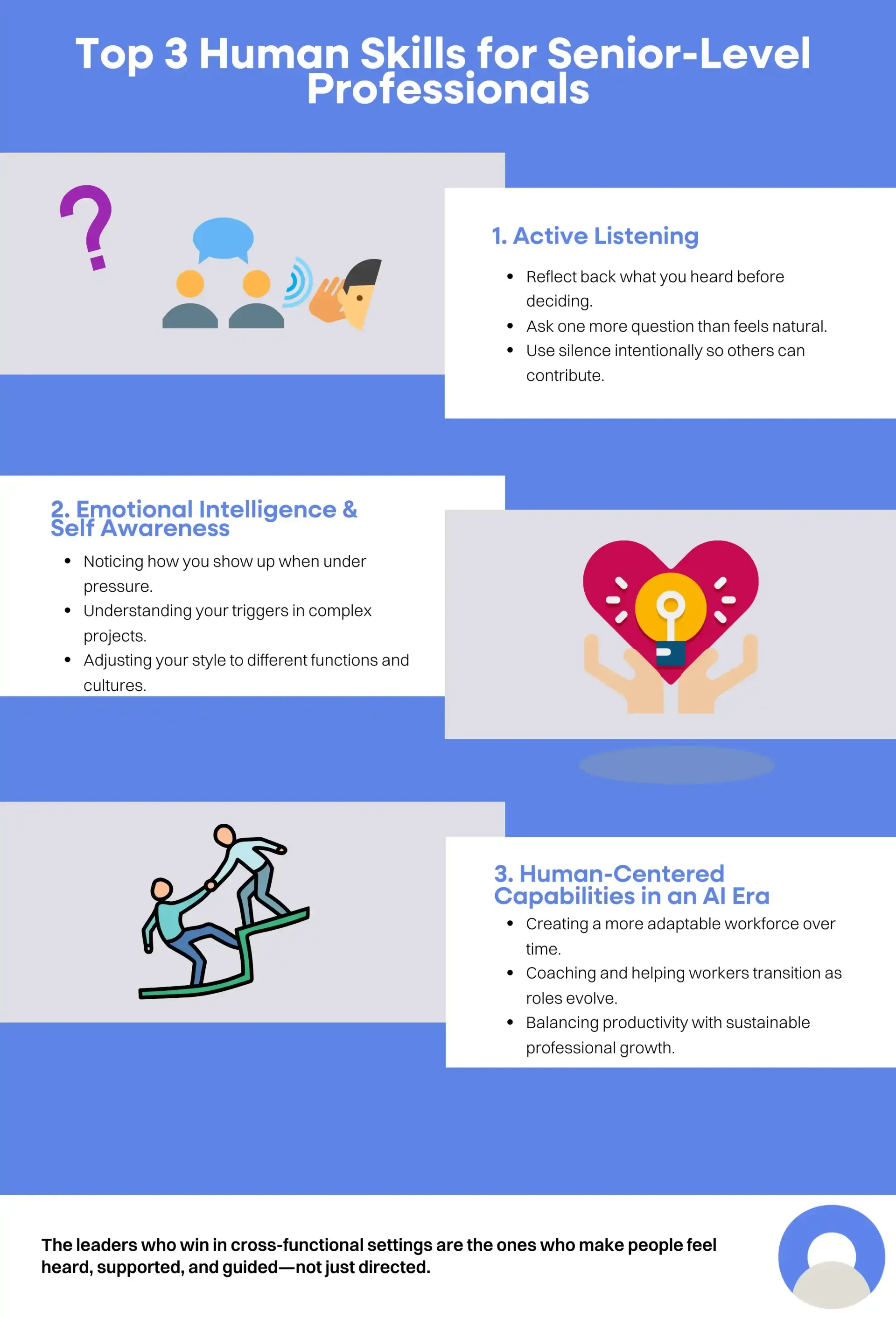
1. Active Listening
Most leaders think they’re great listeners.
In practice, a lot of meetings look like:
- People waiting to talk.
- Leaders solving the wrong problem.
- Frustrated teams who don’t feel heard.
Active listening is a practical leadership tool:
- Reflect back what you heard before deciding.
- Ask one more question than feels natural.
- Use silence intentionally so others can contribute.
It’s a simple way to improve stakeholder management, talent management, and interpersonal skills in one shot.
2. Emotional Intelligence & Self Awareness
In a world of skills disruption and constant change, people aren’t just looking for smart bosses, they’re looking for calm, thoughtful ones.
That means:
- Noticing how you show up when under pressure.
- Understanding your triggers in complex projects.
- Adjusting your style to different functions and cultures.
3. Human-Centered Capabilities in an AI Era
As AI takes on more tasks, human centered capabilities rise in value:
- Creating a more adaptable workforce over time.
- Coaching and helping workers transition as roles evolve.
- Balancing productivity with sustainable professional growth and professional development.
The senior leaders who will stand out are the ones who can blend technical expertise with these human skills; especially when decisions are unpopular or ambiguous.
Creative Thinking, Change Management, and Complex Problem Solving
A lot of senior-level work is now complex problem solving, not just “running the playbook.”
You’re dealing with:
- Interdependent systems.
- Emerging threats (cyber, reputational, regulatory).
- Shifts from climate and the green transition.
- Constraints on budget, talent, and time.
To navigate this, you need a mix of creative thinking skills, change management, and systems thinking.
Think about layering these together:
- Systems Thinking
- Map the system before you fix it.
- Ask: “If we pull this lever, what happens to customers, operations, risk, and cost?”
- Creative Thinking & Problem Solving Abilities
- Run short design sprints instead of long debates.
- Encourage “option C” thinking when teams present only two choices.
- Change Management as a Leadership Skill
- Communicate why the change matters in business terms.
- Align changes to strategic planning, not just short-term metrics.
- Build feedback loops so cross-functional teams can flag issues early.
Such strategies don’t just fix problems. They also position you as a leader who can guide business transformation, not just manage day-to-day execution.
Artificial Intelligence, Big Data, and Technical Expertise for Senior Business Leaders
Let’s talk about the elephant in every boardroom: artificial intelligence.
There’s no way around it—Senior-level professionals need a plan for upskilling here.
Recent research shows:
- Employers increasingly prefer candidates with strong AI skills and comfort with generative AI, even over years of experience in some cases. (Forbes)
- Many executives admit their own AI skills are behind where they should be.
As a senior leader, you don’t have to build models, but you do need to understand:
- How AI tools, machine learning, and big data support your business strategy.
- Where AI can create leverage (automation, digital marketing, forecasting).
- Where AI introduces risk (cybersecurity skills, network security, biased outputs, privacy, and incident management).
Practical focus areas for senior-level professionals and business leaders:
- AI Fluency for Leaders
- Learn the basics of generative AI, machine learning, and automation.
- Use online courses, short intensives, or internal workshops as part of your skills development plan.
- Risk & Cybersecurity Expertise
- Understand the basics of network security, incident response, and how AI affects your threat surface.
- Recent reports show organizations with cybersecurity skills gaps take longer to recover from attacks and pay more per breach. (Fortinet)
- Digital & Data-Enabled Growth
- Get familiar with how digital marketing, social influence, and big data shape customer pipelines.
- Partner closely with your data scientists, product, and marketing leaders to align AI efforts with corporate strategy.
- Human-Centered AI Adoption
- Focus on helping workers transition as AI changes roles.
- Use AI to augment a more adaptable workforce, not replace it.
The integration of AI and big data skills is expected to grow rapidly across nearly all sectors, reflecting a broad-based demand for these competencies.
Your ability to blend technical expertise, human judgment, and leadership development becomes your advantage.
Building a Learning System: Turning Lifelong Learning into a Leadership Skill
Here’s one of the biggest shifts I’ve seen in my own career:
Senior-level professionals need to demonstrate the skill of learning and staying curious.
It’s not just what you know.
It’s the
system you use to stay “in the know.”
What I Saw Inside Boeing
When I was at Boeing, top executives literally had coaches who helped them build learning and skills development plans for the year.
Those plans included things like:
- Reading specific books tied to business strategy or technological advancements.
- Joining clubs, committees, or communities.
- Volunteering or sitting on non-profit boards.
- Taking online courses in emerging tech or resource management.
- Attending sessions on the world economic outlook and major trends.
It wasn’t random.
It was structured.
Their job wasn’t just to run the business; it was to keep adding new knowledge in a way that made them better leaders.
I believe leaders at any company should have a similar game plan.
Your company may not provide a coach, so I compiled helpful information about the best career coaches to help you find one.
Your Learning Plan as a Senior Leader
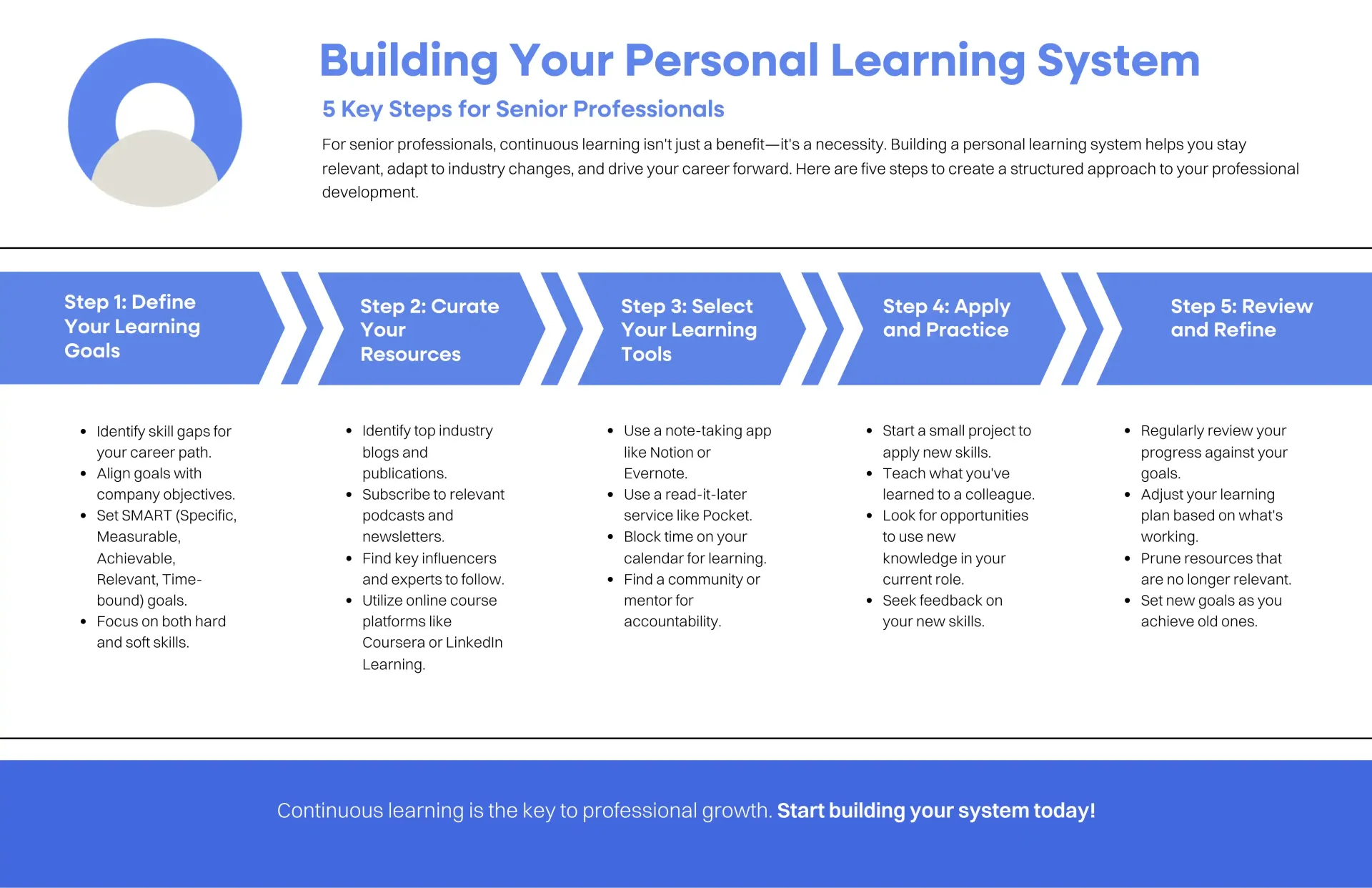
For starters, build a quarterly learning plan that includes:
- Topics
- AI, business analytics, cybersecurity skills, complex problem solving, or the green transition—whatever aligns to your role.
- Inputs
- Books, online courses, internal docs, AI tools, YouTube deep dives, conferences.
- Application
- A small project, presentation, or decision where you apply what you’ve learned.
Some practical elements to include:
- A pipeline to stay in front of emerging skills and emerging threats
- Curated newsletters.
- Mentors and advisors.
- Private communities and peer groups.
- An AI assistant you use intentionally for research and planning
- A simple time management rule.
- For example: 90 minutes per week, non-negotiable, blocked for professional development and skills development.
This is where my core takeaway comes in:
Learning is a skill. You need a plan to keep building and growing this skill. If you don't use it, you'll lose it.
FAQ
1. Why aren’t my existing skills enough to stay in senior-level professional roles?
Because the definition of “senior-level” has changed. Roles that used to reward deep expertise in a single lane now expect you to navigate AI, data, cybersecurity, and cross-functional, hybrid teams—all while leading people through constant change. Your experience is still valuable, but without updated skills in data literacy, technology, and human-centered leadership, it’s much harder to stay competitive for the best senior-level opportunities.
2. What are the most important new skills senior-level professionals should focus on first?
Start with three: stronger analytical and data skills, basic AI and technical fluency, and human-centered leadership (active listening, emotional intelligence, and coaching). Those three unlock most of the others.
3. Do I really need to understand AI and big data if I’m not in a technical role?
Yes. At a leadership level, you don’t need to build models, but you do need to understand how AI, machine learning, and big data create leverage, where they introduce risk, and how they connect to your business strategy.
4. How much time should I realistically spend on upskilling as a senior leader?
A good starting point is 60–90 minutes per week, every week. The key is consistency: a simple, quarterly learning plan you actually follow beats a once-a-year conference you forget three days later.
5. What does a “quarterly learning plan” look like in practice?
Pick one analytical skill, one AI/technical area, and one human skill to deepen. Choose a few inputs (books, courses, mentors, AI tools) and a concrete way you’ll apply each—like a project, presentation, or decision where you use what you learned.
6. How can I develop human-centered leadership skills in an AI era?
Focus on behaviors you can practice immediately: active listening in every 1:1, asking one more question before deciding, getting feedback on how you show up under pressure, and coaching your team through change instead of just announcing it.
7. What if my company doesn’t provide formal support for leadership development?
You can still build your own system: curate newsletters, join private communities, find mentors, use online courses, and work with a career coach. You don’t control the org’s learning budget, but you do control your own learning plan.
8. How can Broda Coaching help me build these new skills?
We work with senior-level professionals to design a targeted learning and career strategy. We'll help you clarify which skills matter most for your next move, build a practical quarterly plan, and hold you accountable so you actually implement it.
Putting It All Together: Your Next Step in Leadership Development
If you’re still reading, you probably already feel the pressure of skills disruption. You may even feel like your role is being disrupted.
If you want a simple starting point for your professional growth over the next 90 days:
- Choose one analytical skill to deepen.
- Example: stronger comfort with data analysis or a core business intelligence tool.
- Choose one AI or technical area to demystify.
- Example: a short course on generative AI, machine learning, or cybersecurity skills relevant to your function.
- Choose one human skill to sharpen.
- Example: deliberate practice of active listening in every 1:1 for the next month.
Then, build a quarterly learning plan around those three.
That’s how you stay relevant, create an adaptable workforce, and continue to grow into the kind of senior-level professional companies fight to keep.
If you know your next level will require new skills, not just more effort, apply to work with Broda Coaching. My team and I will guide you through the moves you need to make to move your career forward.
References
- World Economic Forum – Future of Jobs
- The Future of Jobs Report 2025 and related content outlining that around 44% of core skills are expected to change in the next five years, with “AI and big data” and “leadership and social influence” among the top in-demand skills. (World Economic Forum) (World Economic Forum)
- LinkedIn – Workplace Learning Report 2024
- Highlights how learning & development is central to helping organizations build AI-era capabilities and maintain agility.
- DataCamp – State of Data & AI Literacy Report 2024
- Emphasizes rising demand for data literacy and gaps in employees’ ability to work effectively with data and AI. (DataCamp)
- Microsoft & LinkedIn – 2024 Work Trend Index: State of AI at Work
- Explores how AI is reshaping work, the growing value of AI skills, and the need for targeted upskilling for both employees and leaders. (Source)
- Credly – Top 10 In-Demand AI Skills for 2024 & Beyond
- Notes that over 60% of employees want generative AI training, underlining demand for AI-related skills development. (Credly)
- DeVry University – Closing the Gap: Upskilling and Reskilling in an AI Era (2024)
- Discusses organizational challenges around upskilling and reskilling as AI and high-volume data analytics reshape roles. (devry.edu)
- Fortinet – 2024 Cybersecurity Skills Gap Report
- Reports that 87% of surveyed organizations experienced at least one security breach in 2023 and connects this to ongoing cybersecurity skill gaps. (Fortinet)
- IBM – Cost of a Data Breach & Cybersecurity Skills Gap (2024)
- Shows how shortages in security talent contribute to higher breach costs and longer recovery times. (IBM)
- ISC2 – 2024 Cybersecurity Workforce Study
- Finds that 59% of respondents say skills gaps significantly affect their ability to secure their organizations. (ISC2)
- LinkedIn – The Most In-Demand Skills of 2024
- Confirms ongoing demand for communication, leadership, and problem-solving, even as AI reshapes work. (LinkedIn)