
What Should I Do If I Feel My Role Is Being Disrupted? Here’s How to Lead Through It
TL;DR
- Don’t panic. Diagnose. Name the change, separate what’s disappearing vs. evolving, and map owners; avoid worst-case spirals.
- Identify transferable value. Highlight judgment, influence, and translation skills; package wins using Context → Action → Result for your professional portfolio and to share with leaders.
- Tie work to business outcomes. Connect tasks to revenue, cost, and risk; run a 30–60 day pilot with clear metrics and weekly readouts.
- Invest in professional development. Pick 1–2 adjacent skills (AI/automation/product), build a 30–60–90 plan, and make progress visible.
- Rebuild your network. Reconnect with mentors/peers and communities; ask, “What are you seeing out there?” to surface opportunities.
- Manage stress with self-care. Use box breathing, nutritious meals, sleep, and firm boundaries so your to-do list doesn’t consume your life.
- Plan for the worst case, operate for the best. Keep a one-page contingency, track weekly wins, and build resilience through small, repeatable actions.
If you’re asking, “what should I do if I feel my role is being disrupted?”: focus on diagnosis, measurable impact, and visible learning. That’s how you stay relevant through major disruption and lead the ripple effect of positive change.
Introduction
Disruption at work is personal.
And if you're feeling like your responsibilities are slipping, being absorbed, automated, or reassigned, that internal alarm you're hearing? It matters.
I’ve been through this firsthand, multiple times. I survived layoffs at Boeing in 2019, and again at Amazon in both 2023 and 2024. Here's the truth: the people who stick around aren’t always the smartest, or the longest-tenured. They're the ones tied to work that leadership cannot afford to lose; high-impact, high-visibility, KPI-driven initiatives. When your name is attached to revenue, cost savings, or strategic outcomes, you're a lot harder to replace.
But what should you actually do if you feel your role is being disrupted? Let’s walk through it, step-by-step.
What Should I Do If I Feel My Role Is Being Disrupted? Start With Observation and Diagnosis—Don’t Panic.
When you sense a major disruption, don’t jump to the worst case. Anxiety is real, but reacting too fast blurs the picture. Start with a calm scan so you can adapt with more clarity.
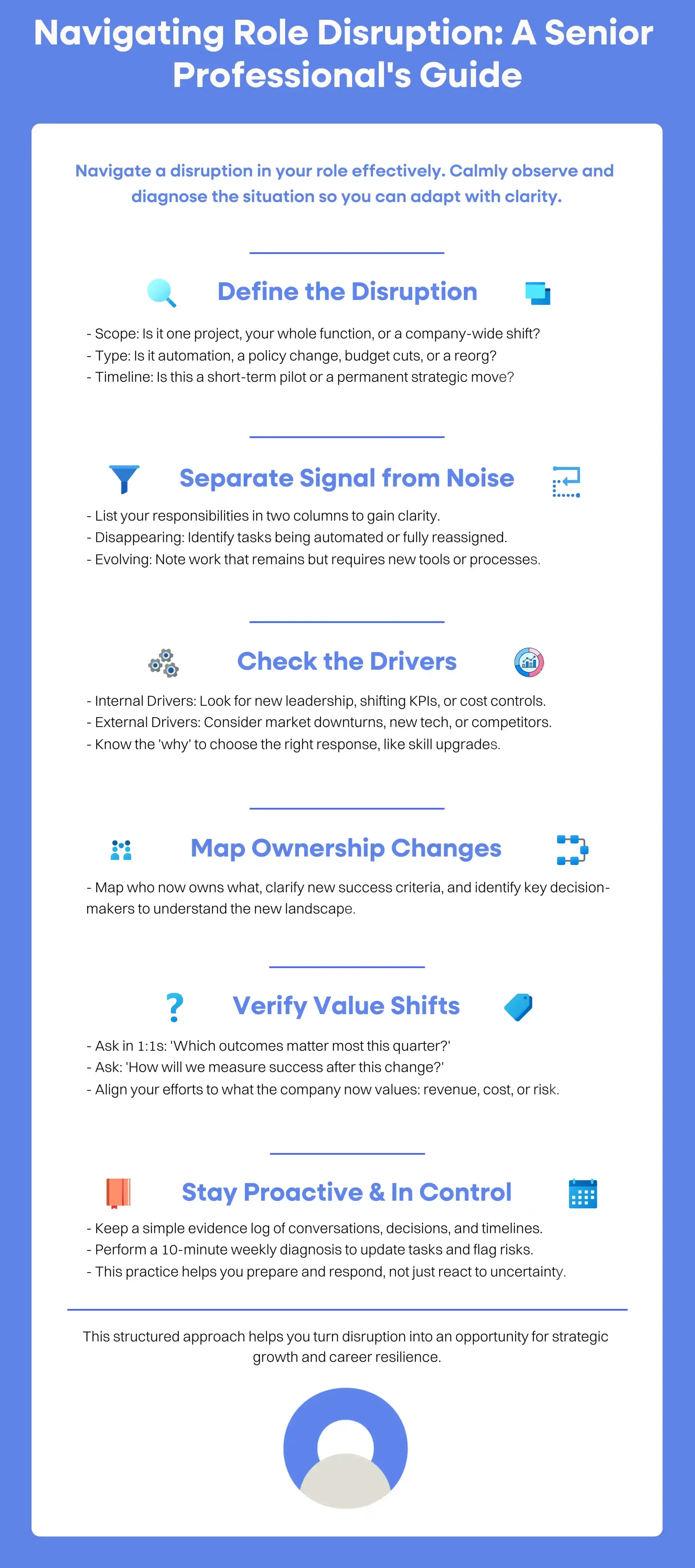
Define the Disruption (What’s Actually Changing?)
To get started, you need to do this one thing: name the change.
- Scope: Is it one project, your whole function, or a company-wide shift with a ripple effect?
- Type: Automation replacing manual work? Policy change? Budget cuts? A reorg?
- Timeline: Is this a short-term pilot or a permanent move?
Separate Signal from Noise (Disappearing vs. Evolving)
List your responsibilities in two columns:
- Disappearing: Tasks being automated or fully reassigned.
- Evolving: Work that remains but with new tools, metrics, or stakeholders.
This prevents treating everything like a crisis when some items just need a new process.
Check the Drivers (Internal vs. External Factors)
Identify why this is happening:
- Internal: New leadership, shifting KPIs, cost controls, quality issues.
- External factors: Market downturn, regulation, new competitors, tech upgrades.
Knowing the driver helps you choose the right response (e.g., workflow changes vs. skill upgrades).

Locate Ownership Changes (Team Member & Stakeholder Map)
Who now owns what?
- Note any team member absorbing your work.
- Clarify success criteria and where your input still matters.
- Map decision-makers vs. influencers (manager, cross-functional leads, vendor partners).
Verify Value Shifts (What the Company Now Values)
Ask directly in 1:1s:
- “Which outcomes matter most this quarter?”
- “How will we measure success after this change?”
Tie your efforts to revenue, cost, risk, or customer metrics so your role stays aligned.
Create a Lightweight Evidence Log (So You Don’t Rely on Memory)
Pro Tip: Keep a simple journal of conversations, expectations, and decisions.
Use this 5-line template after each key meeting:
- Date/Person
- What’s happening (fact, not fear)
- Impact to my responsibilities (disappearing/evolving)
- Expected timeline
- Next step I own
This makes it easier to prepare, not just react, and reduces chronic stress from uncertainty.
10-Minute Weekly Diagnosis (Stay in Control)
Every week, sit for ten minutes:
- Update the two-column task list.
- Confirm owners and deadlines.
- Flag one risk and one opportunity.
- Write one question to talk through with your manager.
Small, consistent reviews keep you on track, without spiraling into worst-case thinking.
Clarify What’s Transferable (Even When the Job No Longer Feels the Same)
Start by naming the value that survives disruption:
- Skills: prioritization, stakeholder alignment, risk trade-offs, vendor negotiation, facilitation under uncertainty.
- Decisions: sequencing work, defining success criteria, choosing the next best move when data is incomplete.
- Relationships: exec sponsors, cross-functional team members, customers—people who talk to you first when things go wrong.

Prove It With Evidence (Outcomes, Not Activities)
Convert work into impact so your company can see it:
- Use Context → Action → Result with a metric.
- Example: “Coordinated Ops/Eng to cut onboarding defects 38% in 10 weeks; saved 420 hours/quarter, boosted retention 2.1 pts.”
- Highlight where your judgment changed the worst-case to a manageable plan.
Categorize Transferable Value (Portable Buckets)
- Cross-functional program leadership: align owners, unblock dependencies, maintain momentum during a reorg’s ripple effect.
- Strategic decisions under pressure: choose scope, set guardrails, protect timelines.
- Translation layer: turn complex data into exec-ready actions that keep projects on track.
Run the “Un-Automatable” Tests
Ask yourself:
- Judgment: Do I make calls when inputs conflict?
- Influence: Can I align misaligned groups in two meetings?
- Translation: Can I turn dashboards into a concrete to-do list with owners today?
If yes, you’ve identified value that outsourcing won’t replace.
Package and Signal Your Value (So Leaders Can Deploy It)
Create a one-page Value Brief (short term, high signal):
- Top 3 wins with metrics.
- Stakeholders impacted (teams, customers).
- Repeatable skills and decisions you own.
- Where that value plugs in next quarter.
Share it in 1:1s and status updates; this builds confidence, reduces anxiety, and helps you lead.
If something or someone is disrupting your role, join the highest-impact initiative—or create a tightly scoped pilot. That’s how you become “un-firable.”
Start Connecting the Dots Between Your Work and Business Value
Roles tied to core outcomes survive major disruption. Tools change; revenue, cost, and risk don’t.
Find the Business Outcome (Pick One)
Choose the clearest line of sight:
- Revenue: expansion, upsell, conversion rate.
- Cost: cycle time, defect rate, rework, vendor spend.
- Risk: incidents avoided, SLA adherence, compliance findings reduced.
Map Tasks to Metrics (Line-Item Traceability)
For each responsibility, answer:
- Metric: What will move (%, $, time)?
- Mechanism: How your work moves it (example: “reduce handoffs to cut lead time”).
- Owner + When: Name + date.
This gives leaders more clarity and keeps you in control.
Design a 30–60 Day Pilot (Short-Term, Real Proof)
- One goal: e.g., “Reduce onboarding time by 15% in 6 weeks.”
- Three actions: automate one step, remove one approval, clarify one SLA.
- Weekly readout: a 5-bullet update to show momentum.
Pilots de-risk change, build resilience, and create executive-ready proof.
Communicate Like an Operator (Not a Reporter)
Use this template in updates to colleagues and leaders:
- Goal: “Cut ticket backlog by 20% by week 6.”
- Signal: “Throughput up 9%, average age down 12%.”
- Blocker + decision needed: “Access to dataset X by Tuesday.”
- Next step: “Ship queue policy change Thursday.”
Clear comms help employees and employers align—faster.
Example: Metric Translation
- “Rebuilt intake → reduced handoffs 3→1 →
cycle time −24% → support cost
−$96k/Q → CSAT
+1.8 pts.”
Tie every improvement to time savings, margin, retention, or error-rate reduction. If your work moves the needle, you’re not going anywhere.
Keep Yourself Sustainable (Boundaries = Performance)
Protect your well being so you stay productive rather than seeing your performance decrease:
- Block deep-work windows; rest hard; eat nutritious meals.
- Ask for support when load exceeds responsibilities.
- Set
firm boundaries with a visible
schedule.
Taking care of yourself isn’t soft, it’s how you deliver consistent results at work and at home with your family and friends.
Invest in Professional Development (ASAP, Not Someday)
If your role feels unstable, choose 1–2 adjacent areas that map to business value: AI copilots, workflow automation, data storytelling, or product strategy. Gut-check with your manager: “Which skills would create the biggest ripple effect for the team this quarter?” This keeps your professional development aligned to outcomes, not random courses.
Choose Fast Paths to Skill (Micro > Massive)
You don’t need a new degree tomorrow. Mix micro-certifications, internal stretch projects, and short job shadows to learn while you deliver. If higher education is on your radar, plan it as a medium-term path; use micro-learning now to stay productive in the short-term.
- Shadow a team member for one sprint.
- Micro-certs (2–10 hrs) to learn core tools.
- Pilot a small automation to reduce cycle time.
Build a 30–60–90 Learning Plan (Stay on Track)
Create a simple to-do list you can share:
- 30 days: complete one micro-cert; ship a tiny proof of concept.
- 60 days: present a results readout; document the playbook.
- 90 days: apply the skill to a live project with measurable impact.
This gives you more clarity, reduces stress, and shows leaders you can lead through change.
Make Progress Visible (Signal, Don’t Hide)
Visibility matters during disruption. Post weekly updates in Slack or during standups:
- What you learned.
- How it helps the company (cost, speed, quality).
- The next experiment you’ll create.
Public learning builds confidence, invites support, and attracts opportunities.
Protect Your Energy (So Learning Sticks)
Block two focused sessions per week on your schedule. Set firm boundaries so learning time doesn’t get bumped. Pair sessions with quick self care—water, a walk, rest—so you can focus. If you’re overwhelmed, ask for resources or access you need; don’t ignore bottlenecks.
Learning = momentum. Momentum = relevance. In a major disruption, the people who develop new skills early, and show the impact, don’t just hang on; they move ahead.
Leverage Career Coaching (Accelerate the Curve)
A great coach turns professional development from a solo grind into a guided plan with accountability and more clarity.
When to consider coaching (short-term triggers):
- You’re stuck translating new skills into business impact and need support to design a pilot.
- Your role no longer feels stable and you need a safe space to think through options.
- You want to pressure-test a “worst case” contingency without spinning in anxiety.
- You feel it's time to make a career change and need guidance.
How coaching helps you move faster:
- Focus & cadence: weekly or more frequent sessions to keep you on track and adjust the to-do list as data changes.
- Decision frameworks: choose the next best move under uncertainty; avoid overcommitting or doing the same things that aren’t working.
- Resilience building: boundaries, energy management, and scripts for asking for access or resources, so you can build resilience without burning out.
If you're not sure which career coach to work with, check out my article on the best career change coaches.
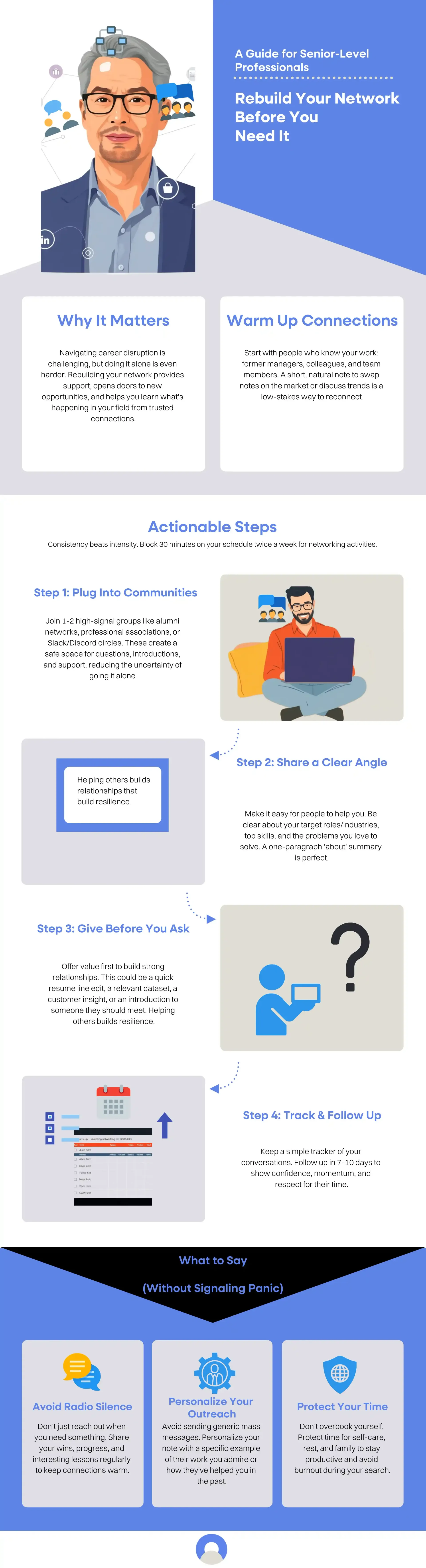
Rebuild Your Network Before You Need It
Navigating disruption is hard. Doing it alone is even harder.
Now is the time to:
- Join communities or alumni groups in your field.
- Let people know you’re exploring and open to learning.
- Reconnect with old colleagues, former mentors, or team members in other industries.
You don’t need to say, “I’m worried about my job.” Just ask: “What are you seeing out there?” These conversations lead to opportunities you never would’ve found on your own.
Warm Up Dormant Connections (Low-Stakes Reach-Outs)
Start with people who already know your work: former managers, colleagues, and team members from prior projects. Send a short note that feels natural:
- “Been a while; I would love to have a quick chat to swap notes on what’s happening in the market.”
- “I’m exploring where to create more impact this year. What trends are you seeing?”
Plug Into Communities (Find a Safe Space)
Join 1–2 high-signal groups: alumni networks, professional associations, Slack/Discord circles, or meetups. These create a safe space for questions, introductions, and support. They ultimately reduce the uncertainty of going it alone.
Share a Clear Angle (Make It Easy to Help)
Give people more clarity on how to help you:
- Target roles/industries, top skills, and the problem spaces you love to lead.
- One-paragraph “about” plus a 3-bullet impact summary keeps it simple and on track.

Use a Simple Cadence (Lightweight, Consistent)
Block 30 minutes on your schedule twice a week:
- 2 reconnection messages
- 1 short call
- 1 helpful follow-up (article, template, intro)
Consistency beats intensity, especially during disruption.
Give Before You Ask (Create a Ripple Effect)
Offer value first: a quick resume line edit, a relevant dataset, a customer insight, or an intro to someone they should meet. Helping others builds relationships that build resilience when your job feels unstable.
What to Say (Without Signaling Panic)
Skip “I’m worried.” Try:
- “I’m mapping where my experience in X and Y can drive revenue/cost outcomes. Any advice on teams doing this well?”
- “I’m testing a short-term project on Z. Mind a 10-minute gut check?”
This invites real conversation without a worst-case vibe.
Track and Follow Up (Don’t Let Threads Go Cold)
Keep a lightweight tracker (name, date, topic, next step). Follow up in 7–10 days with progress: “Tried your suggestion, results were A/B. Thank you.” This shows confidence, momentum, and respect for their time.
Avoid Common Mistakes (That Make Networking Feel Wrong)
- Don’t ignore people between asks; share wins and lessons regularly.
- Don’t send mass messages. Personalize with one specific example of how they’ve helped your career or team.
- Don’t overbook. Protect time for self care, rest, and family so you stay productive, not burned out.
Rebuilding your network isn’t about asking for favors; it’s about rebuilding trust and access. Done right, it opens doors to roles being created, not eliminated.
Check out my article on networking as a senior-level professional for more in depth guidance.
Managing Stress in the Moment: Control What You Can
The chronic stress of uncertainty can weigh on your mental health, impact your relationships, and show up in your work.
This is where self-care becomes your competitive edge:
- Nutritious meals and sleep: basic, but game-changing for your well-being.
- Box breathing: four counts in, four hold, four out, four hold. Use it before meetings or when the anxiety spikes.
- Firm boundaries: start and end your day with intention. Don’t let your to-do list bleed into your entire life.
The goal isn’t perfection. It’s effective stress and energy management.
Use a 60-Second Reset (When Anxiety Spikes)
- Use box breathing for 3-5 cycles.
- Pair it with a quick body scan (jaw, shoulders, hands). Release tension so you can focus on the next meeting or decision.
Fuel and Sleep Like an Operator (Not a Hero)
- Eat nutritious meals on a regular cadence. Get lots of protein and fiber at lunch to avoid the 3 p.m. crash.
- Hit your rest targets. Implement a consistent bedtime, a dark room, and no screens 30 minutes prior. Small habits compound into better well-being and performance.
Set Firm Boundaries (Protect Your Energy)
- Define a daily start/stop window and honor it. Put it on your schedule so colleagues see it.
- Use a shutdown checklist. The last 10 minutes of your workday are to capture open loops, update your to-do list, and set tomorrow’s top 1–3 tasks. Close the laptop.
Create Micro-Buffers (Short, Intentional Breaks)
- Between calls, take 3 minutes to stand, breathe, sip water.
- At midday, take a 10–15 minute walk without your phone. These resets reduce chronic stress and keep you on track.
Communicate Expectations (So Work Doesn’t Bleed Into Life)
- Simple scripts:
- “I’m heads-down 1–3 p.m. for project X. Ping me after.”
- “I can deliver EOD tomorrow. I need time to do it right.”
Clear guardrails can help your team plan. They also protect your relationships at home with family members and friends.
Ask for Support Early (Don’t White-Knuckle It)
- If the workload exceeds responsibilities, talk to your manager with a one-page plan. Share what you’ll do, what can wait, and where you need access or help.
- If you need a safe space to think or vent, book 15 minutes with a trusted team member.
The goal isn’t perfection, it’s energy management. Control the moment, and you’ll control the week.
Focus on What You Can Control: One Thing at a Time
When the ground is shifting, stop trying to do everything. Instead, focus on one thing you can do today to regain traction.
- Create a plan for learning a new skill.
- Reach out to a trusted peer for a quick talk.
- Set a goal for the week that moves your career forward.
Control leads to clarity. Clarity leads to confidence.
Build Resilience for the Long Haul
Here’s the mindset shift that changed everything for me:
You are not your job.
You are the value you bring and the relationships you nurture.
And that value? It’s portable.
Yes, the ripple effect of a disruption can be frustrating. But it can also be freeing. Sometimes the door closing is the nudge you needed to lead something better.
Adopt the Identity Shift (You ≠ Your Title)
Your job can change; your value travels. Anchor your identity to the problems you solve, the team members you elevate, and the outcomes you create. This mindset lowers stress and restores a sense of control during major disruption.
Build Resilience Habits (Small, Repeatable, Measurable)
- Self-care cadence: sleep, movement, and healthy meals to protect your well-being.
- Weekly reset: 20 minutes to review wins, lessons, and priorities. Keep your to-do list realistic.
- Focus blocks: Put 2× 60-minute deep-work sessions on your schedule. Defend them with firm boundaries.
Plan for Worst Case, Operate for Best Case
Write a one-page plan for the worst case (reorg, role change, layoff). Include finances, timeline, outreach list, and a short professional development track (one cert, one project). Having a plan reduces anxiety and keeps you from feeling stuck if something goes wrong.
Keep Relationships Warm (Your Safety Net)
Set a recurring reminder to talk with three people: a mentor, a peer, and a cross-functional partner. Share a quick example of impact you delivered and ask what they’re seeing. These touchpoints create visibility and opportunity for your future.
Track Wins Like a Scientist (Evidence Beats Fear)
Each week, log:
- Problem → action → result (with a metric)
- Who benefited (customer, team, leadership)
- Skill used (decision-making, alignment, translation)
Over time, this becomes your portable portfolio. Use it to lead, prepare for interviews, or propose new work when your role no longer feels stable.
Reframe Disruption as Data (Not a Verdict)
When change is happening, ask: “What is this moment teaching me about my strengths, gaps, and the market?” Then develop one new skill, create one tiny win, and reconnect with one person. Three small moves, repeated, build resilience and keep your life and career moving in the right direction for you and your family.
Final Takeaway
Disruption isn’t a signal to freeze, it’s a signal to focus.
- Identify the shift
- Pinpoint your strengths
- Learn something new
- Reconnect with your people
- Take care of yourself
- Create a plan you can control
You're not alone in this. You’re not powerless in this. And if you’ve been putting off your own professional development, now is the time.
Apply to work with me today. My team and I will guide you through the disruption in my Better Work program.