How to Find Networking Events for Senior Level Professionals
Updated: July 3, 2026
TL;DR
- Your next role will come from conversations, not job boards. At the senior level, networking events and professional networking are core to your career strategy, not a side activity.
- Prioritize high-signal rooms over convenient ones. Focus on executive roundtables, industry networking events, niche conferences, and invite-only sessions where decision makers are sharing insights and actively shaping your industry.
- Use structure, not luck, to find events. Rely on event calendars, Google, LinkedIn events, alumni networks, professional organizations, industry associations, and community groups instead of “networking events near me” searches and random meetups.
- Avoid low-value formats. Skip most general career fairs, broad networking mixers, and events where you’re just collecting business cards from people who can’t influence senior-level hiring.
- Expand your definition of “networking.” Treat virtual networking events, volunteer/community service, community groups, and informational interviews as strategic ways to build deeper relationships. Measure your ROI so you double down on what actually leads to referrals, interviews, and offers.
Why You Should Care: Networking Events at the Senior Level
If you’re a senior-level professional, you already know the feeling: you apply online, tweak your LinkedIn profile, hit submit on a dozen job openings… and nothing.
The higher you go, the more your next opportunity comes from a conversation, not a cold application. For senior leaders, networking events and professional networking are no longer “nice to have.” They’re a core part of your career strategy in a competitive job market.
Most people think “networking” means walking into a room, handing out business cards, and delivering a polished elevator pitch to random professionals at a happy hour. That might have worked earlier in your career. At your level, it’s different:
- You need industry professionals who can actually influence hiring decisions.
- You need events where decision makers are sharing insights on a particular topic or specific industry.
- You need valuable connections, not just more contacts in your CRM.
This guide will walk through how to find networking events for senior level professionals that actually lead to interviews, referrals, and offers; without spending every night at a meetup that just makes you feel productive.
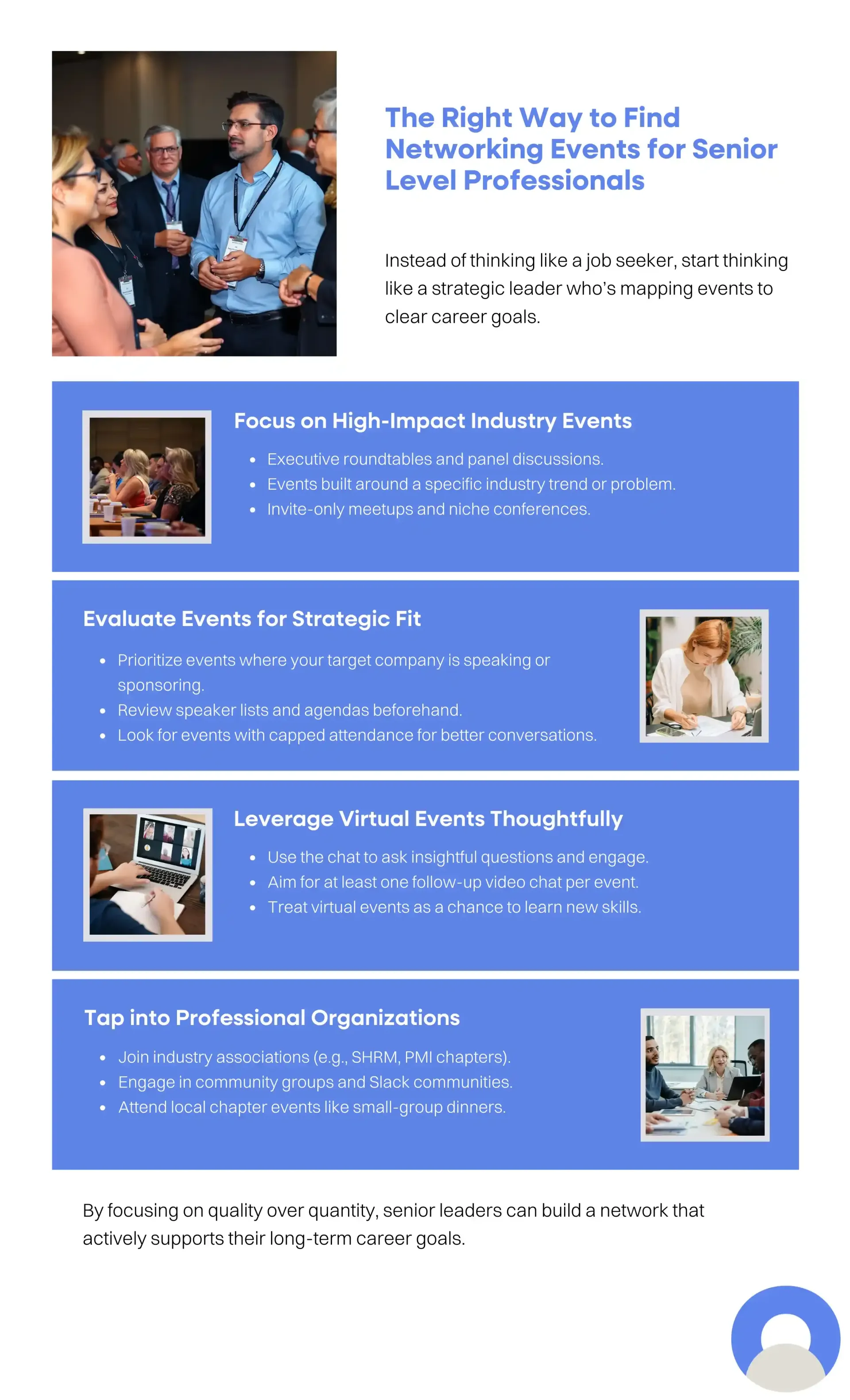
The Right Way to Find Networking Events for Senior Level Professionals
If you're operating at the Senior, Principal, or Director level, your networking strategy needs to evolve. The casual mixers, general job fairs, and broad networking happy hours that served you earlier in your career? They’re probably not going to cut it anymore.
To find networking opportunities that actually move the needle, you need to stop thinking like a job seeker and start thinking like a strategic leader. Here’s how ↓
Industry Networking Events That Actually Move the Needle
Stop optimizing for “events near me” and start optimizing for rooms with authority. For senior leaders, the best networking events tend to be:
- Executive roundtables and panel discussions hosted by consultancies, VCs, or enterprise vendors.
- Industry networking events built around a specific industry trend or problem (e.g., AI in healthcare, customer experience in fintech).
- Invite-only meetups tied to product launches, investor briefings, or local chapters of large professional organizations.
- Niche conferences and seminars where industry professionals gather around a similar interest, not just a shared job title.
Recent executive networking guidance emphasizes that senior leaders get better ROI from smaller, curated environments that encourage peer problem-solving and strategic conversations, rather than from broad, unstructured events. (The Power of Executive Networking in 2025)
These are the best networking events because they attract people who are actively shaping industry trends and opening new roles, not just browsing.
Industry-specific networking events are part of the strategy I teach my clients who want to switch industries.
Industry Events vs. General Networking Mixers
Not all industry events are created equal. When you evaluate where to attend:
- Prefer industry events where your target company is speaking, sponsoring, or running a booth.
- Look for conferences and seminars that publish speaker lists, panel discussions, and agendas so you can see which organizations are actually investing in the event.
- Prioritize events that cap attendance or pre-screen participants. They create better conditions for real conversation and follow ups.
Big, open-invite networking events often attract a mix of early-career professionals, consultants selling services, and people outside your space. That’s not bad, but if you're searching for a senior-level role in a specific industry, those rooms are low-signal.

Virtual Networking Events That Still Feel Personal
Virtual networking events and broader virtual events (webinars, online conferences, speed networking on Zoom) can absolutely be part of your plan; especially if you’re not near major hubs.
When you join:
- Use the chat thoughtfully to engage, ask questions about a particular topic, and connect with other leaders who share similar interests.
- Aim for at least one video chat or coffee chat per event with someone you clicked with.
- Treat each event as a chance to learn new skills or fresh perspectives on your industry, not just to “meet people.”
Recent research on professional networking in 2025 underscores that online communities, industry events, and blended in-person/virtual strategies are now central to career advancement; especially for experienced professionals who are short on time. (Guide To Professional Networking: Benefits & Tips for 2025)
Use Professional Organizations, Industry Associations, and Community Groups
If you’re not already using professional organizations, you’re leaving easy money on the table.
Look for:
- Industry associations (e.g., SHRM chapters, PMI chapters, regional tech councils) that host recurring industry conferences, seminars, and networking events.
- Community groups and networking groups in your space: Slack communities, alumni interest groups, local leadership cohorts, mastermind circles.
- Local chapters that run small-group dinners, panel discussions, and workshops in a more relaxed atmosphere.
These organizations and groups often have event calendars you can subscribe to so you don’t miss the right events.
The Wrong Way to Find Networking Events
Let’s talk about what doesn’t work; the patterns that keep most people busy but not progressing.
The “Google, Continue Scrolling” Approach
Here’s what most people do:
They Google “networking events near me,” continue scrolling until something looks vaguely relevant, and then sign up because it’s close, cheap, and happening this week.
It feels productive, but for senior level professionals, it rarely creates the kind of relationships you actually need. Proximity does not equal ROI.
Over-Relying on Eventbrite, Meetup, and Random Networking Groups
Platforms like Eventbrite and Meetup are fine as lead generators to find networking events. The problem is:
- Anyone can post an event.
- Most events are not curated for senior talent.
- Rooms tend to skew toward early-career professionals and solopreneurs.
Before you attend:
- Look up the organizer, organizations, and event organizers on LinkedIn.
- Scan prior events, photos, or attendee lists.
- Ask yourself: “Will this put me in front of industry professionals and other leaders at the right level?”
If the answer is no, skip it.
Career Fairs and Random Happy Hour Events
For senior-level roles, most traditional career fairs are built for scale, not precision. The structure is closer to speed dating than real relationship building:
- Long lines, quick conversations.
- Recruiters trying to process as many people as possible.
- Roles skewed toward early-career or mid-career bands.
Unless there’s a clearly defined executive track with scheduled 1:1s or private sessions, most senior-level professionals can safely skip generic career fairs and broad “tech happy hour” nights.
You’re better off at one focused
industry networking event with 25 directors than at a huge happy hour with 300 random professionals who can’t get you closer to your next opportunity.
Treating Networking Events Like a Business Cards Game
Networking events aren’t about how many business cards you can shove in your pocket. They’re about the quality of the conversation and the ease of future follow ups.
If you’re leaving events with:
- A stack of cards or new LinkedIn connections,
- No clear memory of who anyone is, or
- No plan for how you’ll connect again,
…you’re doing the hard part (attending networking events) without capturing the upside.
Aim for a few
deeper relationships instead of dozens of surface-level interactions. One good
coffee chat after an event beats ten rushed pitches at the bar.

Waiting for Invitations
Senior-level professionals often assume that once they post enough on their LinkedIn profile, invitations to closed-door dinners and executive networking events will magically appear.
Reality check:
- Waiting is not a networking strategy.
- The leaders who benefit most from events are usually the ones who create or curate them.
Instead of waiting:
- Reach out to organizers of invite-only events and ask about criteria.
- Offer to talk on a panel or moderate a discussion at a niche event in your industry.
- Ask current or former colleagues where other leaders in your space actually go to connect.
Only Doing Virtual Events
Virtual events are a powerful tool, but if every interaction stays inside a chat box or video window, you’ll plateau.
Recent writing on executive networking in 2025 consistently highlights that while digital networking has grown, senior leaders still rely on in-person conferences and curated events to build high-trust relationships and identify new opportunities. (How Executives are Networking in 2025)
Your goal: at least 1–2 in-person industry events each year that align with your career goals and target companies.
How To Find The Best Networking Events for Senior-Level Professionals
So what does it look like to find networking events that are actually worth your time?
Think of it in layers: search, types of events, and what you do once you’re in the room.
Use Event Calendars, Google, and LinkedIn to Find Networking Events
Start with a simple search stack:
- Google + event calendars for your target cities and industry: “fintech industry conferences 2025,” “Seattle product management seminars,” “Austin SHRM annual conference.”
- LinkedIn events: search by keyword and filter for “in person,” “online,” or virtual events.
- Professional organizations and industry associations: SHRM, PMI, local HR or tech associations — many publish all of their conferences and seminars in one place.
When you see an event that looks promising, ask:
- Will I meet people from my specific industry?
- Will decision makers or hiring managers be there?
- Do the topics match the career story I want to tell?
If yes, that’s a great opportunity to attend, connect, and build relationships.
Networking events are a key part of networking strategy for senior level professionals. Check out my article on how senior level professionals can network to find their next role for the whole networking strategy I teach my clients.
1. Leverage Alumni Networks (Still One of the Best Networking Events Sources)
If you went to a major university or business school, you already sit on top of one of the highest-trust networking groups available.
Use it to:
- Join regional community groups or alumni networking groups that host industry events and seminars.
- Attend alumni industry conferences, career panels, and small roundtables where other professionals share their paths and skills.
- Turn casual reconnections into informational interviews about companies, roles, and industry trends.
You don’t have to be the “super-involved” grad. A simple, honest message like:
“Hey, I’m exploring senior product roles in the healthcare industry. Would you be open to a quick conversation about your experience at [Company]?”
…is enough to start a warm, alumni-powered connection.
2. Follow Industry Conferences and Associations
Every serious industry has anchor industry conferences, large conferences, and recurring seminars where the people shaping the future gather:
- HR leaders plug into SHRM26, regional SHRM events, and SHRM Executive Network experiences. (Executive Network Experience at SHRM26)
- Project leaders attend PMI and PMIWDC conferences, Leadership Institute Meetings, and related project management events. (2025 PMIWDC Conference)
Why these work so well:
- Attendees are typically managers, directors, VPs, or above.
- Organizations invest budget to send them, which means the company takes the event seriously.
- Between sessions, people are sharing insights, trading stories, and quietly asking, “Do you know anyone strong for this role we’re about to open?”
Pro tip: don’t spend 100% of your time inside the main hall. Some of the best conversations happen:
- In the line for coffee.
- In hallways between panel discussions.
- At small, invite-only breakouts where a person you admire is speaking on a particular topic.
3. Volunteer and Community Events: A Real Client Example
Here’s the story I always come back to.
One of our clients was targeting a role at Microsoft. Instead of just applying to job openings, she signed up for local volunteer community service events sponsored by Microsoft and other local companies.
Microsoft employees and leaders regularly attended these events. Over a few months, she built genuine connections with managers and directors on a personal level, often in a relaxed atmosphere, wearing jeans and company t-shirts, not badges and suits.
The result? Two referrals and one interview.
No speed networking, no “pitch,” no stack of business cards. Just a smart networking strategy and showing up consistently where her target company already served the community.
How to replicate this:
- Check Corporate Social Responsibility or “community impact” pages for your target companies.
- Look at which community groups and nonprofits they support.
- Use sites that centralize local volunteering to find recurring local events where employees from target companies attend in teams.
Sometimes, the best networking events aren’t labeled as networking events at all.
4. Community Groups and Networking Groups in Your Specific Industry
Don’t sleep on modern community groups:
- Private Slack communities, Discord servers, or curated LinkedIn groups for your industry.
- Local leadership circles that meet monthly to talk through challenges and career goals.
- Meetups focused on a particular topic like customer success in SaaS, supply chain in aerospace, or DEI in healthcare.
These groups often:
- Bring together other professionals from multiple companies.
- Create faster paths to introductions with leaders and clients.
- Share job openings before they hit job boards.
Treat these like long-term networking opportunities, not quick fixes. Show up, contribute, and engage consistently.
5. Treat Informational Interviews as Mini Networking Events
Informational interviews are highly underrated. They are essentially 1:1 networking events you schedule yourself.
Use them to:
- Learn how leaders in a specific industry navigated their careers.
- Get a candid read on company culture that you won’t find on a website.
- Understand how teams are actually structured and where your skills might fit.
To make them effective:
- Be clear on what you want to learn (new market, role, or industry).
- Prepare a few thoughtful questions — not just “So, what do you do?”
- Keep it short (20–25 minutes) and end by asking, “Is there anyone else you think I should meet?”
That one question can quietly expand your network by 2–3 new people per conversation.
Check out another article of mine if you're struggling to get interviews in general despite doing everything right.
6. Online Networking: From Video Chat to Coffee Chat
If you’re limited by geography, online networking becomes your bridge into the right rooms:
- Comment on posts from leaders in your space.
- Join online networking groups aligned with your role or industry.
- After a few exchanges, suggest a short video chat or virtual coffee chat to deepen the relationship.
Online networking is most powerful when you treat it as a path to real conversations, not just likes and follows. Recent LinkedIn-focused articles and reports in 2025 reinforce that visibility, thoughtful engagement, and ongoing relationship building are still core drivers of career mobility. (How to Build Your Professional Network in 2025)
7. Measure the ROI of Your Networking Strategy
If you don’t measure your networking, you’ll default back to events that just feel productive.
Track monthly:
- How many follow ups did I send?
- How many new connections did I make?
- How many job openings, referrals, or interviews came from networking vs. cold applications?
- Which types of events (industry conferences, small seminars, virtual networking events, volunteer events, community groups) actually move me closer to my career goals?
Adjust your plan based on what’s working. Drop the low-yield events. Double down on the ones that lead to real conversations and clear next steps.

Key Takeaways for Senior Level Professionals Searching for Networking Events
Let’s wrap this up. Here’s how to think about how to find networking events for senior level professionals from now on:
- Not all events are equal. Focus on high-signal industry events, industry conferences, and curated networking groups where decision makers actually show up.
- Quality beats convenience. It’s better to fly to one niche conference and walk away with five strong relationships than to attend ten local happy hour events and meet people who can’t influence your next opportunity.
- Leverage structure. Use alumni networks, professional organizations, industry associations, event calendars, and community groups to systematically find networking events instead of guessing week to week.
- Mix in-person and virtual. Use virtual networking events to expand reach and in-person events to deepen trust. Both matter.
- Think beyond “networking events.” Informational interviews, volunteer projects, collaborative content, and even internal “career growth” sessions at your current employer can all be powerful networking opportunities.
- Track your ROI. Treat your networking strategy the way you’d treat any program at work: define goals, track performance, and iterate.
Do that consistently, and networking stops being awkward small talk and starts becoming a real lever in your senior-level career.
Ready to Take Your Networking Strategy to the Next Level?
If you’re a Senior, Principal, Director, or VP and you’re tired of:
- Attending random events that don’t lead anywhere,
- Struggling to translate conversations into interviews, or
- Guessing which industry networking events are worth the time and money…
We can help.
At Broda Coaching, we work with senior-level professionals across industries build targeted networking strategies that:
- Plug you into the right communities and industry events,
- Clarify your value proposition before you walk into the room, and
- Turn casual conversations into real job opportunities, offers, and better work.
Apply to work with us if you want help building a networking plan that’s tuned to your level, your goals, and the job market you’re competing in.

Sources
- Aurora Live, “How Executives Are Networking in 2025” (June 2025) – on how executives balance in-person events with online communities and moderated peer discussions. auroralive.com
- MyPersonalRecruiter, “The Power of Executive Networking in 2025” (July 2025) – guidance on building strategic executive networks that drive career mobility. My Personal Recruiter
- Voltage Control, “Effective Networking Strategies for Executives” (June 2025) – practical tips on digital networking, peer groups, and building meaningful executive-level connections. Voltage Control
- Forbes Coaches Council, “The Power Of Strategic Networking: How Meaningful Connections Fuel Success” (April 2025) – emphasizes generosity, value creation, and long-term relationships in networking. Forbes
- LinkedIn, “Guide To Professional Networking: Benefits & Tips for 2025” and “How to Build Your Professional Network in 2025” – highlight the role of professional networking communities, industry events, and online engagement in 2025 career growth. LinkedIn
- LinkedIn, “Networking Trends to Watch in 2025: What’s Changing This Year” and “Ways Networking Drives Business Growth in 2025” – outline 2025 trends such as niche communities, AI-assisted networking, and the continued importance of in-person events. LinkedIn
- SHRM, Executive Network – Networking & Events, SHRM25 Annual Conference & Expo, SHRM NorCal 2025, and WI SHRM 2025 State Conference – examples of hybrid and in-person conferences with strong executive-level networking opportunities. SHRM
- PMI & PMIWDC, 2025 PMIWDC Annual Conference, Leadership Institute Meetings 2025, and PMI global/ regional events – project and program management conferences focused on networking and professional development. Project Management Institute
- Harvard Business Impact, “2025 Global Leadership Development Study: Fast, Fluid, and Future-Focused” – explores how leadership development (including networking and relationship-building skills) is evolving in 2025. Harvard Business Impact
- Harvard FAS Career Services, “Daunted by Networking? Try the Scientific Method” (June 2025) – reframes networking as structured experimentation for career exploration. Harvard Career Success
- Spann et al., “The importance of professional social networks for long-term career outcomes”
- (2025) – academic perspective on how intentional professional networking shapes long-term career development.
PMC